What is a good frequency for Facebook ads? What we measured in lead campaigns
Meta doesn’t publish a good frequency: its help page says it may average 1 to 2 per ad set or may be much higher, depending on your budget, audience size and schedule.
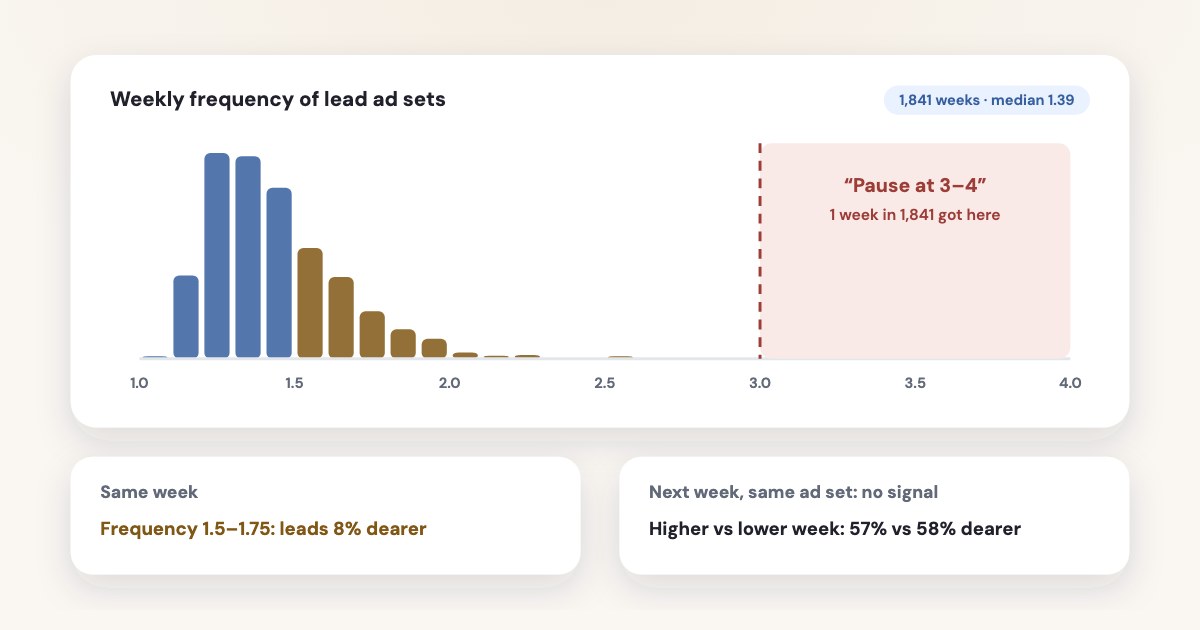
In 32 weeks of lead campaigns we measured, an ad set’s frequency for a week sat around 1.4 and rarely passed 1.7, so the popular “pause at
3 or 4” would almost never fire. Weeks with higher frequency had slightly dearer leads, mostly because impressions cost more, but a week of
higher frequency didn’t predict whether the same ad set got more expensive the next week. Judge by cost per lead against your own past, Meta’s Creative fatigue status and the
sales in your CRM — not by the frequency number.
On this page10 sections
What frequency is, and how to check it
Frequency is The average number of times each Meta Account saw your ad.
Meta calculates it as impressions divided by reach,
and both are estimates from sampled data (source). In Ads Manager it is a standard column: pick the dates at the top
and read the Frequency column at campaign, ad set or ad level.
Three things change what the number means:
- The dates. Frequency counts from the first day you select. A frequency of 3 over seven days and 3 over three months are not the same
thing — as Jon Loomer puts it,
Seeing four ads in four days is very different from seeing four ads in six months.
(source) - The level. Reach counts unique people, so a person reached by two ad sets counts once in the campaign total. Campaign frequency is neither the sum nor the average of the ad set rows.
- Several ads. A campaign frequency of 4 can mean someone saw four different ads, not the same ad four times.
The formula also works the other way, which helps with planning: frequency ≈ impressions ÷ reach, and impressions ≈ budget ÷ CPM × 1,000.
Why there is no “good” frequency
There is no “magic frequency level” that we can prescribe for every brand and campaign.
That study is from 2016 and measured brand recall for large advertisers, not leads. Meta hasn’t published a frequency target for lead or sales campaigns since. The numbers you find in search come from agencies and tool vendors, and they don’t agree:
| What it says | What it is based on | |
|---|---|---|
| Cropink, Percuity, AdAdvisor (2026) | Cold audiences 1–3, retargeting 2–25, depending on the page | Practitioner experience; Percuity’s text and table give different ranges |
| inBeat (04.2026) | Over 2.5 for cold audiences and 5.0 for retargeting is “too high” | No study cited |
| Madgicx | Plan a refresh at 2.0 for audiences under 100K, 2.5 up to 500K | No study cited |
| AdEspresso (08.2018) | At frequency 4, CTR −23% and cost per click +68% against frequency 1 | 500 campaigns compared with their own start, no control |
| Databox (10.2026) | Median frequency 3.0 (middle half 2.1–4.4) | Over 2,800 mid-size and large companies; window not stated |
The AdEspresso figures are quoted in 2026 articles without the year. They come from 2018, measure clicks rather than leads, and compare each campaign with its own first days, so ageing, season and auction prices are mixed into the “frequency effect”. Databox describes what is common, not what works.
What we measured in lead campaigns
One advertiser, 1,090 ad sets, 32 weeks
We took every lead ad set of one online education business we work with in two ad accounts, from March to mid-October 2026: 3,087 ad set weeks, 1,841 of them with at least five leads. Frequency is for each week (Monday to Sunday), not for the ad set’s whole life. Spend, leads and impressions matched the advertiser’s own records.
Frequency stayed low. The median weekly frequency was 1.39; nine weeks in ten were under 1.73, 2% reached 2, and only one outlier passed 3. These were mostly broad audiences. Advice like “pause at a frequency of 3–4” would almost never have fired on them. The picture was the same in both ad accounts and in both halves of the year.
In the same week, higher frequency came with slightly dearer leads:
| Cost per lead against the account’s typical that week | Weeks | |
|---|---|---|
| Frequency under 1.2 | 22% cheaper | 163 |
| Frequency 1.2–1.35 | 7% cheaper | 587 |
| Frequency 1.35–1.5 | About the same | 511 |
| Frequency 1.5–1.75 | 8% dearer | 418 |
| Frequency over 1.75 | 12% dearer | 162 |
Most of that gap is the price of impressions: frequency moved with CPM more closely than with cost per lead, and hardly at all with click-through rate. A high frequency here is a sign of a narrower or pricier audience, not of people tiring of the ad. It is a coincidence in the same week, not proof that frequency causes the higher cost.
Why short samples mislead
Our first pass covered 11 weeks and showed leads 28% dearer at 1.5–1.75. Over 32 weeks it is 8%; in the same short windows the figure swung between 10% and 44% depending on the account. A few weeks of your own data can tell a very different story from a few months.
For the same ad set, it didn’t predict the next week. Across 1,116 pairs of weeks, the cost per lead rose the following week in 59% of cases (live ad sets tend to get dearer over time). Inside the same ad set, weeks above its usual frequency were followed by a rise in 57% of cases, weeks below it in 58% — no difference, in both accounts and both halves of the year.
Between ad sets there was a weak pattern: those running at the highest third of frequency got dearer the next week in 63% of cases, against 55% for the lowest third. So ad sets that live at 1.5 and above deserve a closer look — but a single week of higher frequency is not a reason to pause one. Weekly frequency also barely jumps: in 86% of weeks it stayed within 10% of the week before, and a jump of 30% or more happened in 2% of weeks, too rarely to judge an alert on.
Click-through rate did slip a little after high-frequency weeks: at 1.75 and above, next week’s CTR was about 6% lower on average — a drift, not a collapse. In earlier work on the same business we found that a falling click-through rate on an older creative didn’t predict the money it would bring next (details). Both results point the same way: frequency and CTR describe delivery; leads and sales tell you whether it works.
Why frequency climbs for local businesses
For a clinic, a salon or a school in one town, high frequency is usually arithmetic, not bad creative. When the audience is small,
extra budget can’t find new people, so it turns into repeat impressions. Jon Loomer’s example: at a CPM of $10, $100 a day buys 70,000
impressions a week, and If you are only reaching 10,000 people in all, you’re looking at an average frequency of 7.0 in seven days.
(source)
A smaller illustration with the same formula: $20 a day at a CPM of $8 buys about 17,500 impressions a week. If only 5,000 people in your radius can be reached, the weekly frequency can’t fall below 3.5. Spread over 50,000 people, the same budget gives a frequency closer to 1.5.
Meta’s advice for small areas is to make them bigger: If targeting small geographic areas, combine ad sets into larger geographical areas to aggregate conversions and delivery learnings across ad sets.
(source) Retargeting works the same way: an audience of a few thousand visitors reaches a high frequency within days,
which is why practitioners accept much higher numbers there.
Repetition isn’t always bad either. Loomer notes that for a high-commitment purchase such as a car or real estate, people may need many impressions before they act. If leads stay cheap and turn into customers, a frequency of 5 is not a problem.
Can you cap frequency on a lead campaign?
No. In auction campaigns Meta offers target frequency and frequency caps only for campaigns with Reach or ThruPlay as the performance goal, have lifetime budgets, and that don’t have a bid control.
(source) Some blogs report it for Sales campaigns since 2025; none mentions Leads, and Meta’s help page
doesn’t list either.
The other route, Reservation buying (formerly Reach and Frequency), fixes the price and the frequency in advance, but it needs a
Minimum reach of 200k Accounts Center accounts
and is Available for certain ad accounts.
(source) That rules it out for most local businesses, and it isn’t built for leads either.
On a lead campaign you change frequency indirectly:
- Audience size — a wider radius, merged ad sets, broader targeting.
- Budget — on a small audience, less money means fewer repeats.
- Exclusions — leave out people who already sent a form or bought, so the repeats go to people who haven’t.
- Creative — more genuinely different ads, so the repeats are not the same picture.
Creative fatigue: what Meta actually measures
Ads Manager can mark an ad Creative limited or Creative fatigue. Both are based on cost per result, not on frequency:
limited means the cost per result is higher than your past ads but less than twice as high, fatigue means twice as high or more. Meta counts
all recent exposures of the ad’s image or video, including those from other campaigns from your Page
, and shows the status only
for ad sets with one creative (source). So one ad set’s frequency can understate how often people saw the
picture.
Meta also separates fatigue from similarity: fatigue is about overexposure, while similarity is about a lack of visual diversity
(source). Since late 2025, ads that look alike are treated as variations of one creative, so a new
headline on the same image probably doesn’t count as a fresh ad.
Two widely quoted numbers need context:
- “Results drop 45% at frequency 4.” This retells a post by Meta’s analytics team about repeats of the same creative to the same person (post), not an ad set’s average frequency. We couldn’t open the original, so we don’t rely on the number.
- “CTR falls 23% at frequency 4.” The 2018 AdEspresso sample above, measured on clicks and without a control.
Research supports a milder view. A 2019 study in the Journal of Marketing Research, on banner ads for a financial company across 400+
websites, found that repetition hurt only a subgroup of about 24% of the sample
(source). The ARF wrote in
2025 that true creative wearout is less common than once assumed
(source). An average frequency for a
whole ad set can’t tell you which people are in that subgroup.
What to do when frequency looks high
- Check the money first. Compare cost per lead with the same ad set’s previous weeks. If it holds and leads turn into sales, leave
it. Loomer’s rule:
You will know when frequency becomes a problem because performance will drop.
(source) - Look at the delivery status. Creative limited or Creative fatigue is Meta’s own signal that cost per result rose against your past ads.
- Rule out the market. If cost per lead rose in every campaign in the same week, it’s competition or season, not frequency (how to tell).
- Fix the cause, not the number. Small audience — widen the radius or merge ad sets. Budget too big for the audience — lower it.
Fatigue — add an ad that looks clearly different and keep the old one running: Meta notes that keeping the original active
may maximize results
(source). A plan for adding and removing ads is in our guide to ads per Facebook ad set. - Exclude people who already converted, so repeats go to new prospects.
Check it in one question: Variafy
Variafy connects ChatGPT, Claude and other assistants to your Meta ad accounts. Instead of reading frequency column by column, ask:
- “Which ad sets got more expensive this week — is it frequency, the price of impressions or fewer clicks?”
- “Which ads look fatigued?” — the fatigue check compares frequency, link CTR and the ad’s age with the period before. Its starting thresholds (frequency 4 for cold audiences and 7 for retargeting over 30 days, a 20% CTR drop) come from common practice, not from Meta; you can change them. With your CRM connected, an ad that brings payments is never proposed for a pause.
How we checked
Checked on 17 October 2026 against Meta’s Business Help Center (frequency, frequency controls for auction campaigns, creative fatigue, managing ad volume), Meta’s effective frequency study and its December 2025 post on creative diversification, and the Marketing API page on Reservation. We also read Jon Loomer’s articles on frequency, the AdEspresso 2018 study, Databox benchmarks, Chae, Bruno and Feinberg (2019), the ARF summary from 2025 and the pages that rank for these searches.
Our own figures: weekly impressions, reach, spend and leads for every ad set from Meta’s API, checked against the advertiser’s records: 3,087 ad set weeks from one online education business, two ad accounts, 2 March to 11 October 2026. Cost per lead is compared with the median of the same ad account in the same week. Sales from the CRM were not included: there were too few per ad set per week.
Variafy is our product.
Questions
What is a good frequency for Facebook ads?
Meta has no recommended number; its help page says frequency may average 1 to 2 per ad set or be much higher. In 32 weeks of lead campaigns we measured, weekly frequency sat around 1.4 and didn’t predict next week’s cost per lead for the same ad set. Judge by cost per lead, the Creative fatigue status and sales instead.
How is frequency calculated in Facebook ads?
Frequency is impressions divided by reach for the dates you select. Both are estimates, and reach counts unique people, so campaign frequency is not the sum or average of the ad set rows.
How do I reduce frequency on a Facebook lead campaign?
Lead campaigns have no frequency cap. Widen the audience or radius, merge small ad sets, lower the budget if the audience is small, exclude people who already sent a form, and add ads that look clearly different.
Can I set a frequency cap on Facebook ads?
Only on auction campaigns that optimise for Reach or ThruPlay with a lifetime budget and no bid control, or with Reservation buying, which needs a minimum reach of 200,000 people. Lead campaigns can’t.
What frequency is too high for retargeting?
Meta gives no number. Retargeting audiences are small, so frequency climbs quickly; practitioners quote ranges from about 3 to 15 or more. What matters is whether cost per lead rises against your past weeks.
What is creative fatigue on Facebook?
A delivery status Meta shows when an ad’s cost per result is at least twice as high as your past ads; at less than twice as high it shows Creative limited. It is based on cost per result, counts exposures of the same image or video across your Page’s campaigns, and applies to ad sets with one creative.