Which performance goal to choose for a Facebook lead campaign
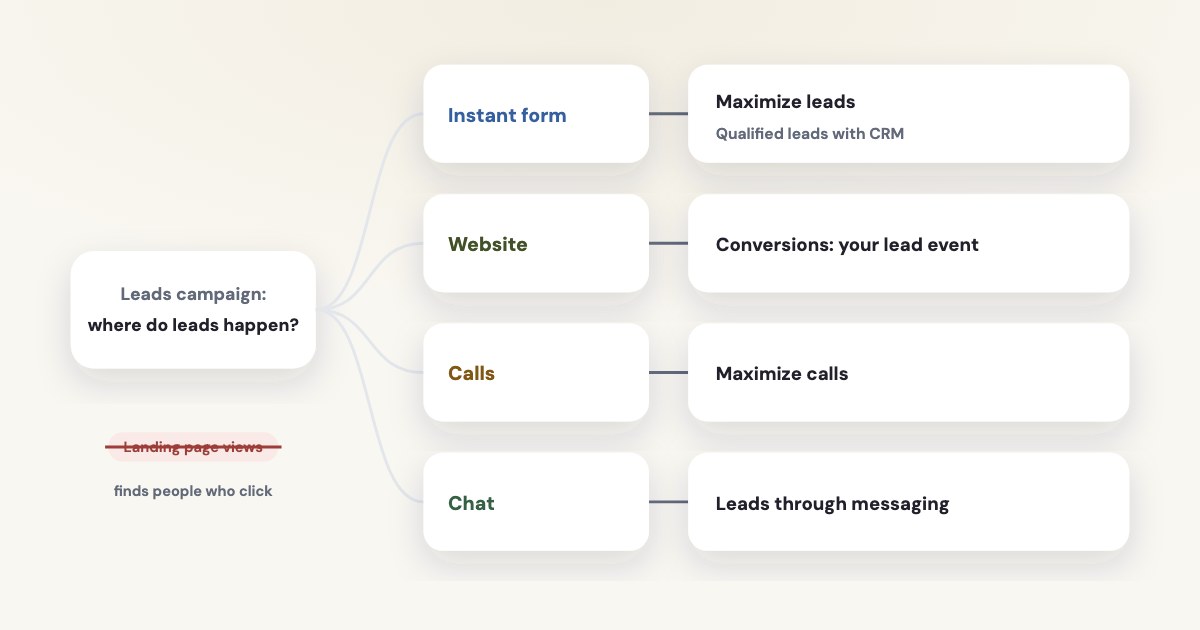
On a Leads campaign the objective only narrows the menu; the performance goal decides who Meta shows your ads to. For most small businesses the answer is Maximize number of leads, with Highest volume bidding. Switch to Maximize number of qualified (conversion) leads once you send lead stages from your CRM through the Conversions API — since April 2026 that goal needs it — and get enough leads for it to learn. Avoid optimising a lead campaign for landing page views or link clicks: you get people who click. Calls and messages have their own goals for businesses that sell by phone or chat.
On this page9 sections
Objective vs performance goal
You choose the Leads objective once, then two settings in the ad set decide what Meta looks for: the conversion location (instant form, website, calls, messages) and the performance goal. Jon Loomer puts it plainly: the objective limits your options, the performance goal is what optimisation follows (source). Meta’s own descriptions in the API show the difference (source):
- Leads:
Optimize for people more likely to fill out a lead generation form.
- Website conversions:
Optimize for people more likely to make a conversion on the site.
- Landing page views:
Optimize for people who are most likely to click on and load your chosen landing page.
- Calls:
Optimize for people who are likely to call the advertiser.
Which goal for which conversion location
| Goals Meta offers | Use when | |
|---|---|---|
| Instant form | Maximize number of leads · Maximize number of qualified (conversion) leads | You want volume on mobile; qualified leads once your CRM sends stages |
| Website | Maximize number of conversions (your lead event) · landing page views · link clicks | The offer needs a page to read; always pick conversions |
| Website and instant forms | Maximize number of leads only | You want Meta to choose the form per person |
| Calls | Maximize number of calls | Your team answers the phone during ad hours |
| Messenger, Instagram, WhatsApp | Leads through messaging (being introduced); conversations | Customers prefer chat to calls and e-mail |
Names follow Meta’s help center (source). With website and instant forms together,
Maximize number of leads is the only performance goal
(source). Meta describes the trade-off between
the two forms: instant forms To increase performance and lower cost per quality lead
, a website to Take specific actions like booking an appointment or generating a quote
(source).
Leads or qualified leads?
Qualified (conversion) leads goes after people most likely to convert after sharing their contact information with you
(source). To do that, Meta needs to know which leads converted — from your CRM:
Beginning April 2026, the qualified leads performance goal is no longer available for new campaign creation without Conversions API integration.
Existing campaigns are affected from August 2026. Meta’s pages disagree on whether it works for website forms; it reliably works for instant forms. Meta dropped the required minimum of monthly leads but still recommends volume, and learning with a CRM takes weeks.
Is it worth it? In a budget-controlled A/B test with 567 advertisers in January 2025, Meta reported 19% lower cost per qualified lead
for advertisers using CRM data. A second test, on 273 advertisers, showed 15% lower cost per quality lead and a 44% increase in rate of converting a lead to a quality lead
(source). Setup is in Conversions API for CRM.
On a small budget
Every goal needs results to learn from: an ad set leaves learning after about 50 optimisation events in the week after its last significant edit (source). At $15 a lead that is about $107 a day per ad set. At $30 a day you get around 14 leads a week — and only a fraction of them are qualified, so a qualified-leads goal learns even more slowly.
If you have to step down, step to leads, not clicks
Meta’s general advice for small budgets is to optimise for an event higher up the funnel. For a lead business, the right step down is from qualified leads to leads — not to landing page views or link clicks, which bring people who click (why). More in Learning limited on a small budget.
Bid strategy is a separate choice
Next to the goal you choose how Meta bids (source):
- Highest volume — Meta
automatically bids on your behalf and gets you the lowest cost results
. The right default. - Cost per result goal —
works best when your ad set gets at least 50-100 weekly conversions
, with a budget of at least five times the goal (source). Meta notes thatAdherence to cost cap limits is not guaranteed.
- Bid cap — for advertisers who can predict conversion rates accurately; a cap set too low stops delivery.
Calls and messages
Call ads suit businesses that close by phone; Meta frames them as reaching people during the moment of consideration
(source). Run them when someone answers, and pair them with an instant form for the rest of the day. Messaging lead
ads let people Chat and connect with potential customers on Messenger, Instagram or WhatsApp
(source) —
useful when customers don’t pick up the phone. Meta’s published gains for calls and messages come without a stated method, so test them
against your current form.
New lead campaigns run with Advantage+ on by default: All campaigns for the leads objective will be Advantage+ On by default.
(source) The performance goal is still yours to choose.
Check what your ad sets optimise for: Variafy
Variafy connects ChatGPT, Claude and other assistants to your Meta ad accounts. Ask “What does each ad set optimise for, and does that event actually arrive?” — the tracking audit lists the goal of every active ad set and checks the events behind it, and with your CRM connected you see which goal brings customers, not just leads.
How we checked
Checked on 17 October 2026 against Meta’s Business Help Center (performance goals, qualified leads, website and instant forms, cost per result goal, learning limited), Meta for Business pages on lead ads with forms, calling and messaging and on Advantage+ leads, and Meta’s Marketing API reference for ad sets and bid strategies. We also read Jon Loomer’s guide to performance goals and the pages that rank for these searches.
Variafy is our product.
Questions
What performance goal should I use for a Facebook lead campaign?
For most small businesses, Maximize number of leads with Highest volume bidding. Move to Maximize number of qualified leads once your CRM sends lead stages to Meta through the Conversions API and you get enough leads for it to learn.
What is the difference between leads and qualified leads on Meta?
Leads optimises for people likely to fill in a form; qualified (conversion) leads optimises for people likely to convert after sharing their details, using lead stages from your CRM. Since April 2026 new campaigns need the Conversions API for it.
Should I optimise lead ads for landing page views?
Usually not. Landing page views and link clicks optimise for people who click and load the page, not people who leave their details. If your budget is too small for leads, combine ad sets or accept slower learning instead.
What bid strategy is best for lead ads?
Highest volume for most small budgets. A cost per result goal works best when an ad set gets at least 50–100 conversions a week, with a budget of at least five times the goal; Meta doesn’t guarantee the goal will be met.
Do I still need 200 leads a month for conversion leads?
Meta removed the required monthly minimum, but still recommends steady volume, and learning with CRM data takes weeks. With few leads, the plain leads goal usually learns faster.