Learning limited on Facebook ads: what it means on a small budget
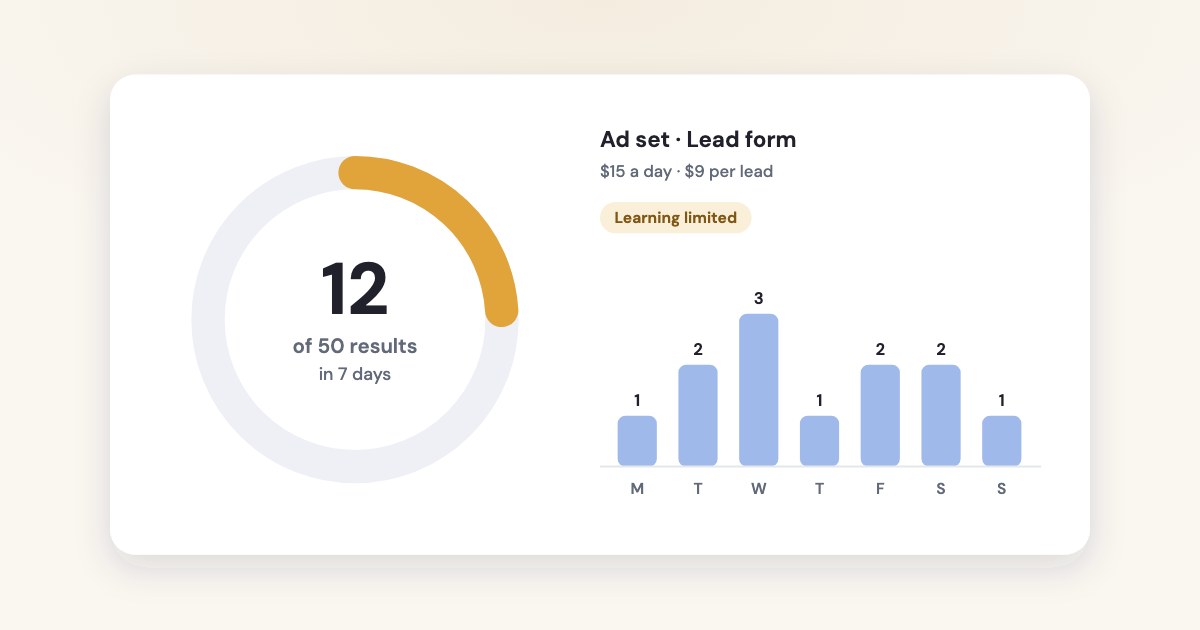
Learning limited means Meta expects the ad set won’t get about 50 results in the week after its last significant edit. On a small budget that is arithmetic: 50 leads a week needs a daily budget of about 7 times your cost per lead, and Meta’s own rule is 10 times. If you can’t pay that, combine ad sets or optimise for a more frequent event — or keep running and judge the ad set by its leads, because the status itself is not a penalty.
On this page8 sections
What Learning limited means
Every ad set goes through a learning phase after it starts or after a significant edit. To leave it, the ad set needs
about 50 optimization events in the week after your last significant edit
(source).
For a lead campaign an optimization event is a lead.
Learning limited is Meta’s forecast that this won’t happen. It isn’t a verdict on last week:
Learning limited isn’t a penalty – it’s an indication that your budget isn’t being spent effectively because the ad delivery system can’t optimize performance with your current setup.
The status can happen any time after you create an ad set or make a significant edit
, so a new ad set with a small
budget can show it on day one.
Counted per ad set, even with a campaign budget
Meta counts learning for each ad set separately: around 50 optimized conversion events for each ad set
(source). Asked how long learning takes with Advantage+ campaign budget, Meta answers:
It’ll take the same time as ad set budgets.
(source). Three ad sets at $10 a day
are three small learners, not one at $30.
Other thresholds you may read about
Meta’s help center gives a separate threshold only for Shops ads. Figures such as “10 events in 3 days” or “25 for Advantage+” come from blog posts, not from Meta. Meta’s API does have “dynamic learning phase” fields with their own thresholds (source), but their values aren’t published — so watch your own ad set rather than someone else’s number.
To see progress, add the Optimization events and Last significant edit columns in Ads Manager (source).
The arithmetic of a small budget
To reach 50 leads in 7 days, the daily budget of one ad set must be about 7 times the cost per lead. Meta’s general
rule is stricter: your daily budget should be at least 10 times the average cost of your optimization event
(source).
| Daily budget for 50 leads a week | Leads a week you actually get | |
|---|---|---|
| $10 a lead | $72 a day (Meta’s rule: $100) | 14 at $20 a day · 35 at $50 a day |
| $15 a lead about real estate | $108 a day (Meta’s rule: $150) | 9.3 at $20 a day · 23 at $50 a day |
| $25 a lead about education | $179 a day (Meta’s rule: $250) | 5.6 at $20 a day · 14 at $50 a day |
| $40 a lead about home services | $286 a day (Meta’s rule: $400) | 3.5 at $20 a day · 8.8 at $50 a day |
| $60 a lead about dentists | $429 a day (Meta’s rule: $600) | 2.3 at $20 a day · 5.8 at $50 a day |
Costs per lead are rounded from WordStream and LocaliQ’s 2026 averages for lead campaigns in the US (source); our guide on cost per lead has the details.
Turned around
At $10, $20, $30 or $50 a day, an ad set can leave learning within a week only if a lead costs under $1.40, $2.80, $4.20 or $7.00. Most small businesses that sell services pay more than that. For them, Learning limited is the normal state of an ad set, not a sign that something broke.
Is Learning limited bad?
Not by itself. Two things are true during learning, in Meta’s words: ad sets are less stable and usually have a higher CPA
,
and your results aren't necessarily indicative of future performance
(source).
Meta also says the phase is needed: you shouldn't try to avoid the learning phase completely
. Jon Loomer, one of the
best-known Meta ads educators, calls 50 a week a rule of thumb. More is better, but it’s not required.
(source)
So judge a Learning limited ad set the way you would judge any other: by its cost per lead and by how many of its leads turn into customers. If both are acceptable, leave it alone. Chasing the status with edits often costs more than the status does.
What Meta suggests, and what works on a small budget
Meta lists five fixes for Learning limited (source). Here they are in the order that usually makes sense when money is tight:
- Combine ad sets. Fewer ad sets share the same budget and each gets more leads. Meta’s opportunity score can suggest it, and an automated rule can combine ad sets when audience fragmentation is detected (source).
- Expand the audience.
The larger the audience, the more opportunities for people to complete your optimization event.
Advantage+ audience does this for you. - Optimise for a more frequent event. If you don’t want to raise the budget, Meta suggests
optimizing for an event that’s higher up in the marketing funnel
(source). For lead campaigns that usually means going from qualified leads back to leads (source). The cost: Meta then finds people who send forms, not people who buy. - Raise the bid or cost control — only if you set a cap; with the default strategy there is nothing to raise.
- Raise the budget — only when the table above says the new budget can reach 50 a week at your cost per lead, and the leads are worth it.
Opportunity score is not a forecast
Meta says so itself: Opportunity score does not reflect your actual or future performance, even if your score is high.
(source) Take its suggestions as a checklist, not as a promise.
What restarts learning, and how to edit without it
Only a significant edit sends an ad set back into learning. Meta lists them (source):
- any change to targeting, ad creative or the optimization event;
- adding a new ad to the ad set;
- pausing the ad set for 7 days or longer;
- changing the bid strategy;
- a large budget or bid change.
Meta does not say how large “large” is. Its example is $100 to $101 versus $100 to $1,000. The rule that you may change a budget by at most 20% is repeated on many marketing blogs, but it isn’t on any of Meta’s pages.
How to edit without starting over
- Raise the budget with a schedule.
Increasing your budget by scheduling a high demand period through budget scheduling won't prompt the delivery system to enter a learning phase.
(source) Useful before a start date or an enrolment deadline. - Batch your edits.
If you input changes one at a time, your campaign may have to re-enter the learning phase each time.
(source) - Edit only with a reason. Meta:
Only edit your ads or ad set when you have reason to believe that the edit should improve performance.
- Don’t pause and unpause. Meta advises against switching ad sets off and on manually.
- Check the Last significant edit column after a change. If its date didn’t move, the edit didn’t restart learning.
What happens when you raise a budget too soon
In one online education business we work with, we looked back at budget changes on ad sets that had at least five leads a week before and after. Of 190 budget increases made within 72 hours of the previous significant edit, 74% were followed by a higher cost per lead, with a median rise of 29%. Of 160 increases made after a quiet week, 66% were followed by a higher cost, median 16%.
Budget cuts showed no such difference. If you need to raise a budget, give the ad set a few quiet days first.
A new ad: documentation versus practice
Meta lists adding a new ad as a significant edit. In a test Jon Loomer published in September 2025, adding one new ad to an ad set with 22 ads didn’t restart learning (source). Check the Last significant edit column rather than assuming either way.
How Variafy helps
Variafy reads Meta’s learning status for every ad set and uses it in two places:
- Account audit. It lists active ad sets that are Learning limited, so you see the whole account at once instead of opening each ad set.
- Before a significant change. When your assistant prepares a change Meta counts as significant — a budget, a bid, targeting, a new ad — the approval page shows the ad set’s learning status, how many optimization events it has had since its last significant edit and when that edit was. If it was less than 72 hours ago, it says so. Nothing is blocked; you decide with the facts in front of you.
Ask your assistant “Which of my ad sets are Learning limited, and what would it cost to get them out?” after adding
https://www.variafy.com/mcp. Variafy is in private beta: join the waitlist.
How we checked
Checked on 15 October 2026 against Meta’s Business Help Center (learning limited, the learning phase, significant edits, learning with Advantage+ campaign budget, budget and optimization event, performance goals for leads, budget scheduling, campaign budget best practices, combining ad sets, opportunity score) and the Marketing API reference for ad set learning stage information. The table is our own calculation from Meta’s “about 50 a week” and WordStream and LocaliQ’s 2026 lead-campaign averages.
The budget-change figures come from the history of one online education business we work with. Variafy is our product.
Questions
What does Learning limited mean on Facebook ads?
Meta expects the ad set will not get about 50 optimization events, such as leads, in the week after its last significant edit, so delivery cannot fully optimise. Meta says it is not a penalty.
How long does the Facebook learning phase take?
Until the ad set gets about 50 optimization events in the week after its last significant edit; some ad sets stabilise earlier. With a small budget and a high cost per lead that may not happen at all, which is when the status changes to Learning limited.
How many conversions do I need to exit the learning phase?
About 50 in the 7 days after the last significant edit, counted per ad set, also with Advantage+ campaign budget. Meta gives a different threshold only for Shops ads.
How much budget do I need to exit learning?
About 7 times your cost per lead per day to reach 50 leads in a week; Meta’s general rule is at least 10 times the cost of your optimization event. At $25 a lead that is roughly $180–250 a day per ad set.
Is Learning limited bad?
Not by itself. Results are less stable during learning, but if the ad set’s cost per lead and lead quality are acceptable, leave it running and avoid extra edits.
How do I fix Learning limited on a small budget?
Combine ad sets so each gets more of the budget, broaden the audience, or optimise for a more frequent event such as leads instead of qualified leads. Raise the budget only if your cost per lead makes 50 a week reachable.
Does changing the budget reset the learning phase?
A large change does; Meta does not publish a percentage, and the “20% rule” is not from Meta. Raising the budget through budget scheduling (high demand periods) does not restart learning.
Does adding a new ad reset learning?
Meta lists it as a significant edit. Some practitioners report it did not restart learning in their tests, so check the Last significant edit column after adding an ad.