Google Ads responsive search ads: assets and pinning
For Google Ads responsive search ads, provide distinct headlines and descriptions, then pin only wording that needs a fixed position. Ad strength is feedback on your asset mix and relevance, not a sales metric or an input to Ad Rank; judge the ad by useful conversions and business outcomes. [2] [3]
On this page10 sections
How many assets can you provide?
These limits follow Google’s official documentation read November 4, 2026, as of November 2026. “Assets” here means the text components of the responsive search ad, rather than every additional asset attached to your campaign. [1]
| RSA field | Documented limit |
|---|---|
| Headlines | Minimum 3; maximum 15 |
| Descriptions | Minimum 2; maximum 4 |
| Each headline | Up to 30 characters |
| Each description | Up to 90 characters |
| Each display path field | Up to 15 characters |
Treat those limits as room to communicate different reasons to choose your service. Filling the available fields with slightly rearranged versions of the same sentence gives you more text without adding much new information.
Start with the service, the relevant customer problem, a useful distinction, and the next action. For a lead business, explain enough about the offer that someone can decide whether an inquiry makes sense.
Keep your essential claims supportable by the landing page and your actual service. A more attractive message is not useful if your team has to explain afterward that the advertised offer does not apply.
What makes an asset mix useful?
Google recommends relevant, unique headlines and descriptions rather than repetitive text. Write each component so it can communicate a coherent idea when combined with the other eligible components. [3]
For your own draft, give each headline a purpose: name the service, describe the location you serve, explain a relevant benefit, or state the next step. You do not need every asset to repeat the same keyword to make the offer understandable.
Use descriptions to add details the reader needs before contacting you. That could include the type of project you handle, what an initial consultation covers, or a condition that materially changes who should inquire.
Read possible combinations aloud. If two headlines repeat each other or a description depends on a previous sentence that might not appear, rewrite the asset so it stands on its own.
Also review what “success” means for the offer. If you want suitable project inquiries, ad copy that encourages any inquiry may make your submission count look healthy while leaving your sales team with the wrong conversations.
For the traffic behind the ad, use the Google Ads search terms guide. Keep query relevance and asset writing connected without rebuilding your entire keyword strategy during a copy review.
What does pinning do, and what does it cost?
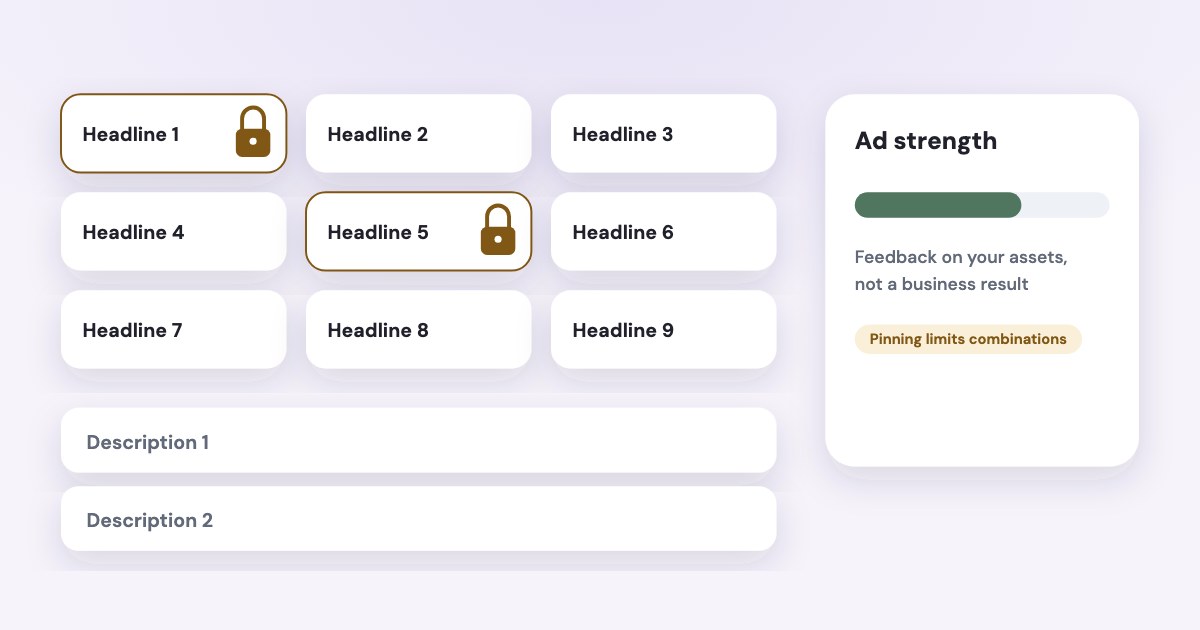
Pinning reserves a position for the selected text and limits the combinations Google can assemble. Google warns that this can affect Ad strength; it does not document a fixed percentage increase in your cost per click or cost per lead from pinning. [2]
Think of the cost as reduced flexibility rather than an automatic cash surcharge. The business question is whether the need for controlled wording outweighs the opportunity to try other messages in that position.
Google documents Headline position 1, Headline position 2, and Description position 1 for text that must appear when the ad serves. It does not guarantee the same visibility for Headline position 3 or Description position 2. [1]
If you need approved mandatory language, protect that requirement first and improve the remaining assets around it. Do not remove required wording merely to obtain a more attractive rating.
Google suggests using several distinct pinned alternatives in a required position when appropriate, rather than pinning near-identical text. Only do that when every alternative satisfies the actual wording requirement you need to meet. [2]
Appearance versus meaning
Pinning a short phrase cannot make an unclear or unsupported offer acceptable. Review the complete message and destination as well as the position.
Where do you edit and pin the text?
The following labels follow Google’s desktop help read November 4, 2026, as of November 2026. Before saving, decide whether you are making a necessary correction or introducing a message you want to evaluate. [1]
STEPS: 1. In the Campaigns menu, open Campaigns and select Ads. 2. Hover over the responsive search ad you want to change. 3. Select the edit icon. 4. Select Edit. 5. Update the relevant headline or description. 6. Select its pin icon if the text requires a fixed position. 7. Choose the required position. 8. Select Save. [1]
Keep a copy of the wording you changed and the reason for the change. Your later review should be able to distinguish correcting an inaccurate claim from testing a new sales message.
After a substantial rewrite, compare later results with the message your customers actually saw. Keep the wording history so you can explain which version a result belongs to.
Use the preview to catch obvious wording problems before saving. Ask whether the service, any qualification, and the next action remain understandable when you read the displayed message together.
What is Ad strength, and what is it not?
Google describes Ad strength as a rating plus actionable feedback about your ad’s potential effectiveness. Its current guidance explicitly says the rating is not used to calculate Ad Rank, Quality Score, or auction wins. [2]
The current page considers relevance, variety, and sufficient assets, including sitelink coverage. As of November 2026, it recommends at least six sitelinks across the applicable account, campaign, and ad group branch when improving this part of the rating. [2]
Use the feedback to find a weak draft: repetitive headlines, missing useful messages, or poor relevance to the ad group. Then decide whether the suggested change improves what a prospective customer learns.
Do not treat Excellent as proof that your landing page works or that inquiries will qualify. Google says Ad strength does not measure external factors such as the quality of your landing page and offering. [2]
If your concern is keyword-level Quality Score, use the Quality Score guide. Keep that diagnostic separate from the RSA writing feedback so you do not chase the wrong number.
How does Google say to test responsive search ads?
Google’s current best-practice page recommends more than one RSA with Good or Excellent Ad strength per ad group; the page gives the minimum as two in one place and one in another, so treat the exact count as guidance rather than a rule. It also recommends using ad variations to test messages and evaluating incremental campaign or ad group outcomes beyond the ad’s clickthrough and conversion rates. [3]
Google’s ad variations tool supports testing a defined change across a selected scope of responsive search ads. You choose the scope and variation details, then review the variation against the original before deciding whether to apply it. [4]
For your own test, start with a real uncertainty: whether explaining the consultation process attracts more suitable inquiries, for example. Change the relevant message and write down the business outcome you want to improve.
Keep sales follow-up and qualification definitions consistent while you assess it. A higher inquiry rate is not a clear win if your team changes how it records qualified inquiries halfway through the comparison.
Do not choose a winner from a single attractive asset or a rating change alone. The useful question is whether the revised setup brings more of the outcomes you value at an acceptable cost.
If conversion timing affects your comparison, use the conversion lag guide. Give the leads comparable time to progress before comparing payments or completed sales.
What to do next
Review one ad group and assign a purpose to each headline and description. Remove needless repetition, protect any essential fixed wording, and use Ad strength feedback to identify remaining gaps.
Then choose one message uncertainty to test with a clear outcome and a stable qualification rule. Keep a change note and review the ad group’s business results before expanding the change elsewhere.
Where Variafy fits
Variafy connects Google Ads and CRM deals and payments to an AI assistant, so your review can include business outcomes alongside ad results. Reading data is free, and any ad-account change is previewed and requires confirmation; the beta is free by invitation and sign-up is closed.. Join the waitlist.
How we checked
Checked on 4 November 2026 against the pages below, read in English. We checked the documentation only: we did not run these steps in a live ad account.
- support.google.com/google-ads/answer/7684791?hl=en — RSA limits, desktop editing and pinning, position guarantees, previews, and edit effects
- support.google.com/google-ads/answer/9921843?hl=en — Meaning and limits of Ad strength, sitelink coverage, and pinning tradeoffs
- support.google.com/google-ads/answer/6167122?hl=en — Current two-RSA recommendation, asset diversity, testing, and broader evaluation
- support.google.com/google-ads/answer/7438541 — Ad variations scope, comparisons, and applying changes
What we could not confirm
- A fixed CPC or conversion penalty for pinning
- A guaranteed sales increase from Excellent Ad strength or another RSA
- Equal serving of every combination
- A universal test duration
- That every optional text position appears. No ad was edited and no experiment was run. Google’s help contains differing descriptions of which unpinned text positions appear
- The article relies on its explicit pinning guidance for essential wording
Variafy is our product.
Questions
How many headlines and descriptions can a responsive search ad have?
Google documents 3–15 headlines of up to 30 characters and 2–4 descriptions of up to 90 characters.
Does pinning hurt performance?
Pinning reduces the combinations Google can test and can affect Ad strength. We found no documented penalty, so pin only wording that must stay in a fixed position, such as required legal text.
Is Ad strength a business result?
No. Ad strength is feedback on your asset mix and relevance; it does not calculate Ad Rank, Quality Score or auction wins. Judge ads by broader results.