Google Ads Quality Score: what should you fix first?
Use Google Ads Quality Score’s expected CTR, ad relevance and landing page experience to choose the first check for a Search keyword. Fix a confirmed mismatch between search, ad and page. Treat the 1–10 number as a diagnostic; judge the result by qualified enquiries and cost.
On this page9 sections
What does Google’s 1–10 Quality Score measure?
Quality Score is a keyword-level diagnostic of how your ad and landing page compare with other advertisers for relevant searches. Google’s Search campaign reference combines expected clickthrough rate, ad relevance and landing page experience; each component is rated Above average, Average or Below average.
This guide covers Search keywords, which is what Google’s reference describes.
Those component assessments compare advertisers whose ads showed for the exact same search over the last 90 days. This is not a count of qualified leads, a page-speed grade or a recommendation to make every keyword reach 10. For a report that does compare you with named competitors, see Google Ads Auction Insights.
Quality Score is not an input in the ad auction.
Ad Rank uses bids, auction-time quality, thresholds, competition, search context and the expected impact of assets/formats. The underlying quality signals can affect eligibility, position and CPC; the displayed 1–10 score is not a multiplier to insert into a bidding formula.
The Ad Rank overview says Our assessment of the quality of your ad is summarized in your Quality Score
, while the Search reference above says the score is not an auction input.
Google’s optimization guide clarifies that the components’ real-time evaluations enter the auction, while the score itself does not.
Google’s ad-quality guidance says higher-quality ads typically cost less per click, not that moving between particular displayed scores guarantees a fixed discount. Our reading: use the score to locate a possible problem, then test a useful change rather than buying a target number.
Google also says not to optimize or aggregate Quality Score with the rest of your data. Its quality guidance explicitly says there is no ad-group, campaign or account-level Quality Score. For ordinary performance columns, use the Google Ads reporting guide.
How do you find the components and a missing Quality Score?
Add the current component columns to the keyword table; use historical columns when you need to understand a change over time. As of 19 Oct 2026, Google Help’s path is Campaigns → Keywords → columns icon, then Modify columns for keywords → All columns → Quality score.
| Current column · Google’s label | Historical column · Google’s label | |
|---|---|---|
| Overall diagnostic | Quality Score | Quality Score (hist.) |
| Click likelihood | Exp. CTR | Exp. CTR. (hist.) |
| Search-to-ad fit | Ad Relevance | Ad Relevance (hist.) |
| Destination | Landing Page Exp. | Landing Page Exper. (hist.) |
Select the needed columns and Apply. Google says you can see daily changes in the historical scores by segmenting the table by day. Keep the period and keyword identity with the figures; current and historical columns answer different questions.
A — means Google has insufficient searches exactly matching that keyword to determine its Quality Score. Our reading: the scale starts at 1, so the dash is not a score of zero. Do not assume a stopped campaign; check actual delivery separately if there are no impressions.
A broad-match keyword may have a score without impressions if a corresponding exact-match keyword has impressions in the last 90 days. When exact-search impressions come through that exact-match keyword in the same ad group, Google says this will report the same score for both keywords (conditions).
Google says changing match type does not itself change the calculation, which uses historical exact-search impressions. Its missing-score advice nevertheless includes relevant higher-volume keywords or broader match types to help gather exact-search evidence. Those are different points: broader reach is not an automatic score increase.
Keep a blank diagnostic blank
Our suggestion: record the dash, actual impressions and available history, then check whether the intended search demand exists. Do not buy broader traffic solely to fill a reporting cell.
What should each weak component make you inspect?
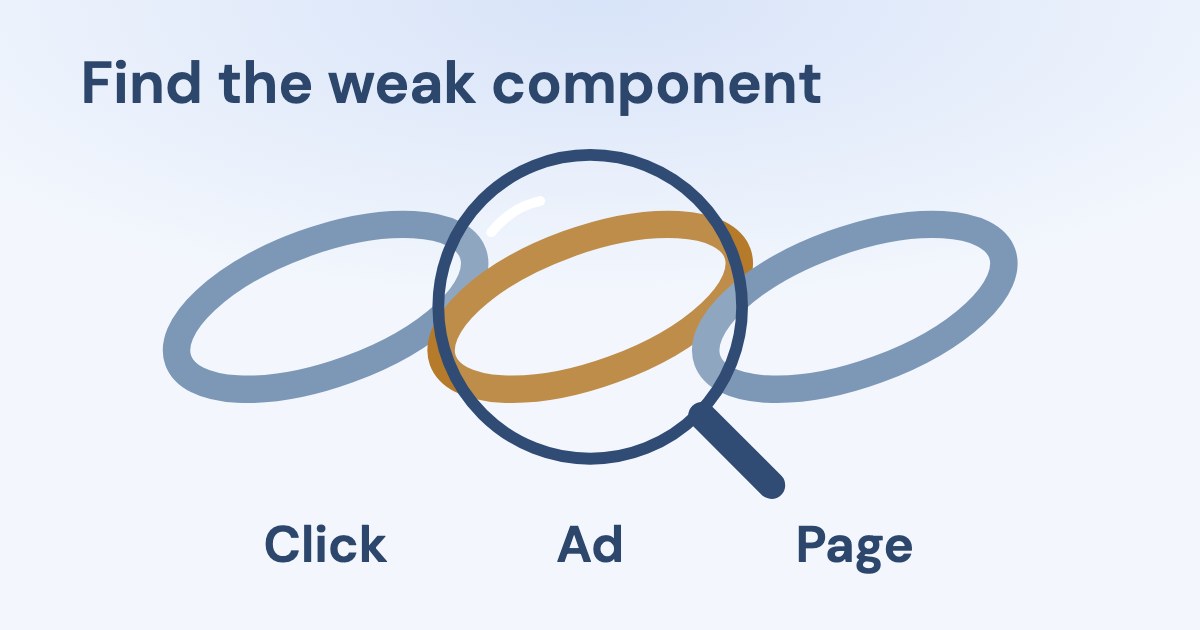
Read a weak component as a direction to investigate, then inspect what the customer actually sees. Google’s improvement guidance treats Average as well as Below average as a possible opportunity; the component alone does not prove the cause.
| What Google’s component measures | Our first check and possible change | |
|---|---|---|
| Expected CTR | How likely the ad is to be clicked when shown. | Read the ad beside the actual query. If it is vague, test a specific service, benefit or call to action that the landing page can fulfil. Avoid attracting clicks for an offer you do not provide. |
| Ad relevance | How closely the ad matches the intent behind the search. | Compare query, keyword theme and ad promise. If one generic ad covers unrelated services, separate those themes and write an appropriate message for each. Do not create groups merely to rearrange the account. |
| Landing page experience | How relevant and useful the destination is after the click. | Open the actual destination on a phone. Check the promised service, useful information, navigation and contact path. Fix a confirmed mismatch, broken form or usability obstacle before cosmetic changes. |
The query-to-offer check matters before rewriting an ad. If searches are for a service you do not sell, clearer copy alone does not repair the traffic selection. Use the search terms and negative-keyword guide to decide which intent belongs in the campaign.
For the page, Google recommends a matching offer, mobile usability, useful original information and an easy way to contact the business or submit an enquiry (landing-page guidance). Its Quality Score guidance also says the word-for-word query does not have to appear on the page. Repeating a keyword cannot replace the promised service.
That guidance also recommends improving loading speed. It gives no numerical speed threshold here.
Expected CTR is not simply your observed CTR: Google normalizes it for position and other visibility factors. Raising the bid to gain a higher position does not by itself improve that rating. A more compelling ad also needs to attract suitable customers.
Which change comes first for a lead business?
Choose a confirmed customer problem on traffic that matters, with a change someone can actually implement. Google’s prioritization advice focuses on high-value areas where you can affect change; the service-specific decision rules here are our suggestions.
Imagine two service campaigns with the same overall Quality Score but different weak components. These are invented diagnostic situations, not client observations or a reconstruction of Google’s scoring formula:
| Evidence in the invented case | Our first action | |
|---|---|---|
| Boiler repairs | Landing page experience is Below average. The query and ad offer boiler repairs, but the destination opens a general plumbing page and its enquiry form fails on a phone. | Have the site owner repair the form and use a truthful repair-service destination. More ad clicks cannot fix a broken enquiry path; check that a real enquiry can be completed. |
| Adult driving lessons | Ad relevance is Below average. Searches ask for weekend driving lessons, but the ad describes general skills training and covers several unrelated courses. | If weekend lessons are genuinely available, align the ad group and message with that service and its destination. If they are unavailable, correct the traffic/offer mismatch instead of promising them. |
The same headline number does not choose between these actions. Start with direct evidence of the failed customer journey, then consider the spend, useful enquiries affected, implementation owner and effort. A rare keyword with no meaningful business exposure may deserve less work than a productive service with a broken form.
What if you cannot change the website?
Assign the page issue to a named owner. Google’s guidance says you can experiment with more useful existing pages even without control of the site.
Our suggestion: choose an existing page only if it genuinely delivers the ad’s promise. Record an unresolved site issue instead of pretending a new headline repairs it.
There are also changes that do not solve the diagnosis. Moving the same ads and keywords to another campaign or account does not change ad quality; moving a keyword to an ad group with new ad text can, because that can affect user experience (Google’s distinction).
Use the full Google Ads audit checklist if delivery, conversion settings or targeting are broken too. Quality Score alone is not a reason to pause a useful keyword or accept more irrelevant traffic.
How do you know a Quality Score change helped?
Measure useful enquiries and their cost alongside the component that prompted the change. Google’s guidance explicitly recognizes that a more specific ad may produce:
lower CTRs, but higher conversion rates.
For a lead business, more clicks or form submissions can still mean fewer suitable enquiries. Our suggestion is to define qualification before comparing: for example, a genuine enquiry for a service you provide in an area you serve. Use the same definition in both periods.
Worked example — every number is invented
Suppose both periods have $500 of spend and the same opportunity for leads to mature. A “qualified enquiry” has the same definition in both. These figures demonstrate the denominators, not a benchmark or proof that an ad change caused an outcome.
| Before · illustration | After · illustration | |
|---|---|---|
| Spend | $500 | $500 |
| Enquiries | 25 | 40 |
| Cost per enquiry | $500 ÷ 25 = $20 | $500 ÷ 40 = $12.50 |
| Qualified enquiries | 10 | 5 |
| Cost per qualified enquiry | $500 ÷ 10 = $50 | $500 ÷ 5 = $100 |
The enquiry looks cheaper, while the qualified enquiry costs twice as much. Even if a component improved, this table would not establish a business win. The cost-per-lead guide explains how to choose a cost target from your own economics.
Keep diagnosis and outcome separate: Google says reported conversions do not affect ad quality, and conversion rate does not determine the landing-page status (ad quality; landing-page status). Better measured conversion rate can be useful evidence without being an input to that rating.
- Save a baseline. Keyword, query context, component ratings, actual destination, cost, enquiries and qualification definition.
- Record the change and date. Keep the intended service, traffic scope and reporting basis comparable; note bid, budget, targeting or seasonal changes that could explain the outcome.
- Allow the business’s observed conversion delay. Choose a check date and acceptable test spend in advance rather than declaring a universal waiting period for Quality Score.
- Check the diagnosis and the business result separately. Use historical/day columns for diagnostic movement, then assess mature useful enquiries and cost. A simple before/after comparison does not isolate causation.
What can Variafy read?
Variafy offers read-only Google Ads access after your beta invitation.
The implementation checked on 19 Oct 2026 includes google_campaign_structure, which can return keyword text, match type and the reported numerical quality_score when keywords are requested.
If Google returns no score value, that reader returns null; it does not establish the reason for the missing value.
It does not request the three component-status fields or historical Quality Score fields. Obtain those diagnostics from Google Ads before asking which component needs work.
A prompt for the reading workflow
“List the returned Search keywords and reported Quality Score, keeping missing values blank and stating data coverage. Use the component ratings I provide to draft one supported customer-experience check per affected service. Separate evidence from a proposed change, and do not change anything.”
These are reads and a proposed investigation; account changes require human approval. Variafy is in the free beta: join the free beta.
What should your first change brief contain?
Write a brief that connects a weak component to a specific customer problem, an owner and a business check. This is our suggested handover format; it is not a Google scoring formula or a promise of improvement.
| Record | Filled example · boiler repairs | |
|---|---|---|
| Evidence | Affected service, keyword/query, date and component; distinguish an observed fault from an assumption. | Landing page experience Below average; general plumbing destination; enquiry form fails on a phone. |
| Proposed change | One coherent change to the customer journey; name its owner and approver. | Site owner repairs the form and checks the truthful repair-service destination before changing the campaign URL. |
| Acceptance check | What must work, and which business outcome will decide whether to keep the change. | An enquiry can be completed; service information matches the promise; qualified enquiries and cost use the agreed definition. |
| Next decision | Check date, mature reporting period, agreed spend limit and any confounding changes. | Keep, adjust or stop the test based on customer experience and useful enquiries; document missing evidence. |
A better score can accompany a better experience, but the useful deliverable is the repaired journey and its measured outcome. If the evidence is missing, request the component or page check rather than inventing a universal “good” score.
How we checked
Checked on 19 Oct 2026 against raw HTML from 7 Google Ads Help pages: the Search Quality Score reference, five improvement methods, ad quality, Ad Rank, the Quality Score optimization guide, quality factors and myths, and ad/landing-page optimization.
Interface labels and conditions use those public pages’ wording as of that date.
Questions
What is a good Quality Score in Google Ads?
Use the component ratings and business results rather than one universal target. Google calls the 1–10 keyword score a diagnostic, says it is not a KPI, and advises against optimizing or aggregating it with the rest of your data.
What are the three Quality Score components?
Expected clickthrough rate estimates the likelihood of a click; ad relevance concerns the match to search intent; landing page experience concerns the destination’s relevance and usefulness. Each has an Above average, Average or Below average status.
Why is my Google Ads Quality Score not showing?
A dash means there are not enough searches exactly matching the keyword to determine its score. Our reading: the scale starts at 1, so a dash is not zero. Google also documents cases where a broad-match keyword receives a score from corresponding exact-match search evidence.
How do I improve a low Quality Score?
Inspect the weak component, the actual query, ad and destination before choosing a change. Our suggested priority is a confirmed customer problem on valuable traffic, with a named owner and a check against useful enquiries and cost; do not pause a keyword solely to improve an average score.
Does a higher Quality Score guarantee a lower CPC?
No. The Google pages we checked state no fixed CPC reduction for any score. They say higher-quality ads typically cost less per click (Ad quality) and can often lead to lower CPCs (Ad Rank); the displayed score is not an auction input.
Does changing match type or increasing the bid improve Quality Score?
Google says changing match type does not itself affect the score’s calculation, and expected CTR is normalized for position. Broader matching may help gather exact-search evidence for a missing score, but it is not an automatic score increase. Bid and targeting decisions still need business evidence.