AI Facebook ad copy: how to use ChatGPT and Claude for ad texts that bring leads
ChatGPT and Claude write good Facebook ad copy when you give them what a copywriter would need: your best and worst ads with their numbers, the landing page, the length for your placements and Meta’s rules. Research on real ad clicks found AI works best as a critic of your drafts, not as a ghostwriter — experienced writers who let it write for them got worse ads. Ask for different angles from different facts, not five rewordings of one line. Then test the texts side by side in the same ad set: a text that “wins” across a campaign is often just running to a better audience.
On this page9 sections
How long Facebook ad copy should be
Meta’s help center gives one rule of thumb — 125 characters of primary text, 40 for the headline, 25 for the description —
and warns that text in ads may be further truncated across various placements and devices.
(source)
Its Ads Guide is more specific per placement:
| Primary text | Headline | |
|---|---|---|
| Facebook Feed | 50–150 characters | 27 characters |
| Instagram Feed | 125 characters | 40 characters |
| Facebook Marketplace | 125 characters (description 30) | 40 characters |
| Instagram Reels | 44 characters | — |
Tell the assistant your shortest placement, not a generic “125”, and ask that the first sentence work on its own: on most placements the rest is folded or cut. With Advantage+ placements, that usually means writing for Reels first.
Use AI as a critic, not a ghostwriter
The most useful study on this measured ad quality by real clicks on social platforms. Its finding:
Using LLMs as sounding boards enhances the quality of the resultant ad copies for nonexperts
The other half matters as much: using the model as a ghostwriter did not provide significant benefits and is, in fact, detrimental to expert users
,
because it produces an anchoring effect, which leads to lower-quality ads.
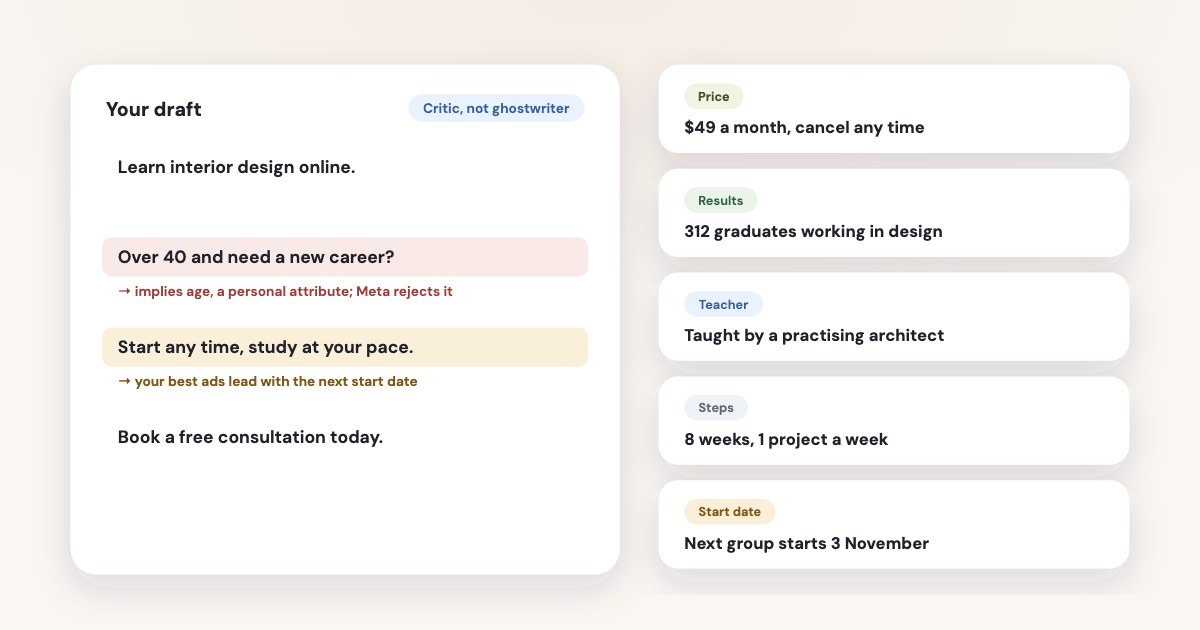
If you know your customers, write the draft yourself and
ask the assistant to attack it — with your numbers in front of it.
Prompt: critique my draft against my results
Below: my 3 best and 3 worst ads from the last 90 days with spend, leads and cost per lead, and the landing page text.
Then my new draft.
1. Say what the best ads do that the worst don't (offer, first line, proof, call to action).
2. Judge my draft against that. Quote the weak phrases and say why.
3. Suggest at most 2 edits per weak phrase. Keep my wording where it already works.
Don't rewrite the whole text.
Anthropic’s guidance supports this setup: put the long inputs first — Place your long documents and inputs near the top of your prompt, above your query, instructions, and examples.
(source) OpenAI says the same about examples: show a diverse range of possible inputs with the desired outputs.
(source) Our prompt guide has the base prompt for
new copy in the voice of your best ads and a policy check.
Five angles, not five rewordings
AI-assisted writing tends to converge. In a study in Science Advances, stories written with AI ideas were rated more creative
individually but were more similar to each other (source). For ads that matters, because Meta now groups
look-alike creative together and leans on variety: its ranking system is built for advertisers who
upload more and more creatives to support a diversification strategy
(source).
Prompt: angles from different facts
From the landing page below, list the facts a customer could care about: price or payment plan, results with numbers,
who teaches or treats, how it works step by step, timing and next start date, guarantees, reviews (quote only real ones).
Write one primary text for each of 5 different facts. Each must lead with its fact in the first sentence,
fit in 44 characters for Reels and in 125 for the feed, and make sense without the others.
Then tell me which two are most different from my current ads.
Each angle becomes its own ad, so you learn which reason to buy works — not which synonym.
Which text won? Check before you believe it
The usual way to pick a winner — sort texts by cost per lead across a campaign — mixes up the text with the audience it ran to. When we built a text comparison into Variafy, one headline looked 43% cheaper across its campaign; compared with the other texts in the same ad sets, the difference was within chance. The audience was winning, not the words.
Two traps we measured
- Audience, not text. A text that ran mostly in its own ad set competes with that ad set’s audience. Compare texts only where they ran side by side.
- Too many texts. With twelve texts and a 95% threshold, about one comparison in four names a “winner” by pure chance. The more texts you test, the stricter the bar has to be.
A simple rule: put the new texts as separate ads in the same ad set as the current one and wait until each has at least 30 leads. Even then a difference of a quarter can be chance (how much chance moves cost per lead), so only act on clear gaps. If your CRM is connected, compare by customers, not by leads.
Does AI-written copy perform better?
Nobody has published lead or sales results for AI copy against human copy. What exists:
- Meta’s own generator. In a 10-week test across about 35,000 advertisers, Meta’s improved text model raised click-through rate by 6.7% (from 3.1% to 3.3%) — compared with its previous AI model, not with advertisers’ own texts, and trained on clicks (source).
- Small vendor tests report double-digit click gains for lightly edited AI copy, on a handful of ads each.
- Figures like “AI copy lifts CTR 15–25%” that circulate in blog posts have no published study behind them.
So treat AI copy as a faster way to produce testable variants, and let your own results decide. That is also how Anthropic says it uses
Claude for its ads: copy written using existing campaign and ad performance data
, checked against character limits and uploaded
(after undergoing manual review)
(source).
Rules AI copy breaks most often
- Personal attributes. “Struggling with debt?” or “Do you have diabetes?” is the default hook of every model, and Meta rejects it: ads can’t assert or imply a person’s health, finances or other personal attributes (source). “You” is fine; “you” plus a condition isn’t.
- Invented proof. The FTC’s 2024 rule bans testimonials that
misrepresent that they are by someone who does not exist, such as AI-generated fake reviews
(source). Tell the assistant to quote reviews only verbatim from what you paste. - Numbers and offers that aren’t on the page. Discounts, deadlines and results must match the landing page. Ask for every number to be traced to your data or the page. For course and coaching ads, the separate guide to Facebook ads for courses and coaches covers the policy scope and the proof behind a learning promise.
Meta doesn’t require a label on AI-written text; its “AI info” label is for images and video. More on rejections in why was my Facebook ad rejected.
Copy briefs from your real results: Variafy
Variafy connects ChatGPT, Claude and other assistants to your Meta ad accounts. Ask “Write new ad texts for this campaign” and its copy brief gives the assistant what this guide asks for:
- every primary text and headline of the campaign with spend, link CTR, results and cost per result;
- which texts beat the others beyond chance — compared inside the same ad sets, with a stricter bar the more texts there are — and which haven’t proven anything yet;
- with payments sent in from your CRM or a sheet, the money each text brought;
- the landing page text and the length limits.
The assistant writes; new ads are created paused and run only after you confirm.
How we checked
Checked on 17 October 2026 against Meta’s Ads Guide (Facebook Feed, Instagram Feed, Marketplace, Instagram Reels) and help center on text length, Meta’s Advertising Standards on personal attributes, Meta’s 2025 post on its ads ranking and the AdLlama paper by Meta researchers, Chen and Chan in Management Science (2024), Doshi and Hauser in Science Advances (2024), Anthropic’s and OpenAI’s prompting guides, Anthropic’s post on how it uses Claude in marketing, and the FTC’s 2024 rule on fake reviews. We also read the pages that rank for these searches.
The two traps in text comparison come from building and reviewing Variafy’s copy brief on one advertiser’s campaigns. Variafy is our product.
Questions
What is a good ChatGPT prompt for Facebook ad copy?
One that includes your best and worst ads with their numbers, the landing page text, the length for your shortest placement and Meta’s rules, then asks for different angles built on different facts. A prompt with only a product description gives the same copy everyone gets.
How long should Facebook ad copy be?
Meta’s rule of thumb is 125 characters of primary text, 40 for the headline and 25 for the description. Its Ads Guide suggests 50–150 characters and a 27-character headline for Facebook Feed, and 44 characters for Instagram Reels. Make the first sentence work on its own.
Is AI-written ad copy better than human copy?
There is no published comparison on leads or sales. Meta’s improved text generator raised clicks 6.7% over its earlier AI model, and a study measured on real clicks found AI helps most as a critic of your drafts. Test AI variants against your current ads.
Can I use Claude to write Facebook ads?
Yes. Give it your past ads with results and the landing page, and ask it to critique your draft or write angles from different facts. Anthropic says it writes its own ads from campaign performance data and reviews them manually before upload.
Do I have to label AI-written Facebook ad text?
Meta doesn’t require it; its AI info label covers images and video. You are still responsible for the claims: no invented reviews or numbers, and no wording that implies the reader’s health, finances or other personal attributes.