Facebook ads campaign structure: how many ad sets do you need?
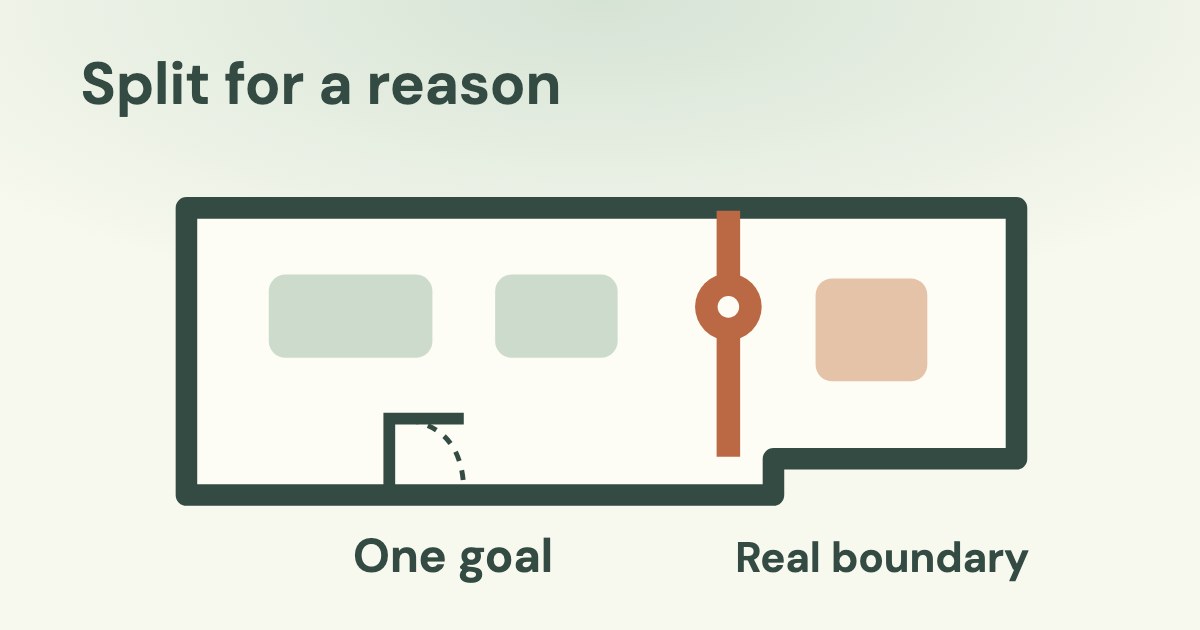
Build your Facebook ads campaign structure around the decisions your lead business must keep separate: offer, service area, follow-up language and budget responsibility. Our starting suggestion for one service is one campaign and one ad set, with different messages as ads. Add a separate ad set only when it protects a real business requirement.
On this page9 sections
What belongs in a campaign, an ad set and an ad?
A campaign holds the objective, an ad set groups delivery conditions, and an ad carries the customer-facing message. Meta’s Marketing API overview, checked 19 Oct 2026, separates these objects:
All ads contained within an ad set should also have the same targeting and optimization goal.
| Meta’s documented role | Our planning question | |
|---|---|---|
| Campaign | Should represent a single objective. | What business outcome and budget responsibility does this campaign serve? |
| Ad set | Shared targeting and optimization goal; schedule and budget settings in the standard outline. | Do these ads need different delivery conditions or an independently managed allocation? |
| Ad | The ad object includes the creative shown to the customer. | What truthful service message, visual and destination should the person see? |
There is a qualification in Meta’s documentation: the overview’s component table places budget at the ad-set level, while its separate Advantage Campaign Budget guide documents a shared campaign budget distributed across ad sets in real time. Do not read the overview table as saying every campaign must use separate ad-set budgets.
Structure and budget allocation are different decisions. Use the campaign-budget versus ad-set-budget guide for that choice; the scenarios here decide which business tasks deserve separate ad sets.
How would you structure one service on a small budget?
Our suggestion is to start the planning sketch with one campaign and one ad set when the service, area, destination and enquiry handling are the same. This is a deliberately simple service example, not Meta’s required or universally best count.
Invented example: a local repair service
One team sells the same repair visit across one service area, uses one enquiry destination and handles all requests in the same queue. Sketch one campaign → one ad set → several genuinely different messages about that service.
A new photo or explanation of the same offer is an ad idea in this plan. It does not create a new branch, response team or spending obligation. Write down the customer question each message answers, such as what the visit includes or which repairs the business actually performs. A register of what each ad set contains is in our guide to ads per Facebook ad set.
Keep the offer true on the destination: the price basis, area and available service should match what a person clicked. If people ask for work the business does not provide, first inspect the promise and enquiry route rather than adding an interest-labelled ad set.
Our suggestion is to keep an existing productive structure unless you can name the problem a change should solve. For the amount the business can afford to test, use budget planning for a lead business; this sketch is not a minimum-spend rule.
Do two branches need two campaigns?
Our suggested starting plan is one combined ad set when branches share the offer, enquiry queue and funding; separate only for a named operating reason.
For small geographic areas, Meta’s ad-volume guidance says:
combine ad sets into larger geographical areas
Its fragmentation guidance explains that too many simultaneous ad sets leave each with fewer learning opportunities and results. Our reading: Meta favours combining; separate branch control is a trade-off that may leave fewer results per ad set.
Our suggestion: start combined and separate only for capacity, funding or a different destination. Record what independent control gains and what pooling you give up.
| Invented operating situation | Our proposed starting plan | |
|---|---|---|
| One shared queue | Both branches sell the same service; customers can be assigned to either; the owner accepts a shared allocation. | Start by considering one common ad set and record the requested branch in the enquiry process. Check whether either branch is left unable to serve the resulting demand. |
| Separate capacity | The north branch needs new bookings; the south branch is nearly full. Each has its own destination and response owner. | Plan separate branch ad sets so the different promise and intended allocation can be inspected. Decide separately whether that control belongs in one campaign or independently funded campaigns. |
| Separate funding | Each franchise pays from its own allocation and must approve its own spending. | Keep the funding responsibility explicit. Do not call one shared total an agreed split; get the proposed account/campaign and budget arrangement approved before launch. |
Our reading: two ad sets under a shared campaign budget do not imply equal spending. Meta’s budget guide describes allocation to available opportunities, and its minimum spending targets are best efforts rather than guarantees. Use the campaign-budget versus ad-set-budget guide to choose how to control the allocation.
Our acceptance check is operational: the ad names a real offer for the correct area, the destination routes to the intended branch, and the owner can see whether useful enquiries reached that branch. For area settings and local service constraints, use the local-business advertising guide.
Should different languages have different ad sets?
Our suggested starting plan is combined when the offer, destination and follow-up can serve both languages; separate only for a named operating requirement.
Meta’s ad-volume guidance says:
combine ad sets and set multiple languages in a single ad set
Meta’s multiple-language guidance describes creating one ad in multiple languages in Ads Manager so you need not create an ad set per language. Availability for your lead campaign is not confirmed here; check the setup.
Our reading: Meta favours combining; separate language control is a trade-off that may leave fewer results per ad set. Our suggestion: start combined and separate only for a different offer, capacity, funding or destination, recording what you give up.
Imagine an adult language school offering the same evening course in two advertising languages. One bilingual team can handle either enquiry, and the destination provides both versions. The first planning option is a shared task with language-matched messages; verify the actual language and delivery controls available in the chosen campaign setup before publishing.
Now imagine a separate team handles enquiries in the second language, with a different timetable and limited seats. The second planning option is a separately managed ad set, its matching destination and its own response owner. A shared pool of cheap leads is not evidence that this team received the enquiries it can serve.
| Keep together when… | Consider separating when… | |
|---|---|---|
| Customer promise | Service, availability and price basis are the same. | The real offer or intake timetable differs. |
| Enquiry handling | The same team can respond in either language. | A different team or capacity limit must be respected. |
| Decision | One useful-enquiry total answers the business question. | Someone must decide and account for the language allocation independently. |
These are operating models, not claims that ad language automatically restricts delivery to speakers of that language. Our suggestion is to check the full route — ad, destination, form and reply — before using a language label as proof of audience control.
Can the budget support the separate decisions?
Estimate how much evidence each proposed allocation could buy before adding more groups. Our calculation is a planning illustration, not a forecast, a learning threshold or a statement that Meta spends equally.
Every input in this example is invented
Assume $60 per day for 7 days and a constant $10 per enquiry. Assume equal spending only to show division. Real costs, delivery, qualification and campaign-budget allocation can differ.
| Assumed spend per task per week | Illustrative enquiries per task | |
|---|---|---|
| One task | $60 × 7 = $420 | $420 ÷ $10 = 42 |
| Two equal tasks | $420 ÷ 2 = $210 | $210 ÷ $10 = 21 |
| Six equal tasks | $420 ÷ 6 = $70 | $70 ÷ $10 = 7 |
The illustration does not prove which structure performs better. It shows why six separate questions may take more time or money to answer than one shared question. If a branch really needs independent control, a smaller evidence pool can still be a necessary business trade-off.
Our suggestion is to agree a check date using the business’s actual enquiry-to-sale delay and an acceptable test spend. Record useful enquiries, booked work and cost on the same basis for each branch or language; do not declare a winner from the cheapest unqualified submission.
Meta publishes its own learning guideline, described in the learning-phase guide. The numbers above are an invented division example and are neither that guideline nor a rule that advertising cannot work below it. Account structure should also protect the business’s service obligations.
How can Variafy help inspect the structure?
Variafy can read Meta campaign and ad-set settings and help turn them into a list of business decisions to check. Its campaign detail reader includes the objective, budget settings and ad sets with targeting summaries; performance comes from a separate insights read.
The targeting summary shows countries, counts of regions and cities, age, gender and placements. It does not show the language setting or the names of cities, so those stay marked “unknown” until you check them in the ad set or the ad itself.
The implementation checked on 19 Oct 2026 reports completeness limits. An incomplete list is not proof that a missing branch or ad does not exist. Names also need checking against the real settings and destination; a label saying “North” does not establish the actual delivery area.
A read-only planning prompt
“Map the returned campaigns and ad sets to offer, service area, language and budget owner. Mark anything the returned fields do not show (for example language) as unknown. State coverage and unknowns. For each proposed split, name the business requirement it protects and the evidence we need. Draft a plan only; make no changes.”
Variafy is in the free beta. Account changes require human approval; this article’s workflow is an inspection and proposed plan. Join the free beta.
What should you approve before changing the account?
Approve the reason for each boundary, the owner and the outcome that will decide whether to keep it. Our suggested brief makes an extra campaign or ad set earn its place before it receives budget.
- State the constraint. Offer, branch capacity, follow-up language or funding responsibility. If none differs, explain why a new ad set is needed.
- Map the customer route. Message → destination → enquiry owner → booking or sale. Test that the route works in the intended language and area.
- Record the allocation. Who approves spend, how it is controlled and what redistribution is acceptable. Do not infer an equal split from the diagram.
- Choose the evidence. Same qualification definition, reporting period, observed conversion delay and spend limit for the decision.
- Set a reversal condition. If the supposed difference has no operating purpose, propose simplification; if the difference is essential, repair its delivery or follow-up problem.
A useful structure answers who the enquiry is for and who can act on it. More boxes, new names and duplicated ads are not by themselves evidence that the business has gained a better acquisition system.
How we checked
Checked on 19 Oct 2026 against 5 public Meta documents: the Marketing API overview and Advantage Campaign Budget guide;
Meta Help: About managing ad volume; Combine ad sets and campaigns in Meta Ads Manager to reduce audience fragmentation; Advertising in multiple languages.
The budget descriptions and the scope of the combining guidance are distinguished in the text.
Questions
What is the difference between a campaign, an ad set and an ad?
Meta’s campaign organizes an objective; an ad set groups delivery conditions such as targeting and optimization; an ad includes the creative. Budget may be allocated through a campaign budget or individual ad-set budgets, so the three-level outline does not by itself choose a budget method.
How many ad sets should I have per campaign?
Our suggested starting point for one service with the same area and enquiry handling is one ad set. Add another when a real offer, delivery or funding boundary needs separate management; this is a planning recommendation, not an official optimal count.
Do two branches need separate Facebook campaigns?
Our suggestion is to decide from branch capacity, the offer and funding responsibility. A shared team and interchangeable bookings may suit a shared plan; separate quotas or owners need explicit control, which two ad sets under a shared budget do not automatically guarantee.
Should every creative have its own ad set?
In our planning model, a new message for the same service is an ad idea. It does not justify a new ad set unless another condition must change; unequal delivery between everyday ads is not a controlled creative experiment.
Should I split ad sets by language?
Our suggestion is to separate them when the offer, destination, response team or capacity needs independent management. Check actual delivery settings; the language written in an ad is not proof that only that language group can see it.
Does a simpler campaign structure guarantee cheaper leads?
No improvement is guaranteed by this plan. Judge a proposed change against the business requirement, useful enquiries and cost, using comparable evidence and recording other changes that could explain the result.