CBO vs ABO on Facebook: campaign budget or ad set budgets for lead campaigns
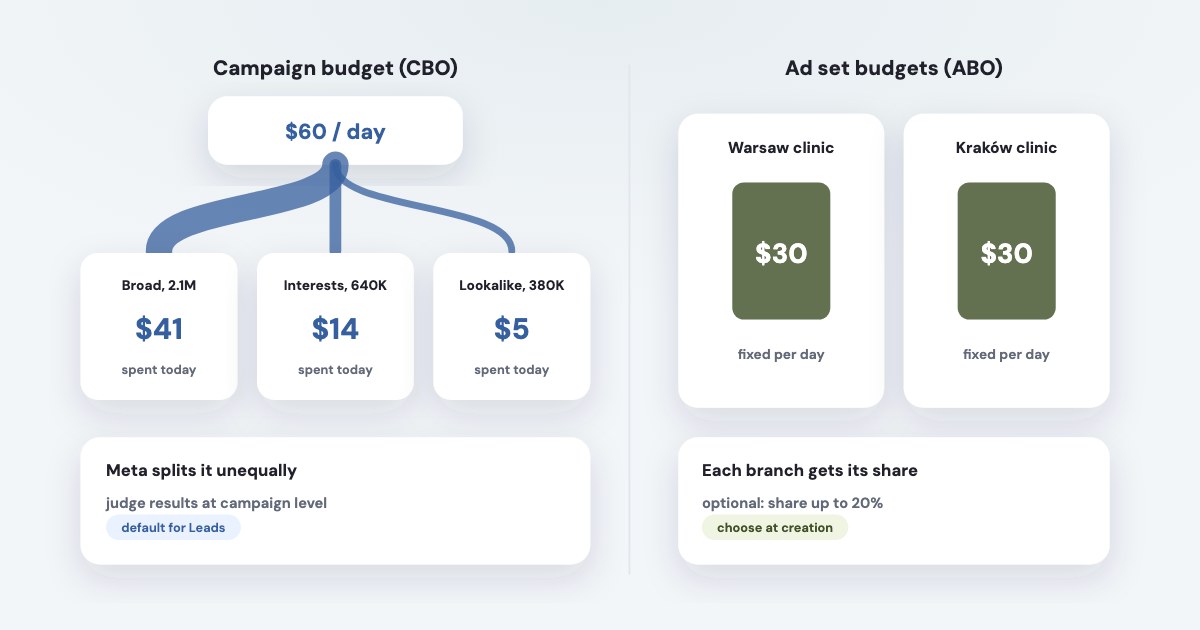
CBO (campaign budget optimisation, now Advantage+ campaign budget) puts one budget on the campaign and lets Meta move money between ad sets; ABO (ad set budget) gives each ad set its own fixed budget. For lead campaigns, the campaign budget is already on by default. Neither is proven better: Meta claims 4.6% lower cost per result for campaign budgets without showing the method, and no independent test with dates and numbers exists. With one ad set the choice barely matters. With several, use a campaign budget when you only care about total leads; use ad set budgets when each ad set must get its share — two branches, two services or a test.
On this page10 sections
What CBO and ABO mean
| CBO: Advantage+ campaign budget | ABO: ad set budget | |
|---|---|---|
| Where the budget sits | On the campaign | On each ad set |
| Who splits the money | Meta, in real time | You |
| Each ad set gets | What Meta decides, often unequal | Its own budget (optionally sharing up to 20%) |
| Good for | Total leads at the lowest average cost | A fixed share per branch, service or test |
| Default for Leads | Yes | No |
Meta renamed campaign budget optimisation to Advantage+ campaign budget; it continuously distributes in real time to ad sets with the best opportunities
(source). “ABO” is advertisers’ shorthand for an ad set budget — Meta suggests it when
You want to control the amount spent on each ad set.
(source)
For lead campaigns, CBO is already on
Sales, Leads, and App promotion campaigns will have Advantage+ campaign budget enabled by default.
If you created a Leads campaign and didn’t touch the budget section, you’re running a campaign budget. Meta tried to make it mandatory for
everyone in 2019–2020 and dropped the plan — Mandatory CBO has been scrapped for the time being.
(Search Engine Journal, April 2020)
— which is partly why the debate is still alive.
How a campaign budget spends
- Unequally, on purpose. Meta
may not spend your budget equally for each ad set
andmight spend most of your budget on one ad set if that’s how we can get the overall best results.
(source) - Often to the largest audience:
ad sets with the largest audiences will likely receive the most budget
(source). A narrow audience for your second branch may get almost nothing. - Judge it as a whole. Meta asks you to
analyze results at the campaign level, rather than at the ad set level
— an ad set with few leads may be there because Meta found cheaper ones elsewhere. - Learning is still per ad set, about 50 results a week each, and moving money between ad sets doesn’t restart it (source). More in learning limited.
- It needs at least two ad sets to matter:
Advantage+ campaign budget is best suited for campaigns with at least 2 ad sets.
(source) With one ad set, both options spend the same way.
When ad set budgets are better
- Two branches or cities. Each clinic or school location needs leads; a campaign budget may send nearly everything to the bigger city. The separate guide to campaign structure and ad sets covers setting those boundaries before choosing a budget mode.
- Two services with different value. Implants and check-ups, a course and a free webinar — the cheaper lead would win the budget.
- A client who pays for a split. Agencies often have to show that each ad set got its agreed budget.
- A test. For a fair comparison use Meta’s A/B test tool rather than either budget type — it splits the audience evenly (how). Ad set budgets are the next best thing.
The middle option: budget sharing
Since Marketing API v24.0 (October 2025), ad sets with their own budgets can
share up to 20% of your budget with other ad sets in the same campaign
. It works only with daily budgets and the same bid strategy in
every ad set, and has to be chosen when you create the campaign: Turning on ad set budget sharing midflight is currently not supported.
(source) You can turn it off later.
Ad set minimums and caps under a campaign budget
To keep a campaign budget from starving an ad set, you can set an ad set minimum or maximum. Meta’s API is honest about it:
the minimum is not a guarantee but our best effort.
(source) Jon Loomer advises against setting both at once,
since it will restrict the algorithm
(source). If you need a guaranteed share, ad set budgets are simpler.
Switching and rules: three things that catch people
- Two hours between switches.
There's a required 2 hour minimum time limit when switching Advantage+ campaign budget on or off.
(source) Make budget changes in one go. - 70 ad sets. Meta advises
Don’t exceed 70 ad sets per campaign
(source); above that you can’t turn the campaign budget off or change the bid strategy. - Cost rules stop working.
You can't create rules with cost-related conditions that turn ads or ad sets on or off or send a notification if you're using campaign budget optimization.
(source) If you rely on “pause when cost per lead is above X”, see automated rules.
Which is better? What the evidence says
Meta says its campaign budget can help you decrease CPA by an average of 4.6%
(source), but the
footnote with its method isn’t shown. Figures like “27% lower cost” that circulate in blogs have no original source we could find. Practitioners
disagree; the most common rule — ad set budgets for testing, campaign budget for scaling — has no data behind it either.
Two myths: Meta names no percentage of budget change that restarts learning — its only 20% is budget sharing — and nothing in its rules says a campaign budget needs thousands per day. For budget size, see how much to spend.
Set and check budgets in a conversation: Variafy
Variafy connects ChatGPT, Claude and other assistants to your Meta ad accounts. It can create a campaign with either budget type, set or cap an ad set’s share of a campaign budget, and show how a campaign budget actually split the money and what each ad set brought — with your CRM, which ad sets brought customers. New ad set budgets are created with budget sharing off. Its budget-split recommendation covers ad sets with their own budgets; under a campaign budget, Meta does the split.
How we checked
Checked on 17 October 2026 against Meta’s Business Help Center (Advantage+ campaign budget, its defaults and best practices, ad set budgets, learning, automated rules — read in a browser on 15–16 October), Meta for Business’s Advantage+ budget page, Meta’s Marketing API references (ad set budget sharing, ad set fields), Jon Loomer (2023, updated 2025) and Search Engine Journal (2020). We also read the pages that rank for these searches.
Variafy is our product.
Questions
What is CBO and ABO?
CBO is campaign budget optimisation, now called Advantage+ campaign budget: one budget on the campaign that Meta splits between ad sets. ABO is an ad set budget: each ad set has its own fixed budget.
Is CBO or ABO better for lead generation?
Neither is proven better. Use a campaign budget when you only care about total leads, and ad set budgets when each branch, service or test needs a guaranteed share. With one ad set it makes no difference.
Should I use CBO or ABO for testing?
For a fair test, use Meta’s A/B test tool, which splits the audience evenly. Ad set budgets come next; a campaign budget favours early leaders and the largest audience, so it isn’t a test.
Is campaign budget on by default for lead campaigns?
Yes. Meta enables Advantage+ campaign budget by default for Sales, Leads and App promotion campaigns. You can switch it off, but not more often than once every 2 hours.
What is ad set budget sharing?
An option since October 2025 that lets ad sets with their own daily budgets share up to 20% with each other. It has to be chosen when the campaign is created and can’t be turned on later.