Facebook ads for salons: from an appointment request to a visit
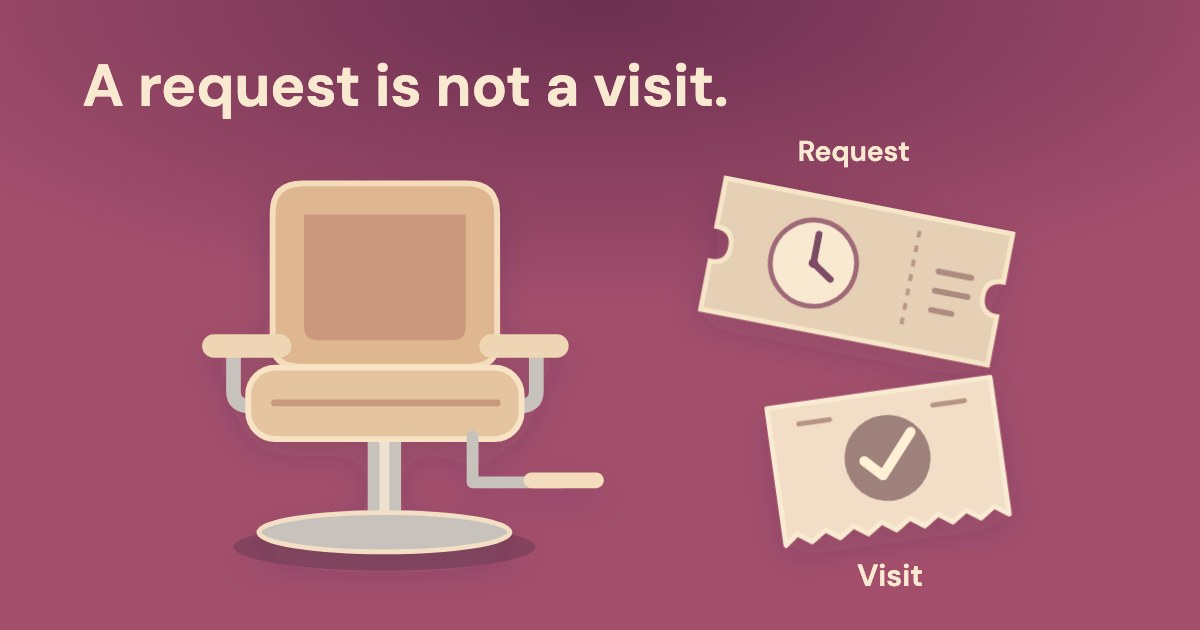
For salon Facebook ads, our suggestion is to offer a specific hair service and confirm its stylist and time before counting a booking. Track the same booking ID through a move, cancellation or visit, with payment recorded separately; an appointment request is not a reserved chair or proof of a paid visit.
On this page9 sections
What should a salon ad offer?
Our suggestion: offer an ordinary service that the named team can perform in real available slots. The invented example here is a standard haircut and finish, not medical aesthetics, treatment or hair restoration.
The fictional service costs $70 and uses a 45-minute reservation, including the salon’s allocated turnaround. Stylists A and B can deliver it. Those are invented operating assumptions, not a recommended price, duration or staffing model.
A suggested draft is: “Haircut and finish at our salon. See what the service includes and the listed price, then send an appointment request. Our team confirms the stylist and time before reserving your visit.” Use only details the actual service can deliver; this is our copy example, not a Meta-approved template.
Write down who can perform the service, which times are available, what the price covers and who confirms the appointment. A free hour with the wrong stylist or at a time the customer cannot attend is not interchangeable capacity.
Use the local-business guide for wider campaign setup. This article starts with the specific service and follows its appointment record rather than rebuilding targeting or the whole salon account.
What do Meta’s policies actually say about hair services?
The checked Health and Wellness page does not explicitly classify a haircut or colouring service. Do not transfer its wording about hair products to every hair service.
Meta’s Health and Wellness policy, checked 19 Oct 2026, says ads promoting cosmetic products, procedures or surgeries must target people aged at least 18. Its age-restriction exceptions include non-permanent cosmetic and beauty products, such as creams, make-up and hair products.
Non-permanent cosmetic and beauty products
The exception names products. It does not say whether an ordinary cut, colour or styling service is a cosmetic procedure. Our reading: neither a universal adult-only rule for all salon services nor an exemption for those services follows from that product list. Check the actual ad against the policy text.
The checked material also does not settle before-and-after imagery for an ordinary haircut or colour. This guide gives no permission or prohibition for that specific case and does not use transformation imagery as its suggested creative.
Meta’s personal-attributes policy, checked 19 Oct 2026, prohibits asserting or implying personal attributes and allows you/your without one. Our suggestion: describe the service rather than imply the reader is old or has an appearance problem. “Tired of looking old?” is our example of wording to avoid, not a Meta quote about this salon.
These are policy boundaries, not an approval decision for a particular ad. Medical cosmetic procedures and local legal conclusions are outside this ordinary hair-service example.
Does an appointment request reserve a salon slot?
Meta’s Appointment request instructions for lead ads with instant forms, checked 19 Oct 2026, describe a preferred date and time for engaging with a business. Our reading: that preference is not confirmation that a particular stylist is available or a slot has been reserved.
Our reading: it records a customer’s preference, not the salon’s calendar. The checked page limits ad delivery to the Facebook app on mobile devices, so do not assume it also runs on Instagram.
Its availability defaults to Monday–Sunday from 07:00 to 22:00, and that range cannot currently be customised.
Our suggested handover is: receive the request, check service/stylist/time fit, offer an actual slot and record the customer’s agreement. Keep it pending when the time is still being negotiated. A staff member owns the confirmation and the calendar entry.
For instant forms, the prohibited-questions page lists health, financial and other restricted information. The creation page allows up to 15 custom questions and optional questions where applicable. That is a ceiling, not a suggestion to ask fifteen.
Neither checked page approves a particular service, preferred-time or stylist question. The fields in our appointment ledger are internal operating records, not a Meta-approved questionnaire. Use the lead-form guide for the wider mechanism and check the actual proposed questions separately.
A filled appointment ledger, including a moved booking
Keep the source request and the current reservation connected without turning every calendar edit into another acquired customer. Everything below is invented: 20 unique requests on 1–7 October 2026, $600 ad spend for the offer and a cutoff of 20 October. Source keys are matched to that offer for this example only.
Eleven requests had a confirmed booking at some point, including the ones later cancelled or missed. These selected records illustrate the states within that cohort; they are not a full export of all 20 requests. Every time is salon-local, and the service in each confirmed record is the same haircut and finish.
In these fictional labels, B identifies a booking, R the original request and AD-H the ad-source key; they are not Meta object types.
| Invented service, stylist and slot record | Evidence, current state and owner | |
|---|---|---|
| B04 · R04 · AD-H1 | Stylist A; 10 Oct, 10:00–10:45. Service and slot confirmed on 7 Oct. | Visit attended on 10 Oct; a separate $70 receipt is linked. Front desk owns the attendance record; cashier owns the receipt. |
| B07 · R07 · AD-H1 | Stylist B; 12 Oct, 14:00–14:45. Confirmed service and time retained under B07. | Visit attended; payment evidence is still unconfirmed at the cutoff. Cashier checks the receipt. Missing payment evidence is not proof the customer did not pay. |
| B09 · R09 · AD-H2 | Stylist A; originally 14 Oct, 10:00–10:45; now confirmed for 22 Oct, 14:00–14:45. | One rescheduled future booking, not a second acquisition. Front desk retains the move history and current confirmation; no attended visit yet. |
| B08 · R08 · AD-H2 | Stylist B; 15 Oct, 11:00–11:45. Cancellation recorded on 13 Oct, before the planned visit. | Cancelled; that slot was released then. Retain the cancellation instead of removing the enquiry from the cohort. Front desk owns the state. |
| B11 · R11 · AD-H1 | Stylist A; 16 Oct, 15:00–15:45. Confirmed appointment, but attendance did not occur. | No-show in the invented desk record. That past reserved time is not retroactively free capacity. Front desk records any agreed next contact. |
| R17 · no booking · AD-H2 | Requested Stylist A on Saturday afternoon; no compatible slot was offered. An alternative time is awaiting the customer’s reply. | Pending request, not confirmed, cancelled or missed. Front desk owns the alternative offer and reply checkpoint. |
The move history for B09
- 12 October: the customer requests a move. Record the request under B09; do not treat the new preferred time as confirmed.
- 13 October: the desk checks Stylist A’s service availability and records agreement to 22 October, 14:00–14:45.
- At confirmation: release the 14 October reservation and reserve the new slot. Keep both events and their timestamps under B09.
- 20 October cutoff: B09 is one future confirmed booking with no attended visit. The released historical slot is not added to this week’s free capacity.
This is our proposed recording model, not a claim about automatic behaviour in Meta or a booking system. If your system creates another technical ID, retain an explicit link so the business report does not count the move twice.
How do visits, payments and available slots reconcile?
Use mutually exclusive current states as well as milestone totals. Our invented cutoff reconciles: 4 unsuitable requests + 5 awaiting a reply + 7 attended visits + 2 future confirmed bookings + 1 cancellation + 1 no-show = 20 requests.
The 11 bookings confirmed at some point are 7 attended + 2 future + 1 cancelled + 1 missed. B09 is one of the two future bookings; the other is on 23 October. Six of the seven attended visits have linked $70 receipts, so confirmed collected money is $420; the remaining visit’s payment evidence is unresolved.
The same $600 spend is $30 per request, about $54.55 per booking confirmed at some point, about $85.71 per attended visit and $100 per visit with a confirmed payment. These are our invented cohort calculations, not Meta benchmarks. They remain provisional while enquiries and future appointments are open.
The $420 receipts are not profit: stylist time, materials and other costs have not been deducted. Nor does a payment-date cash total necessarily describe the same enquiry cohort. Keep the booking/source connection where it is known; leave missing or ambiguous matches unresolved. The CRM-sales guide explains the separate matching setup.
Capacity must fit the actual service
The invented calendar initially offered 12 compatible 45-minute reservations for 20–26 October: 540 minutes, or 9 hours. The two future cohort bookings occupy 90 minutes, leaving 10 slots, or 7.5 hours. In this invented calendar, those free slots fall on Tuesday–Friday; none meets R17’s request for Saturday afternoon with Stylist A.
Our reading: open hours are not proof the current offer fits the remaining requests. Have the desk resolve the alternative times and payment evidence before the owner decides on more spend. Keep a cancellation that released a slot separate from a no-show that used up a past reservation.
For wider enquiry diagnosis, use the lead-quality guide. The next decision here belongs to a particular service, stylist and time inventory, not a universal no-show rate or cost-per-booking target.
How can Variafy help check salon advertising?
Variafy is in the free beta, with Meta support live. It can read ad spend, Meta-reported results and returned campaign, ad-set and ad settings. Ask for the dates, attribution setting, result types and completeness before comparing ads.
A suggested request is: “Show the ads for this hair-service offer and their spend and reported results for these dates. Where content is returned, show the promise and destination. State missing data and questions for the desk; do not infer confirmed bookings or visits from a Meta result.”
The product does not automatically import the stylist’s calendar, appointment confirmations, attendance, cancellations or form answers. The salon’s own record still establishes the slot and visit. It does not choose a policy classification or guarantee ad acceptance.
For payments your business sends, it can match ad-link tags and identify the money source; ambiguous or unmatched amounts stay unattributed. State whether the report uses payment dates or lead dates, and confirm that the required dates are present. A Meta-counted purchase is not a confirmed salon receipt; missing uploaded payment data does not prove zero revenue.
Our suggestion: compare the returned advertising observations with the desk’s ledger and keep the unknowns explicit. Changes to the account require human confirmation; the product does not automatically fill the calendar or change a form.
What should the salon do before asking for more bookings?
Our suggestion: resolve the specific service/time mismatch before expanding the offer. The fictional desk checks R17’s alternative, confirms the two future appointments and asks the cashier to resolve B07’s receipt evidence. The owner then checks the remaining compatible slots and actual service economics.
Copyable appointment handover
Request/source key: __. Booking ID and linked moves: __. Service/stylist/current agreed slot: __. Old slot released when: __. Current state and evidence: __. Attended date: __. Payment evidence/source: __. Next action, owner and date: __. Cohort/cutoff: __.
Do not delete the missed or cancelled records to make the rate look better, count a move as another booking, or convert an unanswered preference into a reserved chair. Update the same cohort when the future visits and open payments become known.
That gives the salon a reproducible answer to what happened after the ad: which actual appointment was agreed, whether it took place and what payment evidence exists.
How we checked
Wording checked 19 Oct 2026 against 5 public Meta documents: Health and Wellness, Privacy Violations and Personal Attributes and Add an appointment request to your lead ad with instant form.
Also checked: Questions prohibited on your instant form and Create a lead ad with instant form. The product exception does not settle the classification of ordinary hair services.
The service, staff labels, IDs, slots, amounts and outcomes are invented. The ledger and handover are our suggestions, not customer data, performance benchmarks or a policy-approval decision.
Questions
Do Facebook ads work for hair salons?
This guide does not establish a success rate. Our suggestion is to offer one service with compatible stylist/time capacity and track requests through confirmed appointments, visits and separate payment evidence. A cheap request alone does not show that a usable slot was filled.
Are hair-service ads automatically exempt from Meta’s age rule?
The checked Health and Wellness exception names non-permanent cosmetic and beauty products, including hair products. It does not explicitly classify haircut or colouring services. This guide derives neither an exemption for those services nor a blanket adult-only rule for every salon offer.
Can a salon use before-and-after haircut photos?
Meta’s Health and Wellness page lists “General cosmetic products, procedures, operations depicting before-and-after transformation” for ages 18 and over (checked 19 Oct 2026). It does not say whether ordinary haircuts or colouring fall within that category; this guide gives no approval or prohibition for those images.
Does Meta’s appointment request confirm a booking?
For lead ads with instant forms, Meta describes a preferred date and time. Our reading: a person at the salon still needs to confirm the service, stylist and slot. Adding the feature limits ad delivery to the Facebook mobile app; its default Monday–Sunday 07:00–22:00 availability cannot currently be customised.
How should I count a rescheduled appointment?
Our suggestion is to keep one booking identity, retain the move history, release the old slot at confirmation and reserve the agreed new one. Do not count it as another acquired booking. A future rescheduled appointment is not an attended visit.
What should I measure instead of cost per salon lead?
Keep cost per request, confirmed booking, attended visit and confirmed payment separate. In the invented cohort, $30 per request becomes about $85.71 per attended visit, with future bookings still open. Compare the same cohort at a stated cutoff and check service/stylist/time fit before requesting more demand.