Facebook ads targeting in 2026: what Advantage+ audience does and what you still control
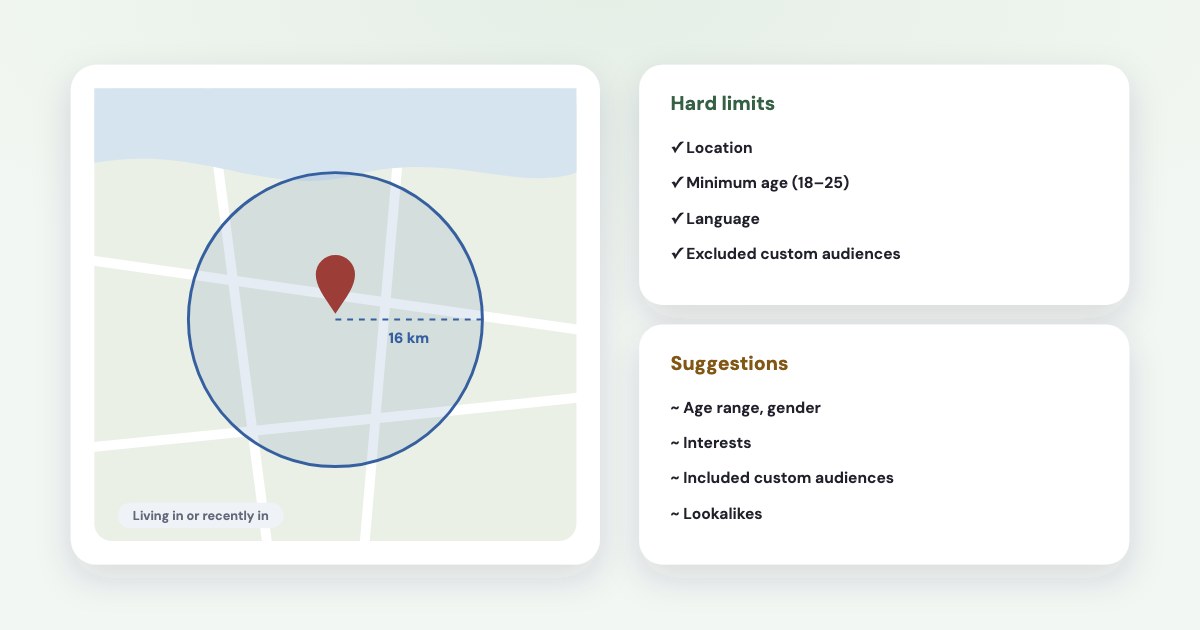
Yes, Facebook ads can target areas, ages, languages and interests — but in 2026 most of those settings are suggestions. With Advantage+ audience, on by default for new lead campaigns, Meta treats only four things as hard limits: location, a minimum age of up to 25, language and the custom audiences you exclude. Age ranges, gender, interests, your own audiences and lookalikes guide the system and can be exceeded. Location also changed: since 2023 you can no longer target only people who live somewhere — ads reach people living in or recently in the area. Set the hard limits carefully, let the rest be broad, and let lead quality in your CRM tell you whether it works.
On this page8 sections
What is a hard limit and what is a suggestion
| With Advantage+ audience | Notes | |
|---|---|---|
| Location | Hard limit | Living in or recently in the area |
| Minimum age | Hard limit — only from 18 up to 25 | A higher minimum becomes a suggestion; maximum is 65+ |
| Language | Hard limit | Useful in mixed-language countries |
| Excluded custom audiences | Hard limit | Your best tool: exclude people who already sent a form |
| Age range, gender | Suggestion | Meta may go beyond |
| Interests, behaviours | Suggestion | Many merged into groups in 2025–2026 |
| Included custom audiences, lookalikes | Suggestion | See custom audiences |
Meta’s description: the AI stays within minimum age, location, language and custom audience exclusions
(source).
Its API is specific on age: with Advantage+ audience, advertisers can pass age_min values ranging between 18 to 25 only
and the maximum is
fixed at 65 (source). Jon Loomer’s summary: audience controls are tight constraints
; age, gender,
interests and custom audiences are not (source).
It’s on by default for lead campaigns
When your leads campaign runs with Advantage+ turned on, which is the default setting in Meta Ads Manager for campaigns using the leads objective, then Advantage+ audience, placements and campaign budget are also enabled.
Since API version 23, new ad sets also default to Advantage+ audience (source). Narrowing the settings too far switches the campaign out of Advantage+ mode. Where the toggle exists, you can return to the original audience options in the ad set; where it doesn’t, turning suggestions into strict limits turns Advantage+ off.
Does it work for leads? Meta reports 9.7% lower cost per result with the Traffic, Engagement and Leads objectives
without a method
(source). In Jon Loomer’s 30-day A/B test on registrations, Advantage+ audience brought 9 more than detailed
targeting — possibly not significant — and 36 more than a lookalike (source). Some B2B advertisers report cheaper
leads but dearer qualified ones. Test with your CRM, not with cost per lead (lead quality).
Can Facebook ads target areas?
Yes — countries, regions, cities, postcodes and a radius around a point. Two things changed:
- No “people who live here only”. In 2023 Meta removed the choice between people living in, recently in and travelling in a location;
the options
have been removed, so you won't have to select a type of location targeting
(source). The API accepts only living in and recently in together (source). Guides that still tell you to pick “people traveling in” are out of date. - Radius limits. Around a city, Meta’s documentation gives 10 to 50 miles (17 to 80 km); in our tests Meta accepted 16 km and rejected 15. Around a dropped pin, from 1 km (source). Housing, employment and financial ads need a wider radius (special ad category).
Local businesses
Because “recently in” is included, a clinic or a plumber reaches some people who only passed through. Make the form do the filtering: ask for the district or postcode as a multiple-choice question, and exclude people who already became leads. A very small area also drives up frequency and cost (why).
Interests: what was removed and when
- 2022: Meta removed detailed targeting based on sensitive topics such as health conditions, politics, religion and sexual orientation.
- 2024–2025: detailed targeting exclusions disappeared from new campaigns, and delivery stopped for old campaigns using them from 31 January 2025 (coverage). Excluding custom audiences still works.
- 2025–2026:
We are combining some of the interests currently available in Detailed Targeting into relevant groupings
; campaigns created before 8 October 2025 with the old interests stopped delivering by 15 January 2026 (source).
Meta’s guidance on size is to go broad: Our ad delivery system works best when your audience size is between 2 to 10 million people.
(source) For a small local business that usually means the whole service area, no interests, and a strong offer.
Europe and special categories
- Less personalised ads in the EU. Since November 2024, people in the EU can choose ads based on a minimal set of data, such as age, location and gender. Meta doesn’t publish how many chose it; interests and retargeting can’t reach them.
- Housing, employment, financial products: age fixed at 18–65+, all genders, no postcodes or lookalikes, a wider radius — but Advantage+ audience and custom audiences remain available. Details in the special ad category guide.
Set targeting right and see where money goes: Variafy
Variafy connects ChatGPT, Claude and other assistants to your Meta ad accounts. When it creates an ad set with Advantage+ audience, it converts your age range to Meta’s rules — strict minimum up to 25, the rest as a suggestion — and tells you so. It only uses the location types Meta accepts, checks radius limits before Meta rejects them, finds interests, places and languages by name, and shows which ages and genders your money actually reaches and where results cost more. Changes are previewed and run only after you confirm.
How we checked
Checked on 17 October 2026 against Meta’s Marketing API documentation (Advantage+ audience, basic targeting, the v24 changelog), Meta for Business pages on Advantage+ audience, Advantage+ leads and ad targeting, Meta’s help page on Advantage+ audience, Social Media Today’s 2024 report on removed exclusions and Jon Loomer’s articles and tests (2023–2025). Radius limits were also checked against Meta’s API responses in our own tests in September 2026. We also read the pages that rank for these searches.
Variafy is our product.
Questions
Can Facebook ads target specific areas?
Yes: countries, regions, cities, postcodes and a radius around a city (from about 10 miles / 16–17 km) or a dropped pin (from 1 km). Since 2023 ads reach people living in or recently in the area; “living in only” and “traveling in” are no longer options.
What is Advantage+ audience?
Meta’s AI targeting that treats your audience settings as suggestions and can go beyond them. Only location, a minimum age of up to 25, language and excluded custom audiences are strict. It is on by default for new lead campaigns.
Should I turn off Advantage+ audience?
Usually not for lead campaigns: Meta reports lower costs with it, and in independent tests it matched or beat manual targeting. Keep the hard limits right, exclude past leads, and compare by leads that become customers. If your business must reach a narrow group, test both with an A/B test.
Are Facebook ads targeted?
Yes, but mostly by Meta’s system rather than by your settings. You choose the location, language, minimum age and who to exclude; Meta’s AI picks who within that sees each ad, using your other settings as hints.
Why did my interest targeting stop working?
Meta removed sensitive interests in 2022, removed interest exclusions in 2024–2025 and merged many interests into groups in 2025–2026; campaigns using the old interests stopped delivering by 15 January 2026. Re-create the ad set with current options or go broad.