Facebook custom audiences and lookalikes for a lead business: what still works in 2026
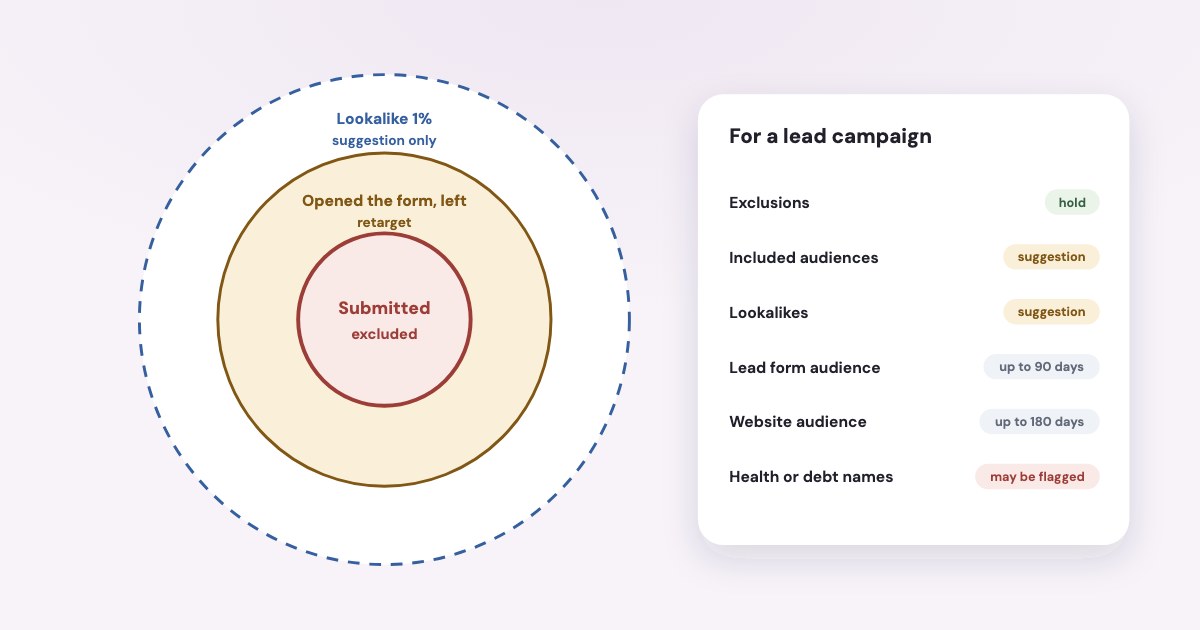
A custom audience is a list of people who already know you — website visitors, people who opened your lead form, Page and Instagram engagers, or your own customer list. A lookalike is a new audience Meta builds to resemble one of them. For lead campaigns in 2026, the most useful thing about them has changed: when you include a custom audience or a lookalike, Meta treats it as a suggestion and may show ads beyond it — but when you exclude a custom audience, that holds. So the reliable use is exclusion: stop paying to reach people who already sent a form. Clinics and lenders also need to avoid audiences that suggest health or financial status: since September 2025 Meta flags them.
On this page9 sections
Custom audience types and how long they keep people
| Who is in it | Kept for up to | |
|---|---|---|
| Website | Visitors of pages or people who fired an event such as Lead, via the pixel or Conversions API | 180 days (source) |
| Lead form | People who opened, submitted, or opened and closed your instant form | 90 days (source) |
| Facebook Page, Instagram | People who engaged with your Page or profile, messaged you, saved a post | About a year in Ads Manager |
| Video | People who watched a share of your videos | About a year in Ads Manager |
| Customer list | Your own contacts, hashed before upload | Until you update it |
The lead form audience is the one lead businesses miss. Meta splits it into three groups: All people who opened the lead generation form regardless of whether or not they submitted the form
,
people who completed the form and submitted it
, and people who close the form without submitting it
(source).
The last group is the best retargeting audience you have.
In 2026, inclusions are suggestions — exclusions are not
With Advantage+ audience, which is on by default for lead campaigns, Meta keeps only a few hard limits:
minimum age, location, language and custom audience exclusions
(source). Meta’s API puts it
this way: Non-negotiable business constraints are NOT expanded
(source). Everything you
include — a website audience, a lookalike — becomes a starting point the system can go beyond.
Lookalikes go further. Jon Loomer found that for performance goals including leads, You are unable to remove suggestions as an option when using lookalike audiences with any of these performance goals
(source). Meta’s documentation confirms the mechanism: Advantage lookalike is switched on by default for
supported objectives (source).
What independent tests found
- In a 30-day A/B test on registrations, Loomer’s lookalike ad set was
my worst performing ad set
; Advantage+ audience brought 36 more registrations than the lookalike (source). - In another of his tests, 26–35% of the budget reached “warm” people whichever way the audience was set up — retargeting happens anyway (source).
One advertiser each, not universal — but enough to stop treating a 1% lookalike as a must-have.
A setup that works for lead campaigns
- Exclude people who already converted: the lead form “submitted” audience (90 days), a website audience on the Lead event
(180 days), and for older leads a customer list from your CRM. In the API this is
excluded_custom_audiences. - Let the main campaign go broad with Advantage+ audience; add a custom audience or lookalike as a suggestion if you like.
- Re-engage people who didn’t finish: a small ad set for people who opened the form and closed it, and website visitors of key pages in the last 30 days — with a different message, such as a price or a deadline.
- Judge by leads that buy, not by cost per lead: warm audiences make cheap leads that may have bought anyway (matching sales to ads).
Lookalike audiences: the rules
- Source size:
Origin audiences must have at least 100 members
, from one country (source). A source built on campaign conversions needs at least 100 unique conversions. - Size: Ads Manager offers 1–10% of a country; the API accepts up to 20%. Smaller is closer to the source.
- Timing:
Lookalike audiences can take 1-6 hours to fully populate
, and Meta refreshes members every 3 days while the lookalike is used in an ad set. - Best source for leads: people who became customers, not everyone who left a form — otherwise Meta looks for more form-fillers.
- Not available for housing, employment and financial products and services ads (source) — see the special ad category.
Clinics, lenders and law firms: flagged audiences
any custom audience or custom conversions suggesting specific health conditions (e.g., “arthritis”, “diabetes”) or financial status (e.g., “credit score”, “high income”) will be flagged and prevented from being used to run ad campaigns.
The restrictions started rolling out on 2 September 2025. Since 6 January 2026, Creating and updating lookalike audiences using flagged seed audiences will fail.
(source) Meta doesn’t publish how it decides, so be careful with what an audience
says about people: one called “Diabetes patients” or built on /debt-relief/ pages is asking to be flagged. Name and build audiences
by service or action instead (“Booked consultation — 90 days”).
Customer lists and privacy
Under Meta’s Custom Audience terms (in force since 3 December 2025), contact data is hashed before you upload and pass it to Meta
,
you confirm you have all necessary rights and permissions and a lawful basis to disclose and use the Audience
, and Meta
will delete the Customer List Data after the match process is complete
(source). In the EU, Meta acts
as your processor; the legal basis is yours. For a clinic, a patient list is health data under the GDPR — check consent before uploading.
Build and check audiences in a conversation: Variafy
Variafy connects ChatGPT, Claude and other assistants to your Meta ad accounts. Ask it to create a website audience (by URL or event such as Lead), a Page or Instagram engagement audience, or a lookalike, and to exclude an audience from an ad set — each change previewed before it runs. It lists your audiences with their size and whether they’re still usable, so flagged ones show up, and tells you which ad sets use each. When you include your own audiences, it keeps them as the audience rather than a suggestion. It doesn’t upload customer lists or create lead form and video audiences — make those in Ads Manager.
How we checked
Checked on 17 October 2026 against Meta’s Marketing API documentation (engagement, website and lookalike audiences, Advantage+ audience, special ad categories, the v24 changelog), Meta for Business’s Advantage+ audience page, Meta’s Custom Audience terms and its October 2025 developer post on flagged audiences, plus three tests by Jon Loomer (2024–2025). Retention in Ads Manager for Page, Instagram and video audiences is taken from the interface as commonly documented; the API allows longer. We also read the pages that rank for these searches.
Variafy is our product.
Questions
What is a custom audience on Facebook?
A group of people who already interacted with your business — website visitors, people who opened or submitted your lead form, Page or Instagram engagers, video viewers, or contacts from your customer list — that you can include in or exclude from ads.
Do lookalike audiences still work in 2026?
They work as a suggestion. With performance goals like leads, Meta can show ads beyond the lookalike and you can’t turn that off. In Jon Loomer’s 2024 test, the lookalike ad set lost to Advantage+ audience. Test it rather than assume it helps.
What is Facebook retargeting for a lead business?
Showing ads to people who already showed interest — website visitors, people who opened your lead form but didn’t submit it — usually with a different message. The more reliable part is excluding people who already submitted, so you stop paying for them.
How big does a lookalike source audience need to be?
At least 100 people from one country, or at least 100 unique conversions for a source based on campaign conversions. A source of customers works better than a source of all leads.
Why can’t I use my custom audience in a campaign?
Since September 2025 Meta flags custom audiences that suggest health conditions or financial status and blocks them from new campaigns; lookalikes from flagged sources fail since January 2026. Housing, employment and financial ads also can’t use lookalikes.