Boosted posts vs Facebook ads: which should a small business use?
A boosted post is a paid ad created from published content. Ads Manager gives you more control over the campaign and the result you ask Meta to pursue. Choose a boost when distributing the post is the task; choose a campaign built around leads or sales when enquiries, bookings or purchases are the task. Judge either route against that task, rather than the number of likes.
On this page11 sections
What question should decide it?
For a local service business, the useful question is: “What do we want someone to do after seeing this, and can we measure whether they did it?” A popular post and an effective customer-acquisition campaign can be different things.
What is the difference between a boosted post and an ad?
Meta describes a boost as an ad made from existing content, including a post, Story or Reel. Its setup offers a shorter set of choices; Ads Manager provides more campaign, creative and targeting controls, including Leads and Sales objectives. Both spend advertising money: Meta says a boosted post is still an ad, because it needs a budget, and it appears as an ad on your bill. Its page lists website clicks, Page engagement and local promotions as boost goals, with fewer targeting options than a campaign built in Ads Manager. Meta’s comparison explains the distinction.
| Question | Boosted post | Campaign in Ads Manager |
|---|---|---|
| Where do you start? | Existing published content | A campaign objective and ad setup |
| What controls do you get? | A simplified set | More campaign and ad controls |
| What should you check first? | Whether the available goal fits the task | Objective, conversion location and performance goal |
| What makes it successful? | The outcome you chose to buy | The outcome you chose to buy |
Available options vary with the content, account and setup. Check the actual goal shown before paying. A tutorial’s old screenshot is a poor basis for assuming that your account offers exactly the same options.
Neither route creates a measurement plan for you. If your real goal is a paid consultation, a report of reactions alone cannot establish whether the promotion worked.
When does boosting a post make sense?
A boost can be a practical, bounded distribution task. Examples include showing a local event announcement to more nearby people, distributing a useful demonstration, or promoting a published community update.
Write down what the exposure is supposed to achieve. For an event, that might be visits to a registration page and completed registrations. For a demonstration, it might be relevant video engagement, with a separate later test of enquiries. These are different evaluation plans.
Our suggested brief is one sentence: “Spend up to $120 distributing this workshop announcement to the intended local audience; review registrations and actual attendance, while reporting reach and engagement separately.”
The amount is an illustration, not a recommended budget. Put your own ceiling and business outcome in the sentence. Include the people responsible for handling messages or registrations. A paid announcement can generate enquiries at a time when nobody is available to answer them.
If the only aim is distributing useful content, do not invent sales attribution to justify it afterward. An awareness task can be deliberate and worthwhile without being described as proven customer acquisition.
When should you use Ads Manager instead?
Start with Ads Manager when you need a defined acquisition workflow: a lead form, a website enquiry, a purchase journey, or controlled campaign comparisons. Work through four decisions before choosing the creative:
- Business outcome: a qualified enquiry, attended appointment or first purchase.
- Place where the action happens: website, instant form, messaging or another supported destination.
- Signal used to evaluate delivery: check the actual objective and performance goal in the account.
- Outcome recorded by the business: whether the enquiry was relevant and ultimately became a customer.
For the second and third decisions, use our lead-form guide and lead-campaign performance-goal guide. They cover the setup choices in detail.
Do not select an engagement goal simply because engagement is easy to obtain, then decide that the campaign failed because it did not produce enough customers. The purchase decision and the delivery signal need a clear relationship.
Ads Manager also does not guarantee better customers. A poorly defined offer, broken form or unstaffed sales queue can waste the benefit of additional controls.
Can you use an existing post in Ads Manager?
Yes, where the post is compatible with the intended setup. Meta documents Use existing post under Ad setup and Select post under Ad creative for Facebook Page posts. It also documents compatibility limitations; an existing call to action can conflict with the proposed ad’s goal. See Meta’s existing-post instructions.
This matters if the published demonstration or testimonial is the asset you want to advertise. Choosing Ads Manager does not automatically mean making a completely new public post.
However, do not assume that every reaction, comment or cross-platform engagement total will behave identically after a change. For platform-specific instructions and the difference between a post ID and an ad ID, use our existing-post guide.
Keep the content decision separate from the campaign decision. “This is a good post” does not settle which outcome to optimise for, which audience to reach or which budget to authorise.
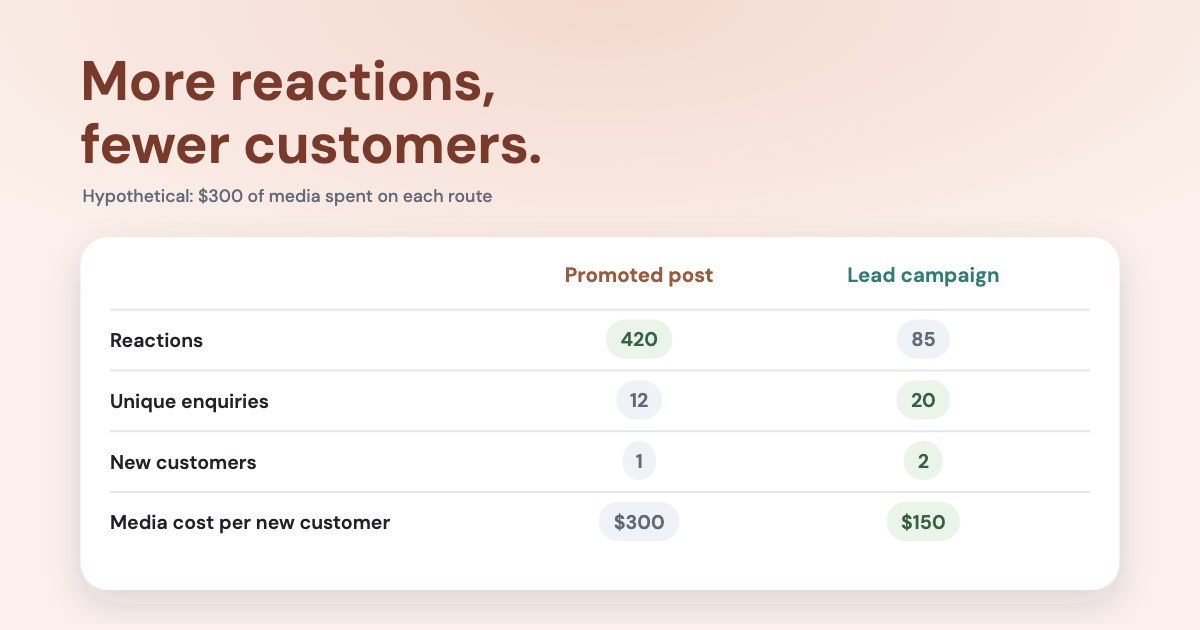
A worked example: more reactions, fewer customers
The following is a fictional service-business comparison. These are two observed cohorts, not a randomised experiment or evidence that one creation route always wins. Both have had the same time to produce sales, and costs below include media only.
| Metric | Promoted post | Lead campaign |
|---|---|---|
| Ad spend | $300 | $300 |
| Post reactions | 420 | 85 |
| Unique enquiries recorded by the business | 12 | 20 |
| Qualified enquiries | 3 | 8 |
| New paying customers | 1 | 2 |
| Media cost per enquiry | $25 | $15 |
| Media cost per qualified enquiry | $100 | $37.50 |
| Media cost per new customer | $300 | $150 |
The promoted post has more reactions. The lead campaign has better acquisition figures in this example. Neither observation tells us why: the audience, offer, creative, timing and delivery settings might differ.
Now suppose the post was announcing a community event rather than selling appointments. A new-customer comparison could be the wrong evaluation. Review registrations and attendance instead. The metric follows the business task.
For either route, avoid dividing media spend by every message notification. One person can send several messages. Decide whether your denominator is unique enquiries, qualified people or individual messages, and label it accurately.
How to compare the two routes fairly
Before moving money, check whether the comparison has the same offer, geography, duration and outcome definition. Record each difference you cannot control.
A useful report has three separate layers:
- Distribution: spend, reach, impressions and frequency.
- Response: the chosen platform result, website actions or unique enquiries.
- Business outcome: qualified enquiries, appointments and new paying customers from those enquiries.
Do not combine the layers into a single score. A reaction and a paid booking are different events. Also keep new customers separate from returning customers and existing open opportunities.
Let outcomes mature. A campaign that began yesterday cannot fairly be judged against last month’s completed sales cohort. If the buying cycle is long, report “outcome pending” and an agreed review date. Use the same follow-up standard for both routes; otherwise the comparison may mostly measure which leads received attention.
If you want to test a change, define the budget ceiling, outcome, observation window and decision rule first. A small sequential test is useful for learning, but differences in timing or audience prevent treating it as a clean causal experiment.
A practical plan for a business already boosting posts
You do not need to rebuild every promotion at once. Start with one campaign whose business goal is clear.
- List current promotions and their actual goals, destinations, budgets and end dates.
- Identify one offer with a measurable next step, such as a consultation request.
- Confirm that the destination works on a phone and that enquiries reach the responsible person.
- Define what counts as qualified and how the first payment will be recorded.
- Prepare the appropriate campaign setup and a spending ceiling for review.
- Compare mature outcomes with the earlier promotion, documenting other differences.
If a boost is still spending, account for that spend while planning the new campaign. An unrecorded overlap can turn a $300 comparison into a larger, confusing test. Check active campaigns rather than relying on someone’s memory of what was stopped.
Download the promotion comparison example and the promotion planning brief. Replace the fictional values with consistent business records; keep sensitive customer details out of shared working copies.
Review the account before spending more
With Variafy, you can ask your connected assistant to review Meta campaign settings and reported results. Supply the promotion history and business outcomes needed for the comparison; do not assume the tool can reconstruct which button someone originally clicked.
Review the selected campaigns for the same period. Show their objectives, available delivery settings, spend and reported results. Keep reactions, enquiries and new customers separate. List missing business data and prepare a comparison before proposing changes.
Variafy is available through its beta programme. Start with reading and analysis; any proposed Meta changes should follow the workspace’s configured approval process. If you already have access, follow the Meta connection guide.
How we checked
Questions
Are boosted posts a waste of money?
They can be useful for a deliberate distribution task. They become difficult to justify when the business buys one outcome and judges another, or has no plan for measuring the intended result.
Are boosted posts always cheaper than Facebook ads?
A lower cost per reaction does not establish a lower cost per customer. Compare the same outcome and cost scope. Include agency, creative and sales costs separately when evaluating CAC versus CPA.
Should I delete a successful post and recreate it as an ad?
First check whether the existing post is compatible with the intended ad setup. There is no need to assume deletion is part of switching campaign workflows.
Can I boost first and build a lead campaign later?
Yes, as a sequence of separate decisions. Treat engagement as information about the post; it does not prove that a later campaign will acquire customers profitably.