First-touch vs last-touch attribution: what changes, what stays unknown
First-touch attribution assigns conversion credit to the first eligible recorded interaction; last-touch attribution assigns it to the last eligible interaction before the outcome. They can give different channels credit for the same customer. Neither establishes how many sales the marketing caused. Choose the model for the reporting question, and state which interactions, identities and time window it can actually observe.
On this page12 sections
Which question should the model answer?
For a business selling after an enquiry, the useful question is often whether you want to understand the recorded acquisition source or the final recorded step before payment. One answer should not quietly replace the other.
First touch versus last touch at a glance
| Question | First-touch model | Last-touch model |
|---|---|---|
| Who receives all credit? | First eligible interaction in the recorded path | Last eligible interaction before the outcome |
| What does it highlight? | The recorded starting point under the rules | The recorded final step under the rules |
| What gets no credit? | Later interactions | Earlier interactions |
| What must be specified? | Path start, eligibility, identity and window | Eligibility, direct-traffic handling, identity and window |
| Does it prove causal contribution? | No | No |
Attribution is credit assignment. A discovery source and a closing source may both be useful observations, but calling them “first” and “last” does not make every important interaction observable.
Keep touch, lead and customer distinct. A person can visit several times before becoming a lead, and several leads or contacts can relate to one company purchase. A CRM’s first lead-source field may start later than the person’s first interaction with the business.
A worked example using the same five customers
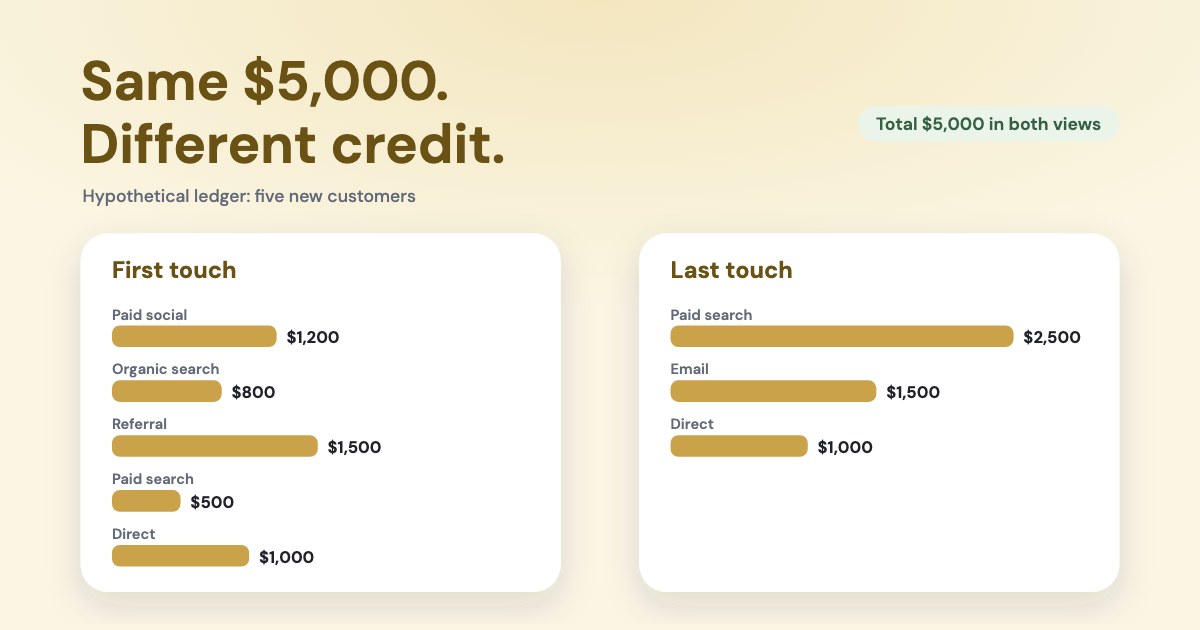
This fictional ledger assumes the listed paths are fully observed within the example’s window, each sale represents one new customer and revenue uses the same definition. Its last-touch rule includes direct visits. It is a simple illustration, not a reproduction of GA4 or either ad platform’s attribution system.
| New customer | Revenue | Recorded path before purchase |
|---|---|---|
| C101 | $1,200 | Paid social → organic search → paid search |
| C102 | $800 | Organic search → paid search |
| C103 | $1,500 | Referral → email |
| C104 | $500 | Paid search |
| C105 | $1,000 | Direct |
The business has five new customers and $5,000 of revenue in both models. Credit changes:
| Credited source | First-touch revenue | Last-touch revenue |
|---|---|---|
| Paid social | $1,200 | $0 |
| Organic search | $800 | $0 |
| Referral | $1,500 | $0 |
| Paid search | $500 | $2,500 |
| $0 | $1,500 | |
| Direct | $1,000 | $1,000 |
| Total | $5,000 | $5,000 |
Paid search receives five times as much credited revenue under last touch: $2,500 versus $500. There are no additional sales. The model moved credit among the same outcomes.
You also cannot conclude that paid social and organic search created no value because they receive zero last-touch credit. Equally, first-touch credit is not proof that those channels caused all the later revenue.
Do not add the two $5,000 totals. They are alternative allocations of one revenue ledger.
Direct traffic needs an explicit rule
“Last touch” and “last non-direct touch” can produce different answers. If someone arrives through paid social and later returns directly before buying, a simple last-touch rule that includes direct assigns the sale to Direct. A rule excluding direct might assign it to the earlier eligible source.
Neither label tells you what your system actually does. Write down the eligibility rule and inspect an example path.
Direct traffic is also not proof that no marketing preceded it. An earlier interaction may be unrecorded, on another device, outside the window or impossible to join to the customer. Do not invent a source for that missing history.
For the direct-only customer in the example, the table reports the recorded evidence. If an earlier touch later becomes available, the classification may change under the chosen policy. Keep an audit trail rather than silently rewriting the original report.
Is GA4's First user source a first-touch attribution model?
It is a user-acquisition dimension, not a universal replacement for an event-level first-touch revenue model. Google’s User acquisition report describes how new users were initially acquired, while Traffic acquisition describes where sessions came from.
That scope distinction matters. A first-user source, a current session source and the attribution assigned to a key event answer different questions. They may use different periods and entities even when the channel names look identical.
Also avoid obsolete setup instructions. Google Analytics no longer offers first click, linear, time decay and position-based reporting models as of November 2023. Google’s attribution settings documentation states the change.
Google Ads also no longer supports those retired models; its documentation describes data-driven and last-click options. See the current Google Ads model guide.
You can still construct a clearly defined first-touch view from an appropriate business dataset. Do not describe that spreadsheet or CRM view as a setting that readers can simply select in the current Google interface.
First-touch acquisition and last-touch sales can use different clocks
A lead acquired in September may pay in October. A report grouped by first acquisition date and a report grouped by payment date do not contain the same cohort automatically.
Before comparing models, freeze the outcome ledger: the same customers, revenue basis, currencies and observation cutoff. Then apply both credit rules to that same set. Otherwise the difference may reflect which customers were included, not just the model.
Keep received payments, signed contract value and predicted conversion value separate. A four-instalment customer should not become four newly acquired customers because four payment events arrived.
For detailed cohort timing, see conversion lag. For the economic inputs behind a credited return, see ROI versus ROAS.
Which model should you use?
Start with the decision rather than choosing the model that gives a preferred channel the largest result.
Recorded acquisition: a first-touch view can help identify where observed journeys began. It requires a trustworthy path start and should distinguish new customers from existing customers returning through another channel.
Recorded final step: a last-touch view can help inspect the interactions immediately before the measured outcome. It can be useful for diagnosing the closing journey, but it can concentrate credit on brand search, email or direct returns.
Budget changes: use either view as descriptive evidence, alongside acquisition cost, customer value, capacity and uncertainty. Deciding what would happen without a channel requires causal evidence beyond its attribution credit.
Team reporting: it can be reasonable to show both views, with one agreed definition for the main financial report. Two labelled views are easier to interpret than a model that changes whenever performance looks disappointing.
Our brand/non-brand guide explains why an efficient closing channel does not automatically deserve every additional budget dollar.
How to build a comparison you can audit
Download the five-customer attribution example and model policy template.
Use this sequence:
- Define the outcome and the unique business ID that prevents counting it twice.
- Freeze the customer cohort, revenue basis, currency and cutoff.
- State which interactions are eligible and how identity joins are supported.
- State the lookback rule and treatment of direct traffic.
- Preserve unknown or incomplete paths instead of assigning them by guesswork.
- Apply both rules to the same ledger and reconcile each total to the business total.
- Record model and data changes so the next report can explain revisions.
If multiple contacts represent one company sale, decide how their paths relate before assigning credit. If that relationship is unknown, keep an account-level unresolved group rather than declaring the first person in the export the acquisition source.
Aggregate channel totals cannot reconstruct individual paths. You cannot work backward from “20 Meta conversions” and “15 Google conversions” to identify the first and last touch of each buyer. Our double-counting guide covers the related overlap problem.
What about data-driven attribution?
A data-driven model uses a different credit-assignment method rather than giving everything to one endpoint. That may answer the platform’s reporting question better, but it does not make missing history disappear or turn attributed revenue into measured incremental revenue.
Compare models only with their documented eligible data and conversion definitions. A paid-only model and an all-channel business model can disagree because their input universes differ, not because one team made an arithmetic error.
If the business lacks reliable identities or stage history, improving the evidence can matter more than selecting a more elaborate allocation rule.
Compare the evidence with Variafy
Variafy can help read supported advertising and Analytics reports. A customer-level first/last-touch comparison requires the underlying journey records and identity mapping; the connector does not reconstruct an unobserved history from aggregate totals.
Using the customer ledger and journey records I provide, compare these two explicit attribution rules. Keep the same outcome total and cutoff, show unknown paths and explain which changes are credit allocation rather than additional sales. Use connected account reports only for the fields they actually contain.
If invited, use the Google Analytics connection guide. Start with reading and reconciliation before proposing any account-setting change.
How we checked
Questions
Is first touch best for awareness and last touch best for sales?
They highlight different recorded parts of the journey. Neither directly measures all awareness created or all sales caused. Describe the reporting purpose more precisely than “best”.
Does changing attribution change actual revenue?
The allocation alone does not create revenue. Changing an optimisation setting can affect future delivery and therefore future outcomes; treat that as a separate operational change, not merely a reporting relabel.
Can a customer have a different first-touch source in the CRM and GA4?
Yes, if their entities, path start, available history or identity rules differ. Reconcile those definitions before choosing which result to use.