Brand vs non-brand Google Ads: separate the results before changing the budget
Branded search includes queries about a named brand; non-brand search includes generic product or service demand. For your own Google Ads report, separate your own brand from generic queries and competitor brands. Compare cost, useful leads and new customers within each group. A low own-brand CPA can reflect existing demand and does not, by itself, measure additional customers caused by advertising.
On this page12 sections
Which question are you answering?
This distinction helps answer two questions: “Where are reported results coming from?” and “What would happen if we changed the spend?” The first is a reporting task. The second needs stronger evidence than an attribution total.
What counts as a branded search?
Use a classification written for your business. A competitor’s brand is branded language, but it is not your own-brand demand. A manufacturer name may be a product category you resell, rather than your business identity.
The examples below use a fictional clinic named Northstar Dental. They are classification examples, not keywords recommended for a real account.
| Search query | Suggested group | Reason |
|---|---|---|
| northstar dental appointment | Own brand | Names the clinic |
| northstar dental reviews | Own brand | Names the clinic, with research intent |
| emergency dentist near me | Generic non-brand | Describes the service without naming a provider |
| competitor clinic appointment | Competitor brand | Names another provider |
| northstar insurance dental cover | Ambiguous | Could refer to a different organisation |
| clinic login | Unclear | Identity and intended action need more context |
Maintain a dictionary of your trading names, meaningful variants and product names. Review ambiguous terms manually. A substring rule can misclassify an ordinary word shared with a brand, while a narrow exact-name rule can miss variants.
Classify query identity and intent separately. “Own brand, customer-support intent” and “own brand, new appointment intent” may need different review even though both mention the business.
Use actual search terms, not just campaign names
A campaign called “Non-brand” is a label, not proof that every query was generic. Likewise, a keyword without the brand name can match a branded search under the applicable targeting rules.
Review the actual visible queries with campaign context and consistent dates. Google distinguishes the user’s search term from the advertiser’s keyword. It also omits some low-activity queries from the search terms report for privacy. Google’s search terms documentation explains both points.
That means the visible query split may not cover every dollar or conversion. Add a reconciliation line. For example, if the selected campaign scope spent $5,000 and the exported visible-query rows total $4,250, $750, or 15%, is outside those rows. Investigate the scope and reporting differences; do not automatically label the remainder generic.
Keep separate groups for own brand, generic, competitor brand, ambiguous visible queries and the unreconciled remainder. They need not all appear in the ad platform as campaign types; they can be report categories.
Our search-terms guide covers the report and negative-keyword workflow in detail.
Why does branded traffic often look efficient?
Someone searching for the business by name may already know it from a recommendation, an earlier visit, an offline interaction or another campaign. The branded search can be the final measurable step of a longer decision.
That is a reason to investigate the lower-funnel context, not a reason to discard the conversion. The ad may still help someone reach the right offer or complete an action. It also does not follow that every own-brand search would have become an organic sale without advertising.
Separate what the report says from the explanation:
- Observation: a named campaign received attributed conversions at a stated cost.
- Hypothesis: some people had existing intent before that ad interaction.
- Causal question: how many useful outcomes would disappear if the advertising changed?
Platform attribution addresses the observed credit under its rules. It does not answer the causal question on its own. For overlap between Google and Meta claims, use the cross-platform reconciliation guide.
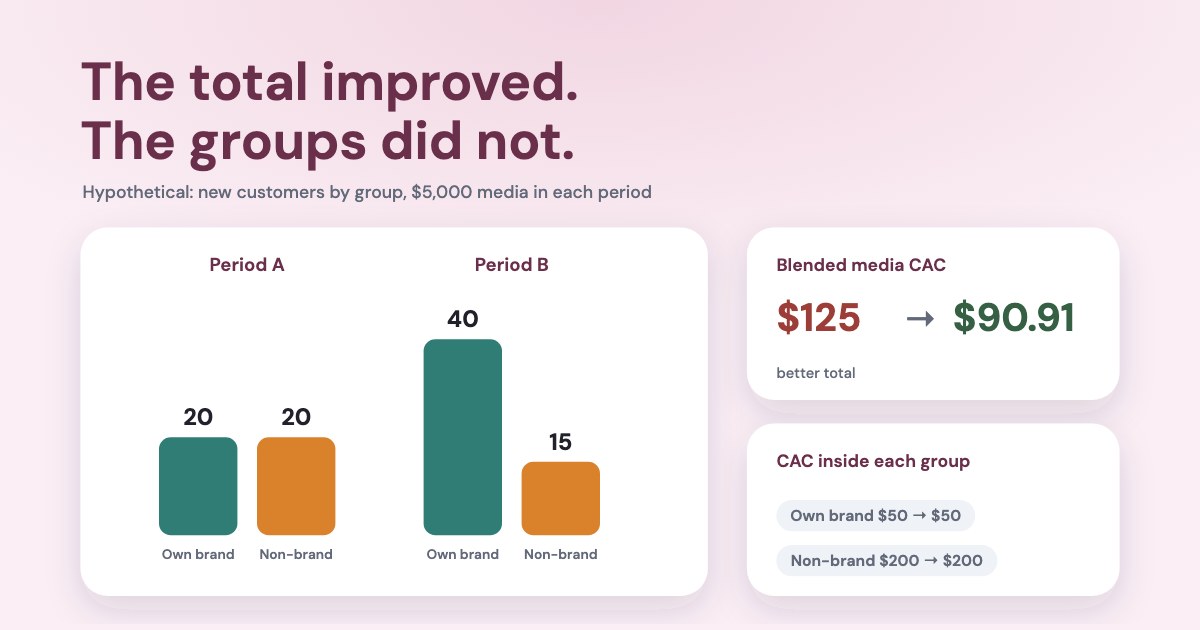
Example: blended CAC improves while non-brand customer volume falls
This is a fictional comparison of two equally mature periods with consistent new-customer definitions. Media costs exclude agency and sales work. Customer counts are deduplicated within the stated report; an attribution rule assigns each customer to one group.
| Metric | Period A | Period B |
|---|---|---|
| Own-brand spend | $1,000 | $2,000 |
| Own-brand new customers | 20 | 40 |
| Own-brand media CAC | $50 | $50 |
| Non-brand spend | $4,000 | $3,000 |
| Non-brand new customers | 20 | 15 |
| Non-brand media CAC | $200 | $200 |
| Total spend | $5,000 | $5,000 |
| Total new customers | 40 | 55 |
| Blended media CAC | $125 | $90.91 |
Blended media CAC improves, but neither group’s unit cost changes. Non-brand new-customer volume falls from 20 to 15. A different mix produces the better total.
The table does not show whether branded advertising caused the extra own-brand outcomes. Branded demand may have changed for other reasons. It also does not show that more own-brand spend can keep producing customers at $50 indefinitely.
The practical response is to report both groups and investigate demand, rather than call the total proof that prospecting became more efficient. Compare CAC and CPA definitions before copying the platform’s conversion cost into this business-customer table.
Should brand and non-brand have separate campaigns?
Separate campaigns can make reporting, budgets and responsibility easier to inspect. They are an operational choice, not a universal performance guarantee.
Start with the reporting problem. If the business cannot tell whether its own name is dominating a campaign, establish the query mix before rebuilding the account. Then decide whether separate budgets, different objectives or different landing pages require a structural change.
A useful review considers:
- How much own-brand and generic demand the campaign currently captures.
- Whether query classification is reliable enough for the decision.
- Whether separate budgets would improve control at the account’s volume.
- What will change in targeting, bidding or measurement at the same time.
- Who will review the effect and when outcomes will be mature enough to assess.
Changing the campaign name alone does not separate delivery. Conversely, a report can separate observed query groups without claiming that the campaigns already enforce that boundary.
Brand inclusions, exclusions and negative keywords are different controls
Google documents brand inclusions for Search and brand exclusions for Search and Performance Max. Brand lists identify brands rather than simply matching literal keyword text. Read Google’s brand-settings overview.
The detailed exclusion instructions, checked on 26 October 2026, list Search, Shopping and YouTube search inventory for Performance Max, with an option to retain Shopping ads on excluded-brand searches. The overview gives a shorter Search-and-Shopping description. Use the detailed instructions and verify your setup; YouTube search does not mean all YouTube placements or all Performance Max inventory.
| Control | Documented purpose | Decision to verify |
|---|---|---|
| Brand inclusion | Restrict Search traffic to selected brands | Is that the campaign’s intended demand? |
| Brand exclusion | Avoid selected branded queries in the applicable inventory | Should another campaign serve that demand? |
| Negative keyword | Exclude terms under negative matching and scope rules | Could the chosen scope suppress useful traffic elsewhere? |
Google’s Search inclusion instructions describe the transition into AI Max settings and a legacy-setting path. Check the actual campaign rather than assuming one interface route applies to every account. Google’s overview adds that when a campaign has both a brand inclusion and an exclusion, the exclusion takes priority.
For implementation details, use Google’s current exclusion instructions. Do not apply an account-wide exclusion merely to clean up one campaign’s report. Confirm the desired coverage and the other campaigns affected before saving a change.
Treat controls and classification separately. A brand list used for delivery is not necessarily identical to your manual reporting dictionary. Verify observed queries after a change and retain ambiguous or hidden coverage as a limitation.
Should you stop bidding on your own brand?
A high attributed return is insufficient reason to keep every brand dollar; the possibility of organic substitution is insufficient reason to stop every brand campaign. Make the decision around your specific demand, customer journey and evidence.
Start with a bounded diagnostic: query intent, search coverage, customer type, organic visibility, conversion quality and the business cost of lost enquiries. Identify where data is unavailable. Organic clicks alone do not reveal how many paying customers would be recovered.
If the stakes justify an incrementality study, write the design before changing spend. A defensible design needs a comparison group or other justified counterfactual, enough volume, a fixed outcome definition and control of important simultaneous changes. Randomised or carefully designed geographic comparisons may help where feasible, but require checks for spillover, comparability and statistical power.
Simply switching a campaign off for a week and comparing with the prior week can be affected by weekday mix, seasonality, competitor activity and other marketing. It can provide observations, but should not be presented as conclusive causal proof.
Protect the business with a documented exposure limit and recovery plan. A test ending without enough evidence is an inconclusive test; do not manufacture a confident lift estimate from small counts.
A weekly brand-demand review
Use a short repeatable report:
- Same date range, time zone, conversion definitions and cohort age.
- Spend and reported conversions by campaign, with query coverage reconciled.
- Own brand, generic, competitor and ambiguous query groups.
- New customers and returning customers, where business records support the distinction.
- Qualification and revenue outcomes with the matching rule stated.
- Changes in offers, availability, other campaigns and measurement.
- One proposed investigation, with an owner and review date.
Download the brand-query classification example, brand/non-brand mix example and review brief. Do not assume that a spreadsheet label changes campaign targeting.
Prepare the comparison in Variafy
Variafy’s Google Ads tools can help your assistant read campaigns, reported performance and available search-term data. Provide the brand dictionary and any customer records needed for the business analysis. Do not assume the tools can expose hidden queries, reconstruct a new-customer identity or prove incrementality.
The current search-term tool does not return Performance Max search terms. Use Google’s applicable reporting for that part of the review, and keep product coverage separate from what the platform itself can report.
Review the selected Google Ads campaigns and available search terms. Using my brand dictionary, separate own brand, generic, competitor and ambiguous demand. Reconcile visible-query spend with campaign totals. Keep platform conversions separate from my customer counts and propose one investigation before any budget change.
Google Ads in Variafy is read-only and available after a beta invitation. If you already have access, use the Google Ads connection guide.
How we checked
Questions
Are competitor keywords non-brand?
They are not your own brand, but they contain a brand. Give competitor queries a separate group so “non-brand prospecting” does not hide their distinct economics and intent.
Does a brand campaign prove the customer was already going to buy?
No. A brand query indicates an association with the brand; it does not reveal the outcome in a world without the ad.
Does an exclusion remove every branded impression from Performance Max?
Do not assume that. Google’s documented brand-exclusion scope is specific to inventory. Check the linked instructions and the campaign’s actual setup.