Should you use broad match for lead generation?
Broad match lets a Google Search keyword reach related searches, including some without its direct meaning. Our suggestion for lead generation: consider it with conversion-based Smart Bidding and a clear enquiry-quality rule. A lower cost per recorded conversion alone does not settle the decision.
On this page9 sections
What is broad match, compared with phrase and exact?
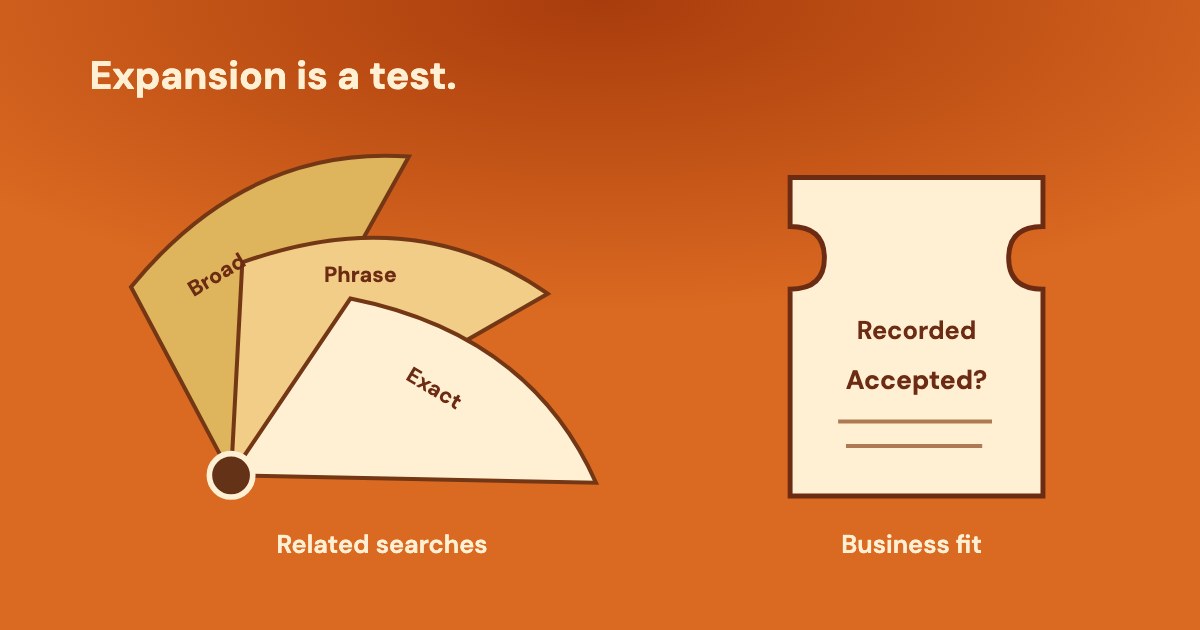
Google’s keyword-matching definitions describe possible eligibility for a search, rather than a guarantee that an ad will appear. The distinction is semantic: broad can go beyond the direct meaning of the keyword; phrase retains its meaning; exact covers the same meaning or intent.
| Google’s matching scope | What that means for a lead campaign | |
|---|---|---|
| Broad · boiler repair | Related searches, potentially without the keyword’s direct meaning. Plain keyword text is broad-match syntax. | Potentially more ways to reach demand; suitability still needs evidence from the business. |
| Phrase · "boiler repair" | Searches include the keyword’s meaning, which can be implied or more specific. | A meaning boundary, rather than a promise that the literal words appear together. |
| Exact · [boiler repair] | Searches have the same meaning or intent as the keyword. | A narrower meaning boundary, rather than an identical-spelling-only rule. |
Google identifies broad as the default match type. Our reading: this describes the default assignment when another match type is not specified; it does not say an existing phrase or exact keyword is automatically converted.
Our suggestion: choose the boundary you can evaluate. A business that cannot yet distinguish a useful enquiry from an irrelevant submission has a measurement problem before it has a convincing reason to expand matching. A narrower keyword list also does not, by itself, establish that the resulting enquiries are suitable.
Should you use broad match with Smart Bidding?
It’s critical to use Smart Bidding with broad match.
Google recommends Smart Bidding with all match types and says broad pairs particularly well with it. Its Smart Bidding explanation describes auction-time optimisation for conversions or conversion value, including Maximize conversions, Maximize conversion value, Target CPA and Target ROAS.
Conversion tracking must be enabled to use Smart Bidding. That prerequisite does not establish that the selected conversion represents a suitable customer enquiry. Our suggestion: confirm which business event is counted, whether it works, and whether the person assessing enquiries agrees with that definition.
Google says Smart Bidding can be enabled without prior data, while recommending conversion baselines to help calibration and evaluation.
some Smart Bidding strategies rely on a minimum volume of historical conversion data
That note is explicitly about best results and depends on the campaign type. Keep the strategy and campaign context attached to the guidance; it does not set one universal conversion minimum for activating broad match.
The broad-match recommendation is also distinct from a technical prohibition. The matching page does not say an ordinary broad keyword cannot run with Manual CPC. AI Max search term matching has a separate, explicit Manual CPC limitation, discussed below.
Some of our other guides treat broad match with manual bids as a risk to check; that is our editorial caution, not a Google rule.
Our suggestion is to resolve a broken signal before expanding reach. Use the conversion-tracking checks for that fault, and cost per lead to distinguish the advertising metric from the business outcome you need.
What should be agreed before trying broader matching?
Our suggested decision record starts with one question: what would make an additional enquiry worth paying for? Write the answer in business language. For a repair firm, that might mean a genuine request for an offered service within the service area, accepted by the office for follow-up.
Then name the person who will classify outcomes, the cost basis and the assessment checkpoint. Keep accepted, rejected and unresolved enquiries separate. If the unresolved group could change the decision, leave the decision open rather than count every unresolved case as either success or failure.
Record the keyword match types, bidding strategy, counted conversion action, AI Max settings and other deliberate changes. Our suggestion: avoid changing the landing page, matching and enquiry definition together if the question is specifically about matching. Otherwise the comparison also includes those changes.
Use the account audit for the broader account diagnosis. Here the deliverable is narrower: an agreed quality rule and a completed decision record. Neither a platform recommendation nor a cheaper initial CPA substitutes for that business agreement.
What does a completed lead-quality decision look like?
The example below concerns a fictional heating business: all people, dates, costs, outcomes and limits are invented. It illustrates our suggested assessment, not a Google benchmark or evidence that broad match causes poor leads. The owner, Maya, sets an invented ceiling of $70 per accepted enquiry.
The fictional comparison covers 1–14 Sep 2026 and is assessed on 20 Oct. Both groups use the fictional North district, a boiler-repair landing page, Maximize conversions and the Heating enquiry conversion action; AI Max is off in both. For this example only, each recorded enquiry is one counted conversion, all outcomes are resolved, and there are no duplicate or unmatched records.
| Phrase/exact baseline · invented | Broad trial · invented | |
|---|---|---|
| Advertising cost | $1,200 | $1,200 |
| Recorded enquiries | 30 | 40 |
| Accepted by the office | 18 | 16 |
| Rejected by the office | 12 | 24 |
| Cost per recorded enquiry | $40.00 | $30.00 |
| Cost per accepted enquiry | $66.67 | $75.00 |
Office manager Jules applies the same acceptance rule to both groups: a real request for an offered heating service within the service area. Accepted does not mean a completed job or revenue. Rejected cases in this example concern requests outside that rule; no enquiry remains awaiting classification.
The arithmetic changes the decision: $1,200 divided by 40 recorded enquiries gives $30, but divided by 16 accepted enquiries gives $75. The baseline’s $1,200 divided by 18 gives $66.67. Only the baseline meets Maya’s invented $70 ceiling, although the trial has the cheaper platform CPA.
Completed decision · invented
Jules owns checking the rejected cases against the matching evidence. Maya approves holding the decision to expand at the 20 Oct checkpoint. The next action is to inspect the difference in enquiry mix and measurement before deciding whether to revise or continue the trial.
This small teaching comparison establishes neither statistical confidence nor causality. It also does not establish that broad match is generally worse. Our conclusion is limited: these invented figures do not justify expansion on recorded CPA alone; another business could reach a different decision from its own resolved outcomes.
Is broad match the same as AI Max?
No. Google’s AI Max setup page describes an optimisation layer within existing Search campaigns. It says AI Max is on by default for new Search campaigns. That campaign-feature default is a separate fact from broad being the default keyword match type.
The AI Max explanation says search term matching expands existing keywords using broad match and keywordless technology. Google’s feature list adds asset-based and landing-page-based technology. Turning on AI Max turns on campaign search term matching, which can be turned off at ad-group level.
AI Max also includes asset optimisation through text customization and Final URL expansion. Our reading: if matching, text and destination settings change together, a before-and-after result does not isolate the effect of one broad keyword. Record the actual settings rather than call every additional query a keyword-only result.
The AI Max FAQ explicitly says its Search Term Matching feature will not work with Manual CPC. Keep that restriction attached to that feature. The setup page separately says matching, URL expansion and text customization need conversion-based Smart Bidding to function effectively; that effectiveness wording is not the same claim as every feature being technically disabled.
Google’s search terms guidance says the reported search-term match type can differ from the configured keyword match type. Some low-activity queries are omitted for privacy; use the search terms guide to interpret the available rows.
What can Variafy help you compare?
Variafy is in the free beta, with Meta and Google Ads support live; Google access is read-only. It can read returned campaign and keyword performance, keyword match types, supported campaign settings including the campaign AI Max on/off flag, and Search terms rows. Those readings can help assemble the advertising side of this decision record.
Our suggested request: “Compare the returned campaign and keyword results for this period. Include bidding, keyword match types, the campaign AI Max flag and returned Search terms. State the date basis and incomplete coverage. Keep the business’s accepted-enquiry figures separate from platform conversions.”
The campaign AI Max flag is not a full configuration of matching, text or URL features; inspect their settings in Google Ads. The product does not return hidden queries or automatically qualify individual enquiries in a CRM.
An aggregate conversion count is not a list of accepted customers. A person must supply the business assessment and inspect missing evidence; the product cannot apply Google keyword, bidding or budget changes.
When should you proceed, pause or keep the decision open?
Our suggestion: proceed with an explicitly bounded trial when the conversion signal works, the business has an acceptance rule and an owner can assess the outcome. That is a decision framework, not a promise of cheaper leads or a Google eligibility checklist.
Pause the proposal when the named conversion is broken or nobody can explain what makes an enquiry useful. Keep the result open when important outcomes are unresolved, the returned evidence is incomplete or several changes prevent a clear interpretation. Give the missing evidence an owner and a checkpoint.
Adopt broader matching only when the business accepts the resulting costs and enquiry mix on its own evidence. Save the settings, quality rule, resolved and unresolved counts, decision, approver and next action together. That gives the next person a decision they can assess rather than an isolated “broad worked” claim.
How we checked
Based on 6 different Google Help documents: keyword matching, Smart Bidding, AI Max setup, how AI Max works, AI Max FAQ and search terms. Google Help pages read on 20 Oct 2026.
Definitions retain Google’s scope and conditional wording. The assessment framework, business, people, figures, dates and ceiling are our invented teaching example. They are neither performance evidence nor Google thresholds.
Questions
What does broad match mean in Google Ads?
Google says ads may show on searches related to the keyword, including searches without its direct meaning. Broad is the default match type; a plain keyword uses broad syntax. This is possible matching scope, not a guarantee of delivery or lead quality.
Is broad match good for lead generation?
It depends on the business outcome. Our suggestion is to assess it with conversion-based Smart Bidding, working measurement and a defined enquiry-quality rule. Compare the cost of accepted enquiries as well as platform CPA; additional recorded conversions alone do not settle the decision.
Does broad match require Smart Bidding?
Google calls Smart Bidding critical with broad match. That recommendation does not state a technical ban on ordinary broad keywords with Manual CPC. Separately, the AI Max FAQ says its Search Term Matching feature will not work with Manual CPC.
How many conversions do I need before using broad match?
The pages used here do not establish a universal activation minimum for broad match. Google permits enabling Smart Bidding without prior data, but notes that, for best results, some strategies rely on a minimum historical conversion volume depending on campaign type. Conversion tracking must be enabled.
Is AI Max just broad match?
No. AI Max is a Search optimisation layer. Its search term matching uses broad match and keywordless technology, and its asset optimisation includes text customization and Final URL expansion. Record those settings separately when assessing a change.
Why can CPA improve while useful enquiries become more expensive?
The denominators differ. In our invented example, $1,200 buys 40 recorded enquiries but only 16 accepted ones: $30 per recorded enquiry and $75 per accepted enquiry. Apply your own consistent acceptance rule and resolve pending outcomes before treating cheaper CPA as a business improvement.