Google Ads cost per lead: what leads cost in 2026 and how to lower it
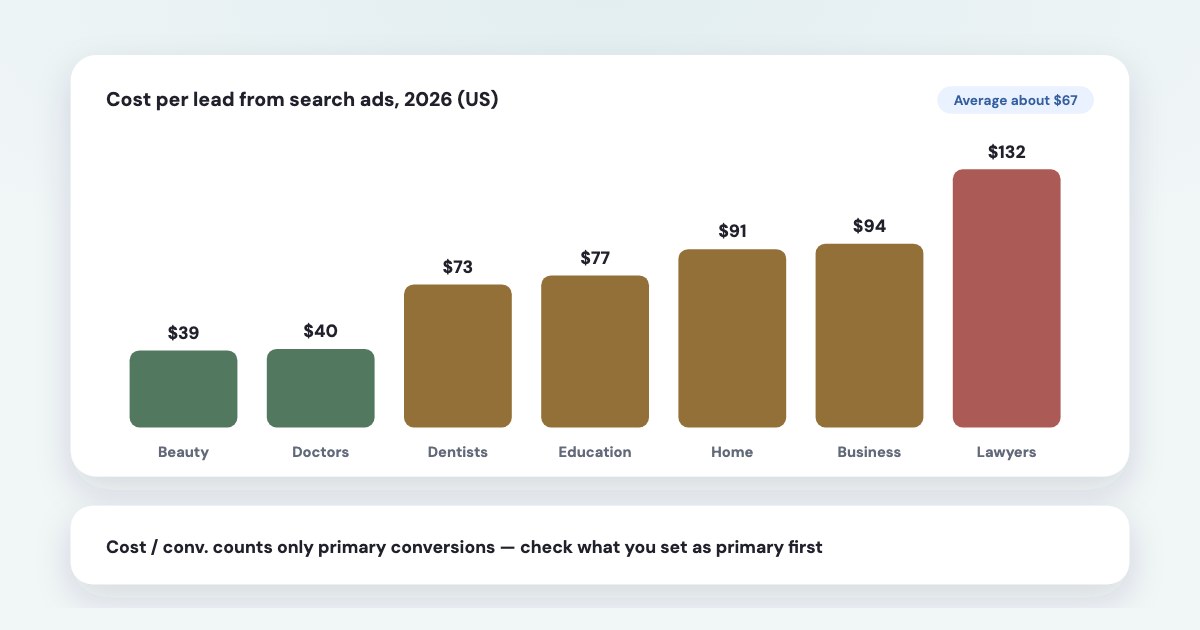
In 2026 the average cost per lead from search ads in the US is about $67, according to LocaliQ — from about $40 for doctors to over $130 for lawyers. But your own number is only as good as what Google counts as a lead: Cost / conv. divides spend by your primary conversions, so a phone-number click or a page view set as primary makes leads look cheap. Fix that first. Then lower the real cost: cut search terms that never convert, use broad match only with smart bidding, keep target CPA near your actual cost, and improve the landing page. Better still, send lead quality back from your CRM so Google bids for leads that become customers.
On this page7 sections
What Google counts as a lead
The "Conversions" column shows the number of conversions that you've received across your primary conversion actions.
Cost / conv. is calculated by dividing your total cost by the number in your "Conversions" column.
— and that column also feeds
smart bidding. Google’s own advice: ensure only bottom-of-funnel actions are set as "Primary" to avoid inflating counts.
(source) All conv. adds secondary actions on top.
Check Goals → Conversions → Summary. Form submissions and qualified calls should be primary; page views, button clicks and “clicks on a mobile number” — which Google can only count as clicks, not calls (source) — should be secondary. For testing a phone route end to end, see Google Ads call tracking: what counts as a phone lead.
Calls: check the minimum length
For calls from ads, Google’s API reference says: A call is reported as a conversion if it lasts longer than a specified duration. The default is 60 seconds.
(source) That sentence sits under the calls-from-ads action type; the Help pages on phone call conversions do not repeat it, so read the minimum
length set on your own action. For a clinic or a school a one-minute call is often a question about opening hours. Set the length to what a real enquiry takes in your business (how).
How much a lead costs on Google Ads in 2026
LocaliQ’s 2026 search benchmarks put the average CPC at $5.42, the conversion rate at 8.18% and cost per lead at about $67 —
cost per lead decreased overall for the first time in five years.
(source) By industry:
| Cost per lead | Conversion rate | |
|---|---|---|
| Physicians & surgeons | $40.04 | 12.43% |
| Beauty & personal care | $39.25 | 10.35% |
| Dentists & dental services | $72.97 | 10.67% |
| Education & instruction | $77.48 | 13.14% |
| Home & home improvement | $90.92 | 8.05% |
| Business services | $93.69 | 4.85% |
| Attorneys & legal services | $131.63 | 5.55% |
Read these with care: they come from US campaigns of LocaliQ’s customers on Google and Microsoft Ads together, and cost per lead in the table isn’t simply cost per click divided by conversion rate. For Europe, treat them as orders of magnitude. Your own number last quarter is a better benchmark — and what a lead is worth to you decides whether $70 is cheap. To turn that into a spending limit, see choosing a Google Ads test budget.
How to lower cost per lead
- Read the search terms report. It shows
the searches that trigger your ads and how those searches are performing.
Add the irrelevant ones as negative keywords (source). Two cautions from Google: negativesdon't match to close variants
, and with too manyyour ads might reach fewer customers.
(source) - Pair broad match with smart bidding. Broad match shows ads on searches
related to your keyword
;It’s critical to use Smart Bidding with broad match.
(source) Our suggestion: with manual bids, prefer phrase and exact — that is editorial advice, not a Google restriction. For the full decision, see should you use broad match for lead generation. - Set target CPA near reality. Google recommends starting from
the average CPA from the last 30 days, adjusted for any conversion delays
; a target that’s too low makes it skip clicks that could convert (source). Judge changes over at least two conversion cycles or 50 conversions (source). - Improve the landing page. Landing page experience is part of Quality Score —
How relevant and useful your landing page is to people who click your ad.
(source) Price range, proof and a short form usually matter more than design. For choosing what to fix first on relevance, see the Quality Score guide. - Re-check targets after August 2026. Campaigns with a target CPA that are limited by budget are now steered closer to the target (source). If you set a generous target, cost per lead can drift up to it (more).
Cheaper leads or better leads
A low cost per lead means little if the leads don’t buy. Google’s answer is to send outcomes back from your CRM. It recommends
starting with enhanced conversions for leads
rather than the older offline import (source): your site
sends hashed lead details, and later you upload which leads became qualified or customers (source). The offline conversions guide covers sending CRM outcomes back to Google Ads and checking data rules before upload.
- Offline conversions uploaded more than 90 days after the click aren’t accepted; for enhanced conversions for leads the window is 63 days (source).
- From 15 June 2026 these uploads move to Google’s Data Manager API (source).
- Then make the qualified stage your primary conversion, so Cost / conv. becomes cost per qualified lead. To show that difference to a client, see the monthly report template for lead campaigns.
Google Ads lead forms let people submit details inside the ad on Search and Performance Max. Google stores leads for 60 days, so download your data often.
(source) For judging which Performance Max leads to accept, see Performance Max for lead generation.
Where your leads get expensive: Variafy
Variafy offers read-only Google Ads access after your beta invitation. An assistant connected through Variafy can show cost per lead by campaign, the search terms that spend without converting, and whether your conversion actions are set up as primary or secondary. It doesn’t download lead form leads or upload offline conversions.
For Meta, see why Facebook cost per lead goes up. Variafy is in the free beta: join the free beta.
How we checked
Checked on 17 October 2026 against Google Ads Help (conversion tracking data, phone call conversions, lead form assets, offline conversion imports and their guidelines, enhanced conversions for leads, search terms, negative keywords, match types, Target CPA, measuring smart bidding, landing page experience, the August 2026 change to target-based strategies), Google Ads API documentation on conversion categories and LocaliQ’s 2026 search advertising benchmarks. The calls-from-ads minimum length was re-checked on 20 October 2026: the 60-second default appears in the API reference, not in the Help pages on phone call conversions. We also read the pages that rank for these searches.
Variafy is our product. Google and Google Ads are trademarks of Google LLC; we are not a Google product, partner or representative.
Questions
What is a good cost per lead on Google Ads?
LocaliQ’s 2026 US benchmarks average about $67 per lead from search ads, from about $40 for doctors and beauty to about $132 for lawyers. A better test is your own history and what a lead is worth: the share of leads that buy times the value of a sale.
How is cost per lead calculated in Google Ads?
Cost / conv. is total cost divided by the Conversions column, which counts only primary conversion actions. If a page view or a phone-number click is primary, your cost per lead looks lower than it really is.
How can I lower my Google Ads cost per lead?
Add negative keywords from the search terms report, use broad match only with smart bidding, keep target CPA close to your recent average, improve the landing page, and send lead quality from your CRM with enhanced conversions for leads.
How do I count phone calls as leads in Google Ads?
Track calls from ads and calls to your website number with Google forwarding numbers. A call counts as a conversion after a minimum length that you set; Google’s API reference gives 60 seconds as the default for calls-from-ads actions, so read the length on your own action and set it to what a real enquiry takes.
How long does Google keep lead form leads?
Google Ads stores lead form leads for 60 days and lets you download only the last 30 days, so connect a CRM or webhook, or download regularly.
Related guides
- Google Ads limited by budget or not spending: what it means and what to do
- Google Ads audit checklist for a lead business (with AI)
- Why is my Facebook cost per lead going up — and what’s a good CPL?
- Cost per qualified lead: the formula, a worked example and your target
- Landing page conversion rate: how to measure it and improve useful leads