IntellectKiddos case study: 2.2× Meta ad spend back in real Stripe revenue
From July to September 2026, IntellectKiddos, a Polish publisher of recorded online courses for children, received 1,362 payments and 93,598 PLN in Stripe on 42,282 PLN of Meta ad spend: 2.21 PLN of real revenue for every złoty spent on ads. There was no sales team and no live teaching, so the ad account decided whether the business made money. The account ran on the in-house version of Variafy, months before Variafy launched publicly.
On this page8 sections
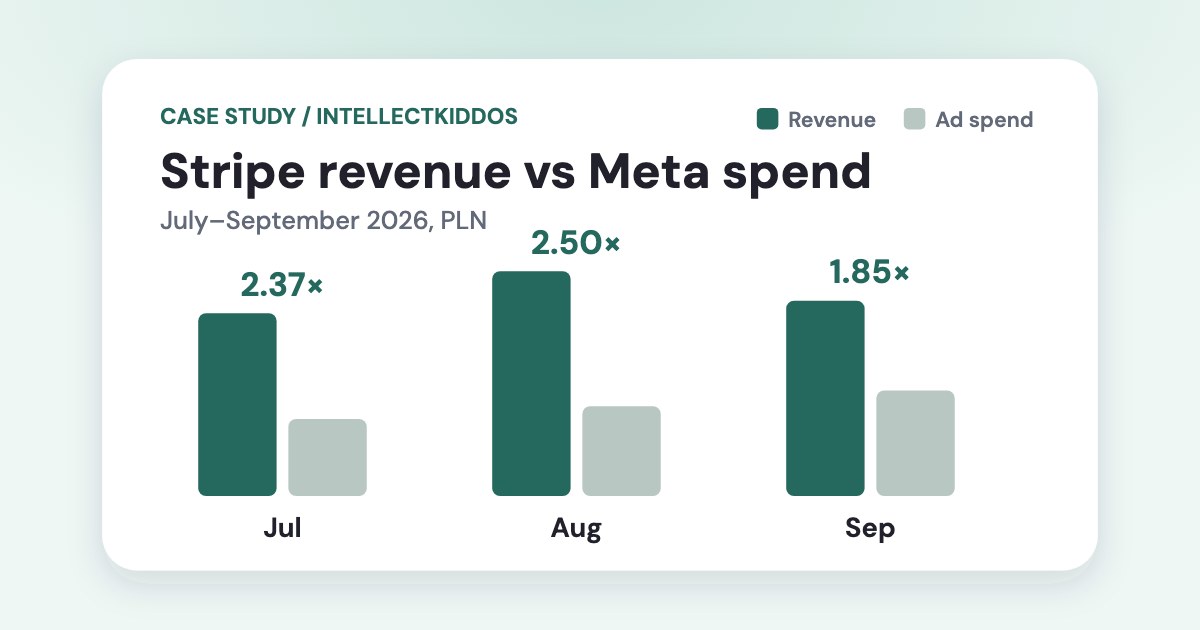
Results in real money, July–September 2026
| Month | Payments | Revenue, PLN | Meta spend, PLN | Revenue ÷ spend |
|---|---|---|---|---|
| July | 398 | 28,362 | 11,959 | 2.37 |
| August | 499 | 34,911 | 13,937 | 2.50 |
| September | 465 | 30,325 | 16,385 | 1.85 |
| Total | 1,362 | 93,598 | 42,282 | 2.21 |
Over the three months, 20 payments worth 1,360 PLN were refunded and Stripe fees came to about 2,995 PLN. Revenue minus ad spend, refunds and fees leaves about 46,960 PLN. Taxes, domains and the course platform are not included in that figure.
To judge whether a ratio like 2.21 is profitable for your own business, compare it with your margin in the break-even ROAS calculator.
The business: recorded courses, automatic payments, ads as the main cost
- Two recorded courses for children: multiplication tables (Tabliczka mnożenia w 3 godziny) and speed reading (Szybkie czytanie dla dzieci).
- Prices of 49 zł and 69 zł per course, and 89 zł for both courses together.
- Checkout and payment through Stripe, with no sales calls.
- Courses were recorded once, so Meta ads were the main running cost.
In July–September, 463 payments were at 49 zł, 455 at 69 zł and 444 at 89 zł. A third of all payments were the bundle.
What did not work first
In 2025 the account was scaled to 45,000–48,000 PLN a month on campaigns at a 69 zł price that were not yet optimized for purchases. By the pixel, those campaigns returned 0.63–0.75 of their spend, so every extra złoty of budget lost money. A second market, the Czech Republic, returned 0.52–0.64 and was stopped.
What changed the result
- A 49 zł price with optimization for purchases (November 2025). Cost per purchase by the pixel fell from about 120 PLN in October to about 38 PLN in November.
- A two-course bundle at 89 zł. It became a third of all payments in July–September.
- CBO campaigns with Advantage+ (from 19–22 July 2026). Cost per purchase by the pixel was 29–36 PLN a month in July–September, and the best of these campaigns returned 1.9–2.5 of their spend by the pixel. The CBO vs ABO guide explains the budget setting.
How the in-house Variafy workflow ran the account
The in-house assistant watched the account every day and raised three kinds of signals. Each decision stayed with the founder.
- Stop. An ad set or campaign was flagged when it kept spending without purchases, or when its cost per purchase stayed above what a sale could pay for. That is how the 69 zł campaigns and the Czech market were cut instead of being scaled further.
- Refresh creatives. When a working ad started to tire, with results falling and cost per purchase rising, it was flagged for a new version before the campaign as a whole went into loss.
- Add budget. Budget went up only where purchases held at a price the business could afford. In July–September, monthly spend grew from 11,959 to 16,385 PLN as budget moved to the CBO campaigns that met that bar.
Every signal was checked against money, not only the pixel: Stripe payments, refunds and fees decided whether a campaign was really profitable. The public Variafy runs the same checks from Claude or ChatGPT: it compares Meta spend with payments, flags ads that spend without paying customers, and shows every change as a preview before it runs. See Variafy revenue tracking.
Did the pixel agree with the money?
For July–September, Meta’s pixel reported 1,343 purchases. Stripe recorded 1,362 paid payments plus 20 that were later refunded. The gap was 1–3%. With a simple checkout and one payment per order, the pixel was a usable daily signal. Scaling decisions still went by Stripe, because the pixel does not see refunds or fees.
When the two sources disagree by more than a few percent, work through why Facebook Ads revenue does not match your CRM before trusting either total.
How we checked
Spend, pixel purchases and campaign results come from the IntellectKiddos Meta ad account, read through the public Variafy on 25 November 2026. Payments, refunds and fees come from the Stripe export for 1 July – 30 September 2026, aggregated by month; failed payments are excluded and no customer data is published. Amounts are in Polish złoty. Taxes and costs other than ads, refunds and Stripe fees are not included. Disclosure: IntellectKiddos and Variafy have the same founder.
Questions
What return on ad spend did IntellectKiddos get?
From July to September 2026, 93,598 PLN of Stripe revenue on 42,282 PLN of Meta ad spend: 2.21 overall, 2.37 in July, 2.50 in August and 1.85 in September.
Was the result measured by the pixel or by real payments?
By real payments in Stripe. The pixel counted 1,343 purchases against 1,362 Stripe payments, so the two were within 1–3%, but refunds and fees are only in Stripe.
Was IntellectKiddos run with Variafy?
It ran on the in-house version of Variafy, before the public launch. The account was connected to the public Variafy in November 2026 to re-check the numbers.