Lead response time: measure speed to lead without hiding unanswered enquiries
Lead response time measures the delay between receiving an enquiry and a defined response event. For a sales team’s first-attempt metric, subtract the original enquiry time from the first genuine staff contact attempt. Report the share of all eligible enquiries attempted within the agreed target, alongside unanswered enquiries and the response-time distribution. A fast average among answered leads can hide a neglected queue.
On this page13 sections
Why check follow-up before blaming the ads?
This matters when a business pays for enquiries through Meta or Google. Before blaming the advertising for poor sales, check whether the enquiries reached an owner and received an appropriate response.
Define the start and finish before measuring
Start the clock when the customer submitted the form, placed the missed call or sent the initial message, according to the channel being measured. If the CRM receives that enquiry later, record the delay instead of resetting the clock at CRM creation.
Separate the events below:
| Event | What it means | How to report it |
|---|---|---|
| Enquiry received | The original customer action reached the intake system | Start time, with source and time zone |
| CRM record created | The enquiry entered the sales system | A processing milestone, not necessarily the start |
| Automatic acknowledgement | Software confirmed receipt | Acknowledgement delay |
| Assigned to an owner | Someone became responsible | Routing delay |
| First staff attempt | A person made a genuine relevant contact attempt | Primary staff-response metric used here |
| Two-way contact | The customer and team actually exchanged information | A separate contact outcome |
If an automated agent can answer questions or hold a conversation, record that activity explicitly as automated service. It may be useful, but should not silently become a human response in a report intended to measure staff handling.
The metric does not reward making an empty call just to stop the timer. Define what counts as a genuine attempt and preserve enough event evidence to audit the count.
How do you calculate speed to lead?
First-staff-attempt delay = timestamp of the first qualifying staff attempt − original enquiry timestamp.
Keep both timestamps in a consistent time basis. Store the source time zone or UTC offset and display local business time where that helps the team. A negative delay is a data problem to investigate, not a fast response.
For an enquiry received at 09:00 and first attempted at 09:08, the delay is eight minutes. If the CRM record was created at 09:05, measuring from record creation would report only three minutes and hide five minutes of intake delay.
Write separate definitions for forms, missed calls and live chat. A live-chat acknowledgement and a next-day response to an appointment request should not become one unexplained average merely because both are called leads.
The response-time example an average misses
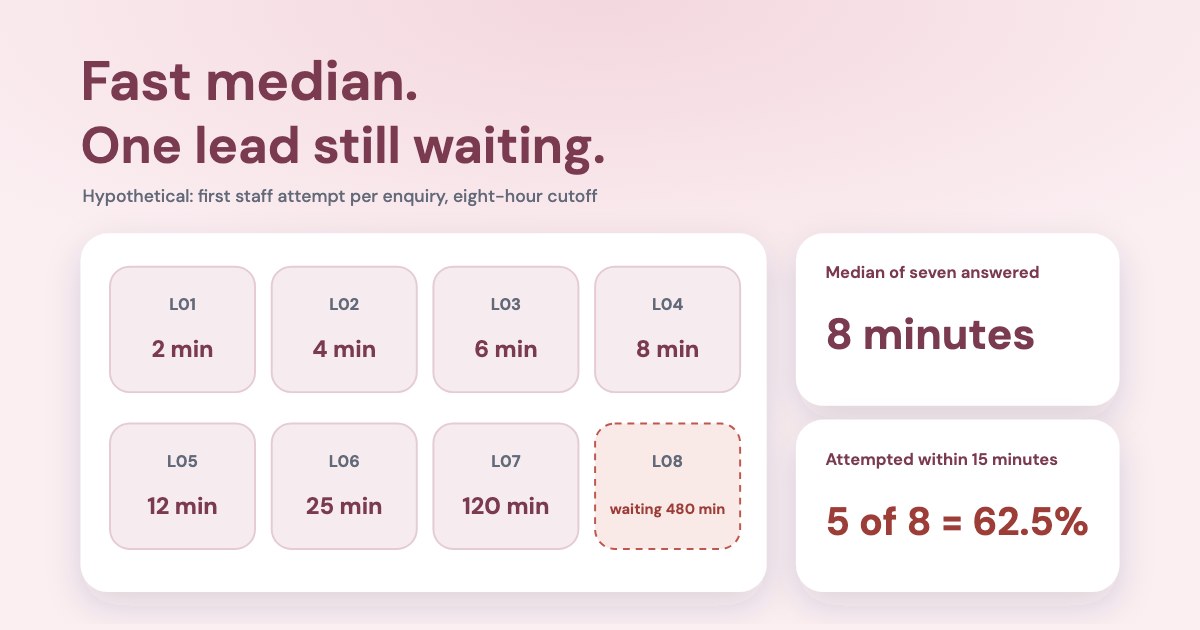
Suppose eight fictional enquiries arrive during staffed hours. Their first staff-attempt delays are shown below. One remains unattempted at the eight-hour observation cutoff.
| Enquiry | First-attempt delay | Status at the cutoff |
|---|---|---|
| L01 | 2 minutes | Attempted |
| L02 | 4 minutes | Attempted |
| L03 | 6 minutes | Attempted |
| L04 | 8 minutes | Attempted |
| L05 | 12 minutes | Attempted |
| L06 | 25 minutes | Attempted |
| L07 | 120 minutes | Attempted |
| L08 | No attempt; waiting 480 minutes | Unattempted |
Among the seven attempted enquiries, the median delay is eight minutes and the mean is about 25.3 minutes. Both exclude the enquiry still waiting, so neither is a complete description of the queue.
For a plainly defined within-target rate, use all eligible enquiries that have had enough time to meet or miss the target:
Within-target rate = enquiries first attempted within the target ÷ eligible enquiries old enough to assess × 100.
All eight example enquiries are old enough at the cutoff. Two of eight were attempted within five minutes: 25%. Five of eight were attempted within 15 minutes: 62.5%. Seven of eight were attempted at all: 87.5%.
For the seven observed delays, the nearest-rank 90th percentile is 120 minutes: select position ceiling(0.90 × 7), or the seventh ordered value. Other percentile conventions can give different small-sample results; name the convention.
Do not assign the unattempted enquiry a response time of zero. Its final delay is unknown and already at least 480 minutes. Report the waiting age and status separately.
Avoid censoring the newest leads unfairly
At a 15-minute cutoff, an enquiry received two minutes ago is not yet a missed 15-minute response. Either evaluate enquiries that have had the full target interval or show the immature group separately.
Conversely, a lead that has waited two hours without an attempt is a known miss against a 15-minute target. Excluding it because it lacks a completed response would make performance look better.
Keep three groups visible: met target, missed target and not yet assessable. Separately distinguish missing timestamps from confirmed no-attempt records; a logging failure is not proof that nobody responded.
Use the same observation rule when comparing weeks, sources or staff. Otherwise a queue containing more fresh enquiries can appear better or worse simply because of the reporting cutoff.
Report elapsed time and working time separately
A staffed-hours clock can help manage a team’s commitment, but it does not describe the customer’s full wait.
Consider a fictional schedule of Monday–Friday, 09:00–18:00, with no holidays. All times in this example are UTC. An enquiry arrives Friday 23 October 2026 at 17:50 and is first attempted Monday 26 October at 09:10.
- Elapsed wait: 63 hours 20 minutes, or 3,800 minutes.
- Scheduled working-time wait: 20 minutes: ten on Friday and ten on Monday.
Both calculations can be correct. Label them. Report in-hours and out-of-hours arrivals separately so the team can see whether the promised service standard matches the coverage it actually provides.
For a local-time schedule, define its time zone and holiday calendar. Daylight-saving transitions can change elapsed time across a weekend; do not subtract unlabelled local clock readings.
Do not publish an always-on response promise if nobody is responsible outside office hours. An acknowledgement can explain when someone will reply or offer a supported self-service next step, but it does not erase the elapsed wait.
What is a good lead response time?
Choose a target that reflects the customer’s task, the channel, urgency and staffed capacity. An urgent request, a scheduled consultation and a downloadable guide do not necessarily need the same service standard.
A 2011 Harvard Business Review article is often cited; it is not a current universal benchmark.
Before using any published multiplier, verify what the original work measured: contact, qualification or completed sales; which businesses and dates it covered; and whether the comparison establishes causality. Do not convert a qualification association into a guaranteed sales increase.
Our operational suggestion is to choose a testable target, measure it honestly and improve the queue. For example, a business could trial “first genuine staff attempt within 15 staffed minutes for eligible sales enquiries”, while separately reporting elapsed waiting and unanswered volume. That is an example policy, not an industry standard.
Fix the handoff in the order it actually fails
Walk through one clearly identified test enquiry from each important intake route. Keep internal tests out of acquisition reporting.
- Receipt: does the original event reach the intake system with its timestamp?
- Transfer: how long does it take to appear in the CRM or queue?
- Assignment: is there one visible owner rather than a shared notification everyone assumes someone else will handle?
- Availability: is the owner working and able to take the enquiry?
- Attempt: can the team act through the appropriate channel and record the result?
- Escalation: what happens when no owner acts before the agreed target?
Notifications alone do not establish ownership. A successful automation run also does not prove the enquiry reached the right person with usable information.
Use relevant, proportionate contact attempts and respect the customer’s stated contact preferences. The objective is useful service, not activity counts that pressure people into repeated unwanted outreach.
Check capacity before buying more leads
A simple workload estimate can expose an impossible promise. Suppose eight eligible enquiries arrive per hour and each needs six minutes of initial handling. That requires 48 minutes of work per hour, before other work and variability.
At a peak of 15 enquiries per hour, the same assumption requires 90 minutes of handling per hour. One person’s hour cannot supply that work, even if the notification arrives instantly.
This is a rough capacity calculation, not a queueing forecast or a staffing standard. Arrival bursts, follow-up, breaks, missed calls and varying complexity add uncertainty. Use the real workload to decide whether to change coverage, simplify handling or constrain acquisition.
The lead-conversion guide helps connect these operational stages to later outcomes.
Do faster replies cause more sales in your business?
Measure the business outcomes, but interpret the comparison carefully. High-intent leads may receive faster responses, experienced staff may handle particular sources and working hours may change both response speed and customer availability.
A table of “fast leads convert more” does not isolate the effect of speed. Compare similar offers and sources, keep cohort age consistent and record changes in routing or coverage. Do not deliberately delay customers to create a slow-response group.
An operational repair can still be justified without a perfect lift estimate: recovering unassigned enquiries and meeting a promised service standard are observable improvements. Report those outcomes honestly instead of inventing a revenue multiplier.
Download the eight-enquiry response example, blank response tracker and response-standard brief.
Separate ad quality from follow-up with Variafy
Variafy can help read connected advertising spend and reported outcomes alongside stage data you supply. The response audit requires your intake, assignment and attempt records; advertising metrics alone cannot prove how promptly the team responded.
Use this response log and lead cohort to report routing delay, first staff-attempt delay, unanswered waiting age and within-target rate. Keep acknowledgements separate. Compare sources only at the same maturity and identify one operational failure before recommending more ad spend.
For the advertising side, invited users can follow the Meta connection guide. Variafy is not represented here as a sales dialler or a complete response-time tracking system.
How we checked
Questions
Does an automatic email count as a response?
It counts as acknowledgement in the definitions used here. Record it separately from a staff attempt and from two-way contact.
Should unanswered enquiries be included in the average?
Their final delay is unknown, so do not invent a completed delay. Show their count and waiting age, and include assessable misses in the within-target denominator.
Should every business target five minutes?
No universal target follows from the metric. Set a service standard appropriate to the task and staffing, then measure both its achievement and customer outcomes.