CAC vs CPA: the difference, formulas and a complete cost example
CAC measures the cost of acquiring a new customer. CPA measures the cost of a defined action, such as an enquiry, signup or purchase. They differ in two places: which costs you include and what you count as the outcome. Always label both. A $20 cost per enquiry and a $400 fully loaded CAC can describe the same campaign accurately.
On this page11 sections
Can $20 and $400 both be right?
For a business that sells after a conversation, replacing CAC with the ad platform’s reported CPA can hide sales work, unsuccessful enquiries and returning buyers. This guide shows how to connect the numbers without mixing their scopes.
CAC versus CPA at a glance
| Metric | Formula | Denominator to define | Typical decision |
|---|---|---|---|
| CPA | Included campaign cost ÷ defined actions | Enquiries, signups, purchases or another named action | Is this campaign producing the intended action affordably? |
| Media CAC | Media spend assigned to acquisition ÷ new customers attributed under a stated rule | Unique first-time customers | What does the paid acquisition cost before other costs? |
| Fully loaded CAC | Included acquisition costs ÷ new customers in the matching scope | Unique first-time customers | What does acquisition cost after supporting work? |
| Blended CAC | Included acquisition costs across channels ÷ all new customers in scope | Deduplicated customers across channels | What does the business’s overall acquisition effort cost? |
CPA is often expanded as either cost per action or cost per acquisition. The abbreviation does not tell you what was acquired. Write “media CPA per enquiry” or “media CPA per purchase” where the distinction affects the decision.
Google’s Cost / conv. uses the cost and conversions eligible for that reporting calculation. Its conversion settings therefore matter: a reported conversion is not automatically a new customer. Google’s conversion-data guidance explains the column.
For the wider acquisition calculation, Stripe describes CAC as acquisition costs divided by new customers, including marketing and sales effort. Your report still needs an explicit cost-allocation policy.
A worked example: $20 CPA becomes $400 CAC
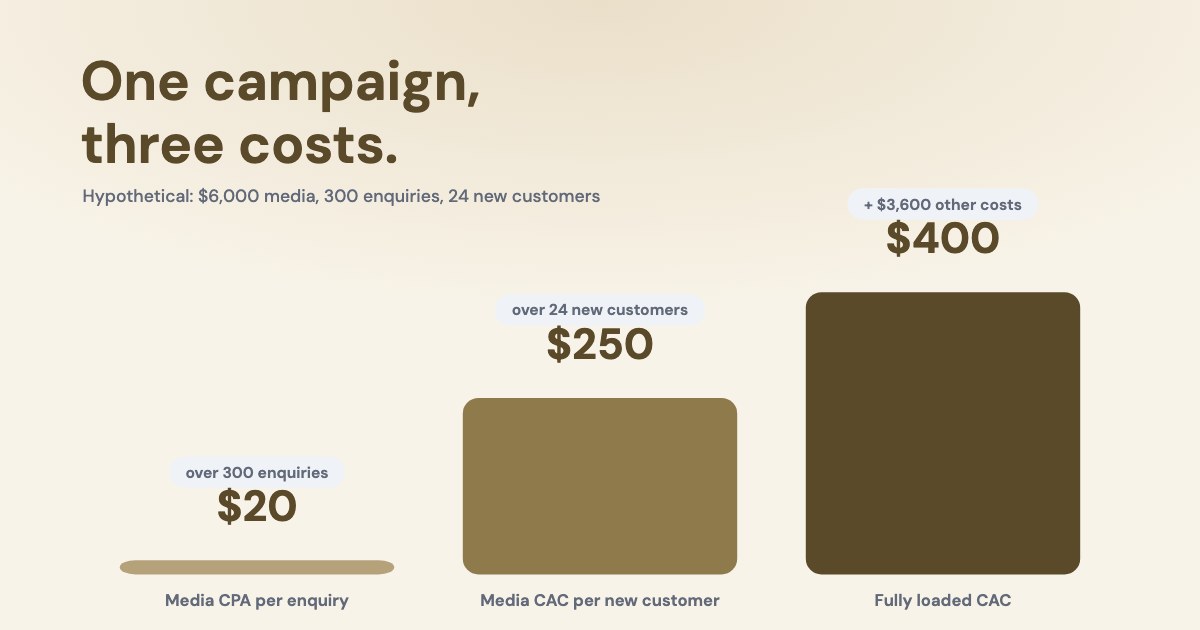
Suppose a fictional training provider runs a campaign and follows the acquired enquiries through an agreed sales cutoff. All values below concern the same mature lead cohort and use dollars.
| Outcome or cost | Amount |
|---|---|
| Media spend | $6,000 |
| Valid unique enquiries | 300 |
| Qualified enquiries | 60 |
| Customers who bought from those enquiries | 30 |
| Returning customers among the buyers | 6 |
| New customers | 24 |
| Allocated agency work | $1,200 |
| Allocated creative production | $600 |
| Allocated acquisition software | $300 |
| Allocated sales labour and commissions | $1,500 |
| Total included acquisition costs | $9,600 |
Now calculate each denominator separately:
- Media CPA per enquiry: $6,000 ÷ 300 = $20.
- Media cost per qualified lead: $6,000 ÷ 60 = $100.
- Media cost per buying customer, including returning buyers: $6,000 ÷ 30 = $200.
- Media CAC per new customer: $6,000 ÷ 24 = $250.
- Fully loaded CAC per new customer: $9,600 ÷ 24 = $400.
This example uses people who bought, not the number of orders or instalments. Three payments from one new customer still represent one acquired customer under this definition.
The difference between $20 and $400 is not an attribution bug. The first metric counts enquiries and media only; the last counts new customers and the defined supporting costs. They answer different questions.
Download the CAC cost bridge example to reproduce the calculation. It is fictional data, not an industry benchmark or a Variafy customer result.
Which costs belong in CAC?
Include costs according to the acquisition question and a consistent policy. For a fully loaded acquisition view, consider paid media, acquisition-related agency work, creative, allocated tools and the sales effort required to win new customers.
Separate costs that serve several purposes. If an employee spends time on both acquisition and existing-customer support, document how the acquisition share was estimated. The same applies to software, content and agency retainers serving several channels.
Do not allocate the same cost twice. An agency invoice may already include creative production. A labour figure may already include commission. A transparent rough allocation is more useful than a precise-looking total assembled from overlapping items.
Keep service delivery costs in the margin calculation rather than silently adding them to acquisition cost. Retention work and acquisition work can overlap operationally, but should not change classification whenever a channel’s results look inconvenient.
For creative that serves multiple periods, state whether you expense it when purchased or allocate it across use. The choice can change short-period CAC. Apply the same policy over time and explain material changes.
Match the customer cohort to the spending
There are two useful reporting views, and they should have different labels.
Period CAC divides acquisition spending in a reporting period by new customers acquired in that period. It is convenient for regular business reporting, but its numerator and denominator can refer to different journeys when the sales cycle is long.
Cohort CAC follows a defined group of acquired leads through to new customers and associates the relevant acquisition costs with that group. It is useful for comparing campaigns, but requires sufficient history, identifiers and a defensible allocation of shared costs.
If October closes customers whose enquiries arrived in August, October spend divided by October customers does not show the cost of October’s enquiries. It is a period ratio. Keep it, but add a cohort view where the data supports one.
Do not label a recent cohort’s current CAC “final” while many enquiries remain open. Record the cutoff date, pending volume and whether prior cohorts were measured at the same age. The conversion-lag guide explains the risk of comparing recent and mature outcomes.
How does lead CPA connect to customer CAC?
When costs, cohort, attribution and customer definitions match:
Media CAC = media cost per lead ÷ lead-to-new-customer rate.
In the example, 24 of 300 enquiries become new customers: 8%. Therefore $20 ÷ 0.08 = $250 media CAC.
Adding the $3,600 of other included acquisition costs contributes another $150 per new customer, bringing fully loaded CAC to $400.
This relationship breaks when the denominators refer to different groups. Do not divide a platform’s attributed lead CPA by a CRM rate that includes organic enquiries, returning buyers and a different month.
The formula is also a useful planning check. Suppose a business sets an illustrative ceiling of $650 fully loaded CAC after considering expected customer contribution and its other commitments. If non-media acquisition costs are expected to be $150 per new customer, the media allowance is $500. At an assumed 8% lead-to-new-customer rate, the implied media CPA ceiling is $500 × 0.08 = $40 per lead.
Those are assumptions to validate, not permission to increase spend. If lead quality changes at greater volume, the old 8% rate may no longer apply. Our lead-conversion guide explains how to monitor that rate.
Is CAC always higher than CPA?
Only under compatible definitions can you make that comparison confidently. With the same spend, new customers that are a subset of purchase outcomes, and additional non-negative costs, fully loaded CAC will be at least as high as media CPA per purchase.
Across different scopes, that relationship need not hold. In a separate illustration, a business spends $9,600 on total acquisition and acquires 120 customers across paid, referral and other channels: blended CAC is $80. Its paid campaign spends $6,000 and is assigned 24 new customers: media CAC is $250.
The $80 blended figure does not prove that the paid campaign acquired customers for $80. Nor does $250 show that the other channels are free. Each denominator describes a different scope, and shared costs still need allocation.
Avoid a dashboard rule that automatically flags every instance of CAC below CPA as an error. First inspect the definitions.
Which metric should you improve first?
Find where acquisition cost is being created. If irrelevant enquiries dominate, investigate targeting, the promise and qualification. If useful leads are not contacted, inspect routing and sales capacity. If customers buy but delivery costs consume the revenue, lower CPA alone may not solve profitability.
Use a short review table:
| Signal | Investigation | Guardrail |
|---|---|---|
| Low lead CPA, high CAC | Qualification and lead-to-customer rate | Do not optimise only for form volume |
| Similar media CAC, higher loaded CAC | Supporting costs and allocation | Do not cut essential sales work without checking outcomes |
| Falling blended CAC, flat paid CAC | Channel mix and existing demand | Do not claim paid efficiency improved automatically |
| Rising recent-cohort CAC | Cohort age, open leads and tracking | Do not treat pending outcomes as final losses |
Judge customer value alongside CAC. A lower acquisition cost is not a better business result if the acquired customers have much lower contribution, higher refunds or unaffordable payment delays. See ROI versus ROAS and the LTV:CAC calculator.
Build an acquisition cost bridge with Variafy
Variafy can help an assistant read connected advertising spend and reported outcomes. Provide the acquisition-cost ledger and customer counts that the platforms do not contain. Do not assume ad data includes salaries, margin or a deduplicated customer registry.
Show media CPA for the named action, then build a separate CAC calculation using my cost ledger and new-customer cohort. State the cost scope, attribution rule and cutoff. Keep returning customers, open leads and missing costs visible.
If you have been invited to the beta, use the Google Ads connection guide. Variafy’s Google Ads tools read data; they do not change campaigns.
How we checked
Questions
Does CAC include existing customers buying again?
The new-customer denominator used here excludes them. Repeat-customer acquisition or reactivation can have its own cost metric; label it separately.
Can CPA equal CAC?
They can coincide when the chosen CPA outcome is a unique new customer and both metrics use the same costs and scope. Equal numbers alone do not establish equal definitions.
Can I add Meta and Google customers to calculate blended CAC?
Only after resolving overlap and applying a consistent customer definition. Both platforms can claim the same outcome. Use a deduplicated business record; see cross-platform double counting.