Cost per qualified lead: the formula, a worked example and your target
Cost per qualified lead (CPQL) is the cost of producing leads that meet a written qualification standard. Divide the relevant acquisition and qualification costs by the number of qualified leads. To compare advertising campaigns, use the same standard, the same cost scope and equally mature lead cohorts.
On this page11 sections
How do you calculate cost per qualified lead?
For a media-only comparison:
Media CPQL = ad spend ÷ qualified leads = CPL ÷ qualification rate
A campaign with a higher cost per lead can have a lower CPQL. That makes it worth investigating, not automatically worth scaling: sales conversion, profit and capacity still matter.
All numerical examples in this guide are hypothetical.
What counts as a qualified lead?
Choose a specific, observable stage. For a home-services company, “qualified” might mean that a person has a project you offer, is inside the service area and has confirmed a realistic buying timeframe. For a training provider, it might mean that the requested course matches the person’s needs and that the person has confirmed interest in a sales conversation.
“Filled in the form” and “sales says this looks good” are too different to share one denominator.
Write a short qualification agreement:
| Field | Example rule to agree |
|---|---|
| Fit | We offer the service requested in the lead’s location |
| Intent | The person confirms a relevant need and a conversation |
| Evidence | A recorded call outcome or a completed qualification checklist |
| Count | Each unique lead enters the qualified count once |
| Exclusions | Test entries and duplicate enquiries are identified separately |
| Pending | Not yet assessed; never silently treated as rejected |
| Timing | Qualification is measured at the same age after enquiry |
This is a template, not a universal definition. Marketing-qualified leads, sales-accepted leads and sales-qualified leads can represent different stages. Name the actual stage in your report.
Google Ads distinguishes qualified leads from converted leads, using offline business outcomes to describe progress through the lead journey. A qualification is not necessarily a completed sale.
CPL vs CPQL vs customer acquisition cost
| Metric | Media-only formula | What it helps answer |
|---|---|---|
| CPL | Media spend ÷ unique raw leads | What does an enquiry cost? |
| Qualification rate | Qualified leads ÷ unique raw leads | How often do enquiries meet our standard? |
| CPQL | Media spend ÷ qualified leads | What does an acceptable prospect cost? |
| Qualified-to-customer rate | New customers ÷ qualified leads | How often do acceptable prospects buy? |
| Media cost per new customer | Media spend ÷ new customers | What media spend accompanies one acquired customer? |
That last measure is not fully loaded CAC. To report CAC, define whether agency fees, creative, qualification work and sales costs are included. The ROI and ROAS guide explains why hiding costs changes the conclusion.
For the CPQL identity, enter the qualification rate as a decimal. A $20 CPL with a 20% qualification rate gives $20 ÷ 0.20 = $100, not $1.
A higher CPL can produce a cheaper qualified lead
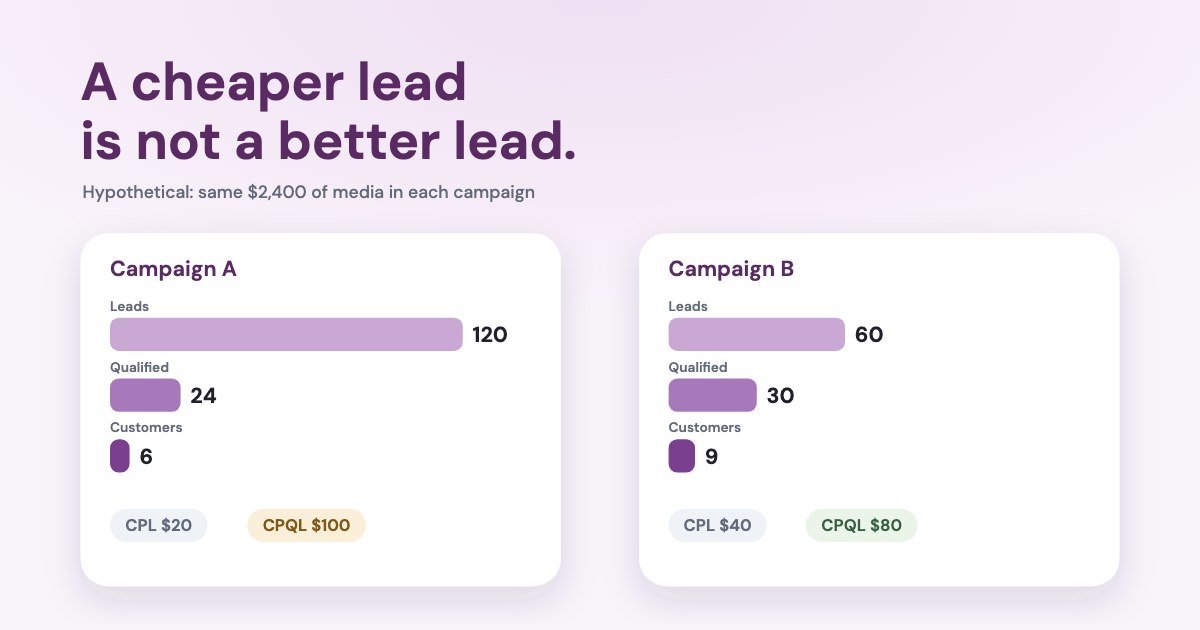
Two mature lead cohorts each cost $2,400 in media:
| Metric | Campaign A | Campaign B |
|---|---|---|
| Unique raw leads | 120 | 60 |
| Qualified leads | 24 | 30 |
| Qualification rate | 20% | 50% |
| CPL | $20 | $40 |
| Media CPQL | $100 | $80 |
| New customers | 6 | 9 |
| Qualified-to-customer rate | 25% | 30% |
| Media cost per new customer | $400 | $266.67 |
If the decision used CPL alone, Campaign A would win. Campaign B actually produces more qualified prospects and more customers on the same media spend in this example.
Now include acquisition and qualification costs beyond media: $600 for A and $900 for B. CPQL becomes $3,000 ÷ 24 = $125 and $3,300 ÷ 30 = $110 respectively.
The ranking survives this particular cost allocation. It might not survive another one. Show the fully loaded and media-only columns beside each other rather than moving between them without saying so.
These observations do not establish that a particular form format or advertising platform caused the difference. The offer, audience, sales process and measurement could differ too.
How to set a target CPQL from your economics
Do not start with a generic industry benchmark. Work backward from what the business can spend to acquire a customer.
For a cost pool that includes the same acquisition costs in both measures:
Maximum CPQL = allowable customer acquisition cost × qualified-to-customer rate
If the owner can allow $600 of acquisition costs per new customer and 20% of qualified leads become customers, the corresponding ceiling is $600 × 0.20 = $120 per qualified lead.
That identity assumes the costs being compared have the same scope. If CPQL stops at qualification but closing the sale costs another $100 per acquired customer, reserve that amount first:
Maximum pre-close CPQL = ($600 − $100) × 0.20 = $100
For a media-only target, also reserve the non-media acquisition expenses. If $200 of the $600 allowance is needed outside media, the maximum media CPQL is $400 × 0.20 = $80.
The close rate should come from a comparable, mature cohort. If it is only a planning assumption, label the resulting target as provisional. A threshold based on one sale from five leads can move sharply when the next lead buys or declines.
What to do when CPQL changes
| Situation | What to check before an ad edit |
|---|---|
| CPL improves, CPQL worsens | Qualification rate, changed qualification rules and lead mix |
| CPQL worsens across every campaign | CRM freshness, unassessed backlog and changes in the sales process |
| One ad has poor CPQL | Comparable cohort age, enough observations and the underlying lead reasons |
| CPQL improves, customer cost worsens | Sales conversion, follow-up outcomes and customer definition |
| Qualified leads exceed sales capacity | Scheduling, service capacity and the owner’s spending decision |
| No qualified leads are observed | Whether the cohort is mature and assessed; show spend and counts, not a $0 CPQL |
When there are zero qualified leads, the ratio has no finite value. When no qualification data exists, the metric is unavailable. Neither condition means acquisition was free.
Investigate repeated, specific rejection reasons before changing multiple targeting and form settings together. A form improvement is a testable hypothesis; it is not a promise that volume and quality will both rise.
Should you tell Google or Meta which leads qualify?
Business reporting and platform optimization are separate tasks. A clean CPQL table does not itself update a conversion goal or send an event to an advertising platform.
In Google Ads, inspect the selected goals and actions before making a change. Primary and secondary actions serve different reporting and bidding purposes; custom goals are an important exception to the usual treatment of secondary actions. Do not switch a campaign to a deeper outcome just because the label sounds better. Check its availability, timeliness and relevance to the business first.
Meta reports its own cost per qualified lead for lead ads that use the conversion leads goal. Meta describes those metrics as estimates built from the CRM events you send and partly modeled, so treat them as a platform view and keep your own cohort table as the record; the Meta lead-quality guide has the details.
For implementation details, use the existing guides to Google Ads offline conversions and Meta lead quality.
Review quality with Variafy
Variafy can bring supported ad-account readings into your AI assistant. Pair them with the available CRM or cohort data; do not ask the assistant to invent qualification outcomes from clicks or CTR.
Use this request:
Compare these campaigns using the same lead-created cohorts and qualification definition. Show spend, unique leads, qualified leads, pending assessments and the observation cutoff. Calculate media CPQL only where the denominator is known. Keep fully loaded costs separate. List the evidence still needed before recommending a change.
The Google Ads connection guide and Meta connection guide explain the supported setup and current access conditions.
How we checked
Questions
What is a good cost per qualified lead?
A CPQL that fits your acquisition allowance after accounting for how often qualified leads buy and which costs remain after qualification. A cross-industry average cannot establish that for your business.
Is CPQL better than CPL?
It answers a later-stage question. Keep both: CPL shows enquiry economics, while CPQL adds the agreed quality standard. Neither replaces customer cost or contribution.
Can a qualified lead be counted more than once?
Not in the cohort method here. Count the first entry of a unique lead into the agreed stage. If you deliberately measure multiple opportunities per contact, name that a separate opportunity metric.
Should pending leads count as unqualified?
No. A lead that has not been assessed is unknown, not rejected. Report the pending share and compare cohorts after a consistent assessment window.
Can I average the CPQL of several campaigns?
For the combined result, divide total included costs by total qualified leads. A simple average of campaign ratios gives a small campaign the same weight as a large one.
Related guides
- Facebook lead quality: why lead forms bring junk leads and how to fix it
- Google Ads offline conversions: send CRM sales back
- ROI vs ROAS: the difference, formulas and a worked example
- CAC vs CPA: the difference, formulas and a complete cost example
- Lead conversion rate: the formula, a funnel example and a practical improvement plan