LTV:CAC ratio calculator: CAC, LTV and payback by ad channel for lead businesses
LTV:CAC is the margin a customer brings over a period divided by what it cost to win them. David Skok’s rule of thumb is at least 3:1; below 1, every customer loses money. The free calculator below works it out by ad channel for businesses that get leads and sell later — with sales time in CAC, instalments in payback, and ROI next to ROAS.
Open the free LTV:CAC and payback calculator by channel ↓
On this page11 sections
LTV:CAC ratio calculator by ad channel
LTV:CAC and payback calculator by channel
1. What one customer is worth
2. Cost of winning them, by channel (one month of leads)
| Channel | Ad spend | Agency, creative | Leads | New customers |
|---|---|---|---|---|
Count customers whose first lead came in that month from that channel, by the source on the deal in your CRM — not the platforms’ own conversion counts.
| Channel | Cost per lead | Lead → customer | Paid CAC | Fully loaded CAC | LTV:CAC | Payback | ROAS | ROI, 12 months |
|---|
LTV:CAC colours: red below 1 (each customer loses money), amber 1–3, green 3 or more. ROAS uses the first sale, as ad platforms do; LTV, ROI (12-month margin minus all costs, divided by all costs) and the chart add repeat purchases, counted at month 12.
Everything is calculated in your browser. LTV is counted over 12 months on margin; payback is the first month in which a customer’s cumulative margin covers the fully loaded CAC. For the most you can pay per lead before the first sale breaks even, use our break-even ROAS and cost per lead calculator.
Example: why the channel with the best ROAS can lose
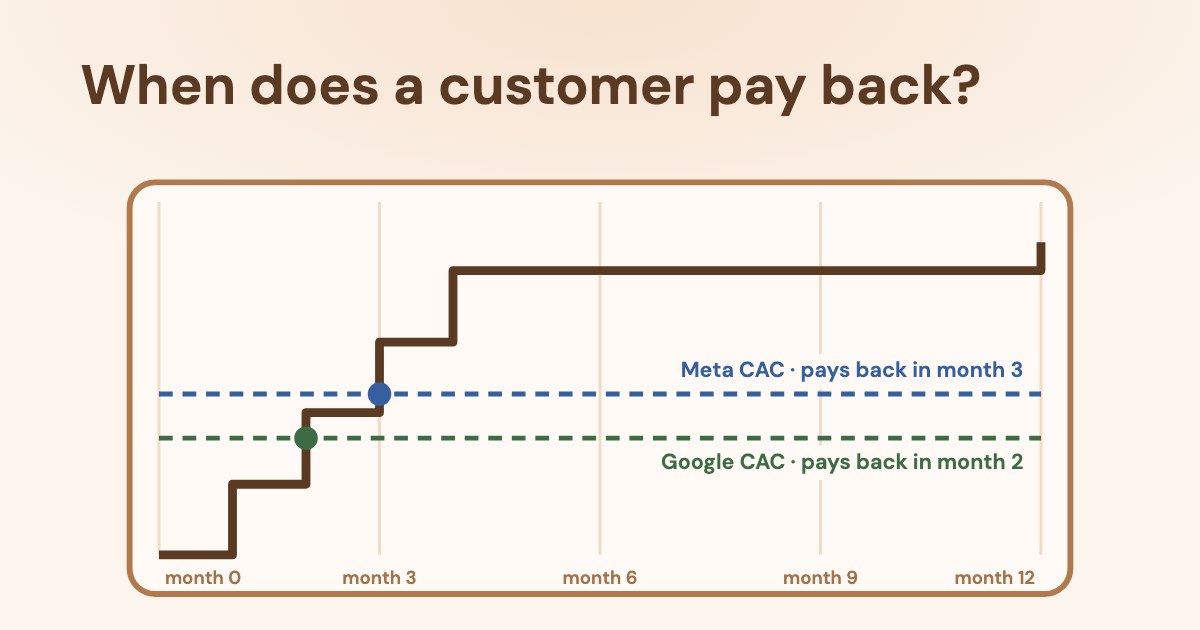
A school sells a €2,400 course in four monthly instalments at a 60% margin with 5% refunds; 20% of customers buy a second €1,200 course within a year. Its sales team costs €8,000 for a month of leads. These are illustrative numbers, which you see in the calculator above.
| Meta | Google Ads | |
|---|---|---|
| Ad spend | €6,000 | €4,000 |
| Leads → customers | 400 → 16 (4%) | 100 → 10 (10%) |
| Cost per lead | €15 | €40 |
| Paid CAC (ads and agency) | €375 | €400 |
| Sales time, shared by leads | €6,400 | €1,600 |
| Fully loaded CAC | €775 | €560 |
| LTV, 12 months, on margin | €1,505 | €1,505 |
| LTV:CAC | 1.9 | 2.7 |
| Payback | month 3 | month 2 |
| ROAS | 6.4× | 6.0× |
| ROI over 12 months | 94% | 169% |
By ROAS and paid CAC, Meta wins. Once the sales team’s time is in the cost, Google’s leads are cheaper per customer, pay back a month sooner and return almost twice the ROI — because Meta needs 25 leads for each sale and Google 10, and every lead takes sales time.
Customer acquisition cost calculator: CAC by channel
paid CAC         = (ad spend + agency and creative) ÷ new customers from the channel
fully loaded CAC = (ad spend + agency and creative + share of sales cost) ÷ new customers
blended CAC      = all acquisition costs ÷ all new customers, organic included
Customer acquisition cost or CAC should be the full cost of acquiring users, stated on a per user basis.
a16z adds that investors find paid CAC more important than blended CAC, since only paid CAC shows whether you can raise the acquisition budget profitably. HubSpot calls attribution “the biggest challenge in true CAC calculation” (HubSpot). For a business with leads, take each customer’s channel from the first lead’s source in your CRM: Google and Meta each credit themselves for shared customers, so adding up their conversions overstates customers and understates CAC.
Do not divide a month’s spend by that month’s payments
Payments in May come partly from leads of March and April. When the budget grows, CAC computed that way looks too low; when it shrinks, too high. Divide May’s spend by the customers whose first lead came in May, and wait until most of them have had time to buy.
How do you calculate customer lifetime value (LTV) — on margin, not revenue?
LTV (12 months) = first sale × (1 − refunds) × margin
                + repeat rate × repeat value × (1 − refunds) × margin
Lifetime value is the present value of the future net profit from the customer over the duration of the relationship.
The formula above uses contribution margin: revenue minus what delivering the sale costs. a16z goes further and subtracts every future cost of serving the customer, so treat a margin-based LTV as an upper bound — and LTV on revenue as far too high. a16z also prefers 12- and 24-month LTV to “lifetime”: a year is a horizon you can check against real customers. If you sell subscriptions, add the monthly margin times the share of customers still paying each month.
Is 3:1 a good LTV:CAC ratio?
My rule of thumb is that LTV must be at least 3x greater than CAC.
The rule comes from venture-backed software; Skok himself calls these “only guidelines” (Skok). HBS Online calls a ratio of three or higher “attractive” (HBS Online). Bill Gurley warned that the inputs are guesses and that “businesses are complex adaptive systems that cannot be modeled with certainty” (Above the Crowd).
LTV:CAC = LTV ÷ CAC most you can pay per customer at 3:1 = LTV ÷ 3
For a school, a clinic or a service business: below 1 every customer loses money; between 1 and 3 the channel pays for itself but leaves little; above 3 it can usually take more budget. More useful than any threshold is comparing channels with each other on the same fully loaded CAC.
How do you calculate the CAC payback period?
CAC Payback Period = CAC / Monthly Profit per Customer
That formula assumes equal monthly payments. With instalments or one-off sales, add up the margin month by month and take the first month in which it covers CAC — the calculator draws this curve. In the example, four instalments of €342 margin cover Google’s €560 in month 2 and Meta’s €775 in month 3; paying in full would make both pay back in month 1, with the same LTV.
Benchmarks come from software: Bessemer targets under 12 months for small-business customers, 18 for mid-market and 24 for enterprise (Bessemer). For a business that pays for ads in cash, the practical test is whether payback is shorter than the time you can afford to wait for the money. “Payback period” calculators for investments — initial outlay ÷ annual cash flow — answer a different question.
ROI vs ROAS, and a marketing ROI calculator
| Formula | Use it for | |
|---|---|---|
| ROAS | revenue ÷ ad spend | Comparing campaigns and setting bids inside one channel |
| ROI | (margin − all costs) ÷ all costs | Deciding which channel gets the next euro |
Google’s glossary defines ROAS as “total conversion value divided by total spend” and ROI as “total profit divided by total spend” (Google); its help page subtracts the cost of goods sold too (Google). Some marketing guides compute ROI on revenue, which makes it look much better than it is. With margin m and no other costs, ROI = ROAS × m − 1: a 4× ROAS at 25% margin is exactly break-even. For the full difference, a worked example with non-media costs and the lead-to-sale delay, see ROI vs ROAS.
Where do the numbers for each channel come from?
Ad spend and leads come from the ad accounts; customers, payments and refunds from your CRM; sales cost from payroll and tools. The weak link is matching: Google keeps a click ID for 90 days for offline conversion uploads (Google), Meta reports within its attribution window, and a course paid in instalments shows up in neither. Keep the lead’s source on the deal in your CRM — UTM tags or click IDs — and count customers from there. Our guide to connecting Facebook ads to CRM sales shows how.
How does Variafy calculate CAC and payback?
Variafy reads spend and leads from Meta, Google Ads, LinkedIn and Microsoft ad accounts and payments from your CRM, so in ChatGPT or Claude you can ask for revenue and cost per payment by channel without filling this table by hand. Sales salaries are not in any ad account or CRM: add them to the question, or use the calculator for the fully loaded view.
How we checked
Checked on 23 Oct 2026 against a16z’s “16 Startup Metrics”, David Skok’s SaaS metrics articles, HBS Online on LTV:CAC, Stripe on CAC payback, Bessemer Venture Partners on payback benchmarks, Bill Gurley on the limits of LTV, Google Ads Help (glossary, ROI, offline conversions) and HubSpot on multi-channel CAC. We tried the CAC, LTV and payback calculators we found through web search; most are built for online shops or software, and we found none that combines leads, sales time and instalments.
The example is illustrative, not client data. Searches for “LTV calculator” are mostly about loan-to-value in mortgages and “payback period calculator” about capital investments; this page is about customers.
Questions
What is the LTV:CAC ratio?
LTV ÷ CAC: the margin a customer brings over a period divided by what it cost to win them. 3 means each euro of acquisition returns three euros of margin.
Is a payback period calculator the same as CAC payback?
No. Most payback period calculators are for investments: initial outlay ÷ annual cash flow. CAC payback is the months it takes a customer’s margin to cover the cost of winning them.
What is a good LTV:CAC ratio?
3:1 is David Skok’s rule of thumb for SaaS. Below 1 each customer loses money. For a lead business, compare channels with each other on margin-based LTV and fully loaded CAC.
How do you calculate CAC by channel?
(Channel ad spend + its agency and creative costs + its share of sales cost) ÷ new paying customers whose first lead came from that channel.
What is the difference between blended CAC and paid CAC?
Blended CAC divides all acquisition costs by all new customers, organic included; paid CAC counts only paid channels and their customers. Blended CAC flatters paid channels.
Should LTV be calculated on revenue or margin?
On margin. Revenue-based LTV overstates what you can afford to spend on acquiring a customer.
How do you calculate CAC payback?
CAC ÷ monthly gross profit per customer. With instalments or one-off sales, add up margin month by month and take the first month it covers CAC.
What is a good payback period?
Software benchmarks are under 12 months for small-business customers and up to 18–24 for larger ones. For a business paying for ads in cash, shorter than the time you can wait for the money.
What is the difference between ROI and ROAS?
ROAS is revenue ÷ ad spend. ROI is (margin − all costs) ÷ all costs. ROAS can be 4× while ROI is zero or negative.
Should sales salaries be part of CAC?
Yes, for deciding where the budget goes (fully loaded CAC). For bidding inside an ad platform, use cost per lead or per sale. Share sales cost by leads, because cheap leads use the same sales time.
Why is CAC from Google Ads and Meta lower than from my CRM?
Each platform credits itself for shared customers and only within its attribution window. Your CRM counts each customer once.
Related guides
- ROAS calculator: break-even ROAS, CPA and cost per lead for businesses that sell after a lead
- Which Facebook ads bring paying customers: matching CRM sales to ads
- Google Ads offline conversions: send CRM sales back
- ROI vs ROAS: the difference, formulas and a worked example
- CAC vs CPA: the difference, formulas and a complete cost example
- Lead conversion rate: the formula, a funnel example and a practical improvement plan