How to A/B test Facebook ads (and creatives) on a small budget
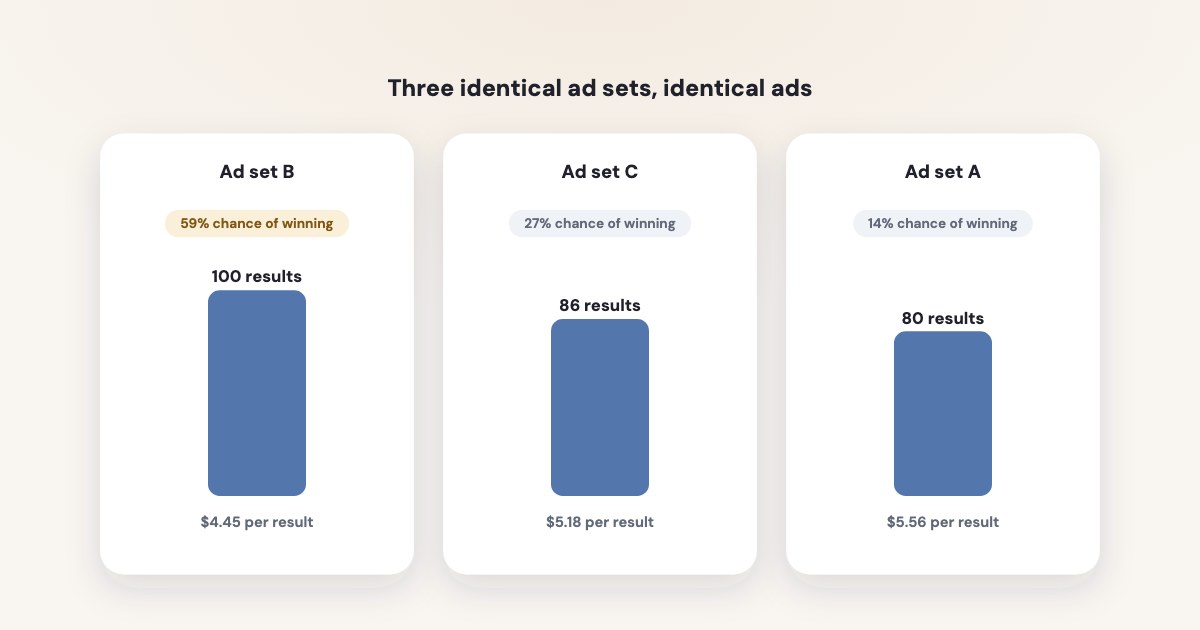
A real A/B test on Meta splits your audience into random groups that don’t overlap and changes one thing between them — set it up in Ads Manager’s A/B test tool, not by running two ads side by side. Run it for at least a week, two on a small budget, and expect Meta’s first results only after about 100 results per version. That’s the hard part for lead businesses: at 20 leads per version, a 25% difference can be pure chance. So test big questions — offer, form type, a different creative idea — not button colours, and read Meta’s “chance of winning” as a hint: in one test of three identical ad sets, Meta gave a “winner” 59%.
On this page9 sections
What an A/B test on Meta is
Meta splits the audience into random, non-overlapping groups
that see versions identical on all aspects except for a distinct variable
(source). Two campaigns running at once aren’t the same thing: When multiple campaigns or ad sets run simultaneously in Ads Manager without the A/B Testing tool, the system does not evenly split them
— and Meta’s FAQ adds: This isn't true experimentation.
You can test creative, audience, placement and objective
and up to five versions (source). The rule
that matters most: Select only one variable per test.
(source)
How many leads a test needs
You'll see early results after at least 100 events for the cost per result you're testing
For a lead business that’s 100 leads per version — $2,000 per version at $20 a lead. Most small budgets get far fewer. Here is how much chance alone moves cost per lead when nothing has changed:
| Looks 25%+ more expensive by chance | Looks 50%+ more expensive by chance | |
|---|---|---|
| 10 leads | about 1 time in 3 | about 1 in 8 |
| 20 leads | about 1 in 5 | about 1 in 15 |
| 30 leads | about 1 in 6 | about 1 in 30 |
| 50 leads | about 1 in 12 | under 1 in 100 |
Our Poisson calculation, from why cost per lead goes up. With 20 leads per version, only a gap of 50% or more is worth acting on. That’s why small businesses should test big differences.
How long to run it
Meta gives two answers. Its help center recommends a minimum of 7-day tests
and a maximum of 30 days
(source); its marketing page says keep your A/B tests running for at least 2 weeks or up to 30 days.
(source) If people take longer than a week to buy, run longer. On a small budget, two weeks is the safer choice —
and don’t change the ad sets while the test runs.
Meta names no minimum budget; it says only that larger reach, longer schedules or higher budgets tend to deliver more statistically significant results.
(source) Give each version the same budget, and keep the test audience from overlapping your other campaigns.
How to read “chance of winning”
Meta picks the version with the lower cost per result and runs simulations to estimate how often it would win again (source). Meta doesn’t set a pass mark; numbers like “90%” or “95%” come from blogs.
Three identical ad sets, one “winner”
Jon Loomer ran three identical ad sets with identical ads and spent over $1,300.
They got 100, 86 and 80 results — and Meta’s test gave one of them a 59% chance of winning. His conclusion:
Do not underestimate the contribution of randomness to your results.
(source)
Treat anything below a clear majority as “no difference”, and confirm a winner by what happens in your CRM: a version with cheaper leads that don’t buy hasn’t won.
Testing creatives: three ways
| How it works | Use it when | |
|---|---|---|
| A/B test (Experiments) | Separate ad sets, audience split evenly, one variable | A big question: offer, form type, a new creative concept |
| Creative Testing in the ad | 2–5 copies of an ad in one ad set, each person sees one, up to 20% of budget | Comparing new ads before rolling them out |
| Several ads in one ad set | Meta spends unevenly and favours early winners | Everyday running — not a test |
Creative Testing appeared in Ads Manager in late 2025; Meta hasn’t published a help page for it, so the details above come from Jon Loomer’s
review and may change (source). Whatever you use, make versions genuinely different: Meta treats
look-alike ads as one — When multiple ads look or feel alike, these are seen as variations of the same creative
(source). Ideas for different angles are in AI ad copy. A day-to-day register for several ads in one ad set, kept apart from an equal experiment, is in our guide to ads per Facebook ad set.
What to test first on a small budget
- Offer: free consultation vs price from $X; a course start date vs “start any time”.
- Form: instant form vs website form; standard vs higher intent (lead quality).
- Creative concept: a person on camera vs a result photo vs a price card.
- Audience setup: Advantage+ audience vs your own audience (targeting).
Skip button colours and single-word headline changes: the differences are too small to see with a few dozen leads.
Run and read tests in a conversation: Variafy
Variafy connects ChatGPT, Claude and other assistants to your Meta ad accounts. It can start an A/B test between 2–5 campaigns or ad sets — Meta splits the audience so nobody sees more than one version — and later compare the versions’ spend, results and cost per result. Meta doesn’t publish its winner through the API, so Variafy shows the numbers and says when a difference could be chance, and with sales from your CRM, which version brought customers. It doesn’t create Creative Testing inside an ad; for texts already running, its copy brief compares them within the same ad sets.
How we checked
Checked on 17 October 2026 against Meta for Business pages on A/B testing, Meta’s Business Help Center (A/B test best practices, how winners are determined), Meta’s Marketing API guide to split testing, Meta’s December 2025 post on creative diversification and two articles by Jon Loomer (2024–2026). The chance table is our Poisson calculation. We also read the pages that rank for these searches.
Variafy is our product.
Questions
How do I A/B test Facebook ads?
In Ads Manager, use the A/B test tool: duplicate a campaign, ad set or ad, change one variable — creative, audience, placement or form — and let Meta split the audience randomly. Run it for 7–30 days with equal budgets and compare cost per result and, ideally, sales.
How long should a Facebook A/B test run?
Meta’s help center recommends at least 7 days and at most 30; its marketing page suggests at least two weeks. On a small budget, run two weeks and don’t edit the ad sets during the test.
What budget do I need for a Facebook A/B test?
Meta names no minimum, but shows early results after about 100 results per version. For lead campaigns that’s often thousands per version; with fewer leads, test only big differences and treat small gaps as chance.
What does “chance of winning” mean in a Meta A/B test?
Meta’s estimate, from simulations, of how often the leading version would win again. It isn’t proof: in Jon Loomer’s test of three identical ad sets, one got a 59% chance of winning.
Is putting several ads in one ad set a test?
No. Meta spends unevenly across ads in one ad set and favours early leaders, so results reflect delivery, not a fair comparison. Use the A/B test tool or Creative Testing for comparisons.