Facebook lead ads on a $400 monthly budget
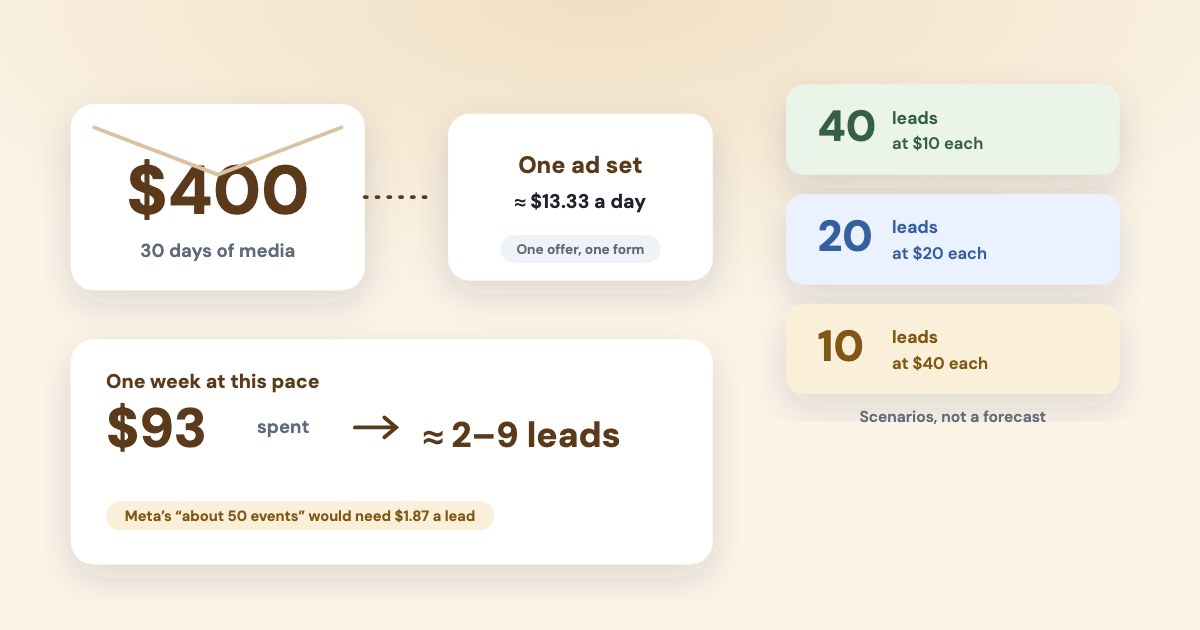
With $400 a month, test one lead offer in one ad set and judge qualified enquiries and sales. Over 30 days, the media allowance averages $13.33 a day; an assumed $20 per lead would buy 20 submissions. These are scenarios, not a forecast or a guarantee that Meta finishes learning.
On this page8 sections
Decide what the $400 covers
The calculations here assume $400 of media spend, in dollars, over a defined 30-day test. If $400 is your entire cash allowance, first allow for any applicable taxes, payment costs, creative work, software or sales support.
Do not silently convert an account in another currency to this example. Decide the actual media allowance in the account’s currency before entering a budget.
A test needs a question
A useful question is “Can this offer produce enquiries we can qualify and serve within our cost limit?” A $400 test cannot promise a reliable comparison between many audiences, countries and offers at once.
Set the maximum loss the business can tolerate and the evidence needed to continue. The budget-planning guide works backwards from sales, lead conversion and cost per lead; this article works forwards from a fixed allowance.
What $400 can buy at different lead costs
| Assumed media CPL | Submissions over 30 days | Submissions per 7 days at the same pace |
|---|---|---|
| $5 per lead | 80 | 18.7 |
| $10 per lead | 40 | 9.3 |
| $20 per lead | 20 | 4.7 |
| $40 per lead | 10 | 2.3 |
These are hypothetical scenarios: leads = spend ÷ cost per lead. Fractional weekly values describe a spending pace, not a promise of a fraction of a person or a stable weekly result.
Submission cost is only the first check. In a separate illustration, $400 buys 20 submissions and five meet your qualification rule: media CPL is $20 and media cost per qualified lead is $80. If some leads remain open, do not treat them as final sales losses.
Use cost per lead for the platform metric and cost per qualified lead for the business check. Neither number establishes profitability without the sales outcome and relevant costs.
Is $400 enough to exit learning?
Meta’s Learning limited guidance uses about 50 optimization events in the week after the last significant edit as its general diagnostic. If the selected event is a submitted lead, the 30-day spending pace gives $400 ÷ 30 × 7 = $93.33 a week.
Dividing $93.33 by 50 gives approximately $1.87 per lead. That is the cost needed for this illustrative pace to fund 50 weekly events; it is not an achievable CPL forecast or a guarantee that the status changes.
Meta separately gives a general delivery guideline of a daily budget at least ten times the average optimization-event cost in its ad-delivery troubleshooting page. At $13.33 a day, that points to an event cost of about $1.33 or less.
Learning limited isn’t a penalty
The two calculations answer different questions: funding roughly 50 weekly events and meeting Meta’s separate budget guideline. They are consistent with our Learning limited guide; neither creates a universal minimum spend for every business.
Plan for Learning limited
At the assumed $10–$40 per lead, Meta’s ten-times guideline would ask for roughly $100–$400 a day, against $13.33 here. Our Learning limited guide reaches the same conclusion at $25 a lead. Expect the status on a $400 test; it describes delivery, not whether the offer works.
Do not buy the wrong event to clear a status
Changing the goal to clicks changes what you are asking Meta to find. If the business needs enquiries, a completed click-learning phase does not show that it can acquire qualified leads affordably.
Start with one ad set and one offer
- Choose one serviceable offer. State what the enquiry is for, where you serve and any material price or eligibility condition.
- Use the Leads objective and the appropriate conversion location. If you choose instant forms, check the form and follow-up route before the test starts.
- Keep one ad set. Three equal ad sets would each average only about $4.44 a day over 30 days. Each would have its own optimization context.
- Keep creative manageable. One or two distinct ads is our starting suggestion for this allowance, not a Meta requirement or a fair A/B test.
- Record a review point and stop condition. Review tracking, delivery and lead handling immediately if they break; assess business outcomes as the cohort matures.
A separate retargeting allocation is not compulsory. Split the allowance only when you can explain what decision the extra segment will support and whether it can receive enough delivery to answer it.
Meta lists consolidation among the options for limited learning. It also says significant edits can restart learning, so avoid changing the audience, offer and event repeatedly without a documented reason.
Keep the budget tied to the test dates
Meta describes a lifetime budget as the amount for the entire run of a campaign or ad set. For a fixed $400 media test, use that budget duration with the intended start and end dates, after checking the setup preview.
A daily budget is an average with daily flexibility, rather than a hard daily or calendar-month ceiling. In a simple setup without ad set budget sharing, Meta may spend up to 75% more on an individual day and applies a weekly limit of seven times an unchanged daily budget.
At $13.33 a day, a 31-day month is already about $413 before considering the timing of spending. If you use daily budgeting, check dates, spend to date and remaining allowance; do not assume “about $13” safely means “at most $400 this month.”
Decide what the first month actually taught you
| Observed result | What to investigate | Decision evidence |
|---|---|---|
| No delivery | Payment, review, schedule, restrictions and minimum-budget errors | A delivery failure is not a lead-cost estimate |
| Submissions, few useful enquiries | Offer clarity, qualification and follow-up | Qualified volume and cost, with reasons for disqualification |
| Useful leads, no mature sales yet | Open quotes, sales-cycle length and contact attempts | A dated cohort with pending outcomes visible |
| Affordable qualified leads | Sales capacity and actual customer contribution | A separate decision about continuing or increasing spend |
Do not increase spend just to improve a learning badge. Continue only when the business can fund further uncertainty and the evidence supports the offer, lead handling and economics.
Variafy’s Meta integration is in testing and under Meta app review, with access by manual tester invitation. You can join the waitlist; external or client-account connection is not guaranteed.
How we checked
Sources checked on 30 October 2026: Meta’s Learning limited, delivery and budget guideline, daily budgets, lifetime budgets and significant edits. Meta Help Center text was read in Chrome; the arithmetic was cross-checked against our existing learning and budget guides.
Not confirmed: a universal CPL, guaranteed lead count, probability of a sale or a universal time to obtain reliable results on $400. All dollar scenarios are illustrative calculations; the suggested structure is editorial guidance, not an account test. Variafy is our product.
Questions
Is $400 a month enough for Facebook lead ads?
It can fund a limited test if the setup meets the account’s requirements. It does not guarantee enough qualified leads, profitable sales or an exit from learning.
How many leads will $400 buy?
Divide the media allowance by your actual cost per lead. At assumed costs of $10, $20 or $40, the arithmetic gives 40, 20 or 10 submissions; these are scenarios, not predictions.
Should I split $400 across several ad sets?
Start with one unless there is a specific reason to separate delivery. Dividing a small allowance makes each ad set’s data thinner and does not create a reliable audience experiment.
Does Learning limited mean my account is restricted?
No. It is a delivery diagnosis about insufficient optimization events under the current setup. Account restrictions are a separate issue.