What is a good CTR for Facebook ads?
CTR is the share of impressions that got a click. Ads Manager shows two main versions, and they differ about twofold: CTR (all) counts every click — likes, “see more”, profile taps — while link CTR counts only clicks to your site or form. 2026 benchmarks: Databox puts the median link CTR at 1.18% and CTR (all) at 1.90%; WordStream/LocaliQ reports 2.70% for US lead campaigns without saying which CTR. So a “good” CTR is roughly 1–2% link CTR — but compare against your own account, not the market. CTR isn’t an input to Meta’s auction, and clickbait that lifts it lowers ad quality. In one lead business we work with, ad sets with higher link CTR than the rest of the account that week did get cheaper leads.
On this page8 sections
What CTR means in Facebook ads
| What it counts | Use it for | |
|---|---|---|
| CTR (all) | Every click: link, likes, comments, “see more”, profile, photo | Rough attention |
| Link CTR | Clicks to your website, or opening an instant form | Comparing ads for leads |
| Outbound CTR | Clicks that leave Meta’s apps | Website campaigns; near zero for instant forms |
Meta defines CTR (all) as The percentage of impressions where a click (all) occurred out of the total number of impressions.
(source) and link CTR as The percentage of impressions that received a link click out of the total number of impressions.
(source) The formula: clicks ÷ impressions × 100 — Ads Manager calculates it for you. For lead forms, link CTR is the
column to watch: opening the form counts as a link click. More on reading the columns: how
to read a Facebook ads report. Comments are counted in CTR (all); to find the real question in them and answer it, see the separate guide to Facebook ad comments.
What is a good CTR? 2026 benchmarks
| CTR | Which CTR, sample | |
|---|---|---|
| Databox, Oct 2026 | link 1.18% · all 1.90% (medians) | 2,800+ companies with 1,000+ staff, all goals |
| WordStream/LocaliQ 2026 | lead campaigns 2.70% · traffic 1.93% | US, 452 lead and 1,377 traffic campaigns; type not stated |
| Superads, Jul 2026 | 2.34% (median) | $3B+ spend worldwide, mostly online shops; type not stated |
Sources: Databox, LocaliQ, Superads. They differ because they measure different things — link or all clicks, leads or traffic, the US or the world. Databox is the only one with both types on one sample: CTR (all) is about 1.6 times link CTR.
WordStream/LocaliQ’s lead-campaign CTR by industry in 2026: dentists 1.62%, education 1.74%, home improvement 2.14%, personal services 2.24%, real estate 4.17%, physicians and surgeons 4.18%. Treat these loosely: some industries rest on a handful of campaigns and swing a lot from year to year.
Does a higher CTR mean cheaper leads? What we measured
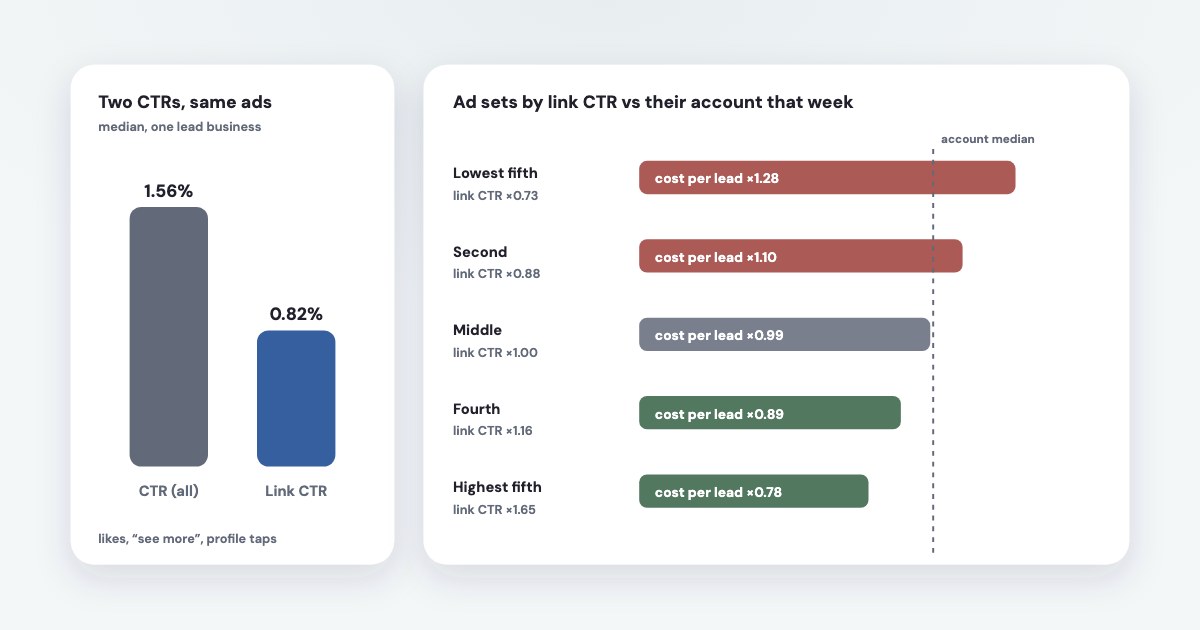
We took two ad accounts of one online education business we work with — 32 weeks of 2026 lead campaigns, 1,836 ad set-weeks with at least 2,000 impressions and 5 leads — and compared each ad set with its own account’s median that week. Median CTR (all) was 1.56% and median link CTR 0.82%, so about half.
| Link CTR vs account median | Cost per lead vs median | More expensive than median | |
|---|---|---|---|
| Lowest fifth | ×0.73 | ×1.28 | 72% |
| Second | ×0.88 | ×1.10 | 59% |
| Middle | ×1.00 | ×0.99 | 46% |
| Fourth | ×1.16 | ×0.89 | 38% |
| Highest fifth | ×1.65 | ×0.78 | 29% |
Rank correlation −0.37 — a stronger link to cost per lead than frequency or CPM had in the same data. Two limits: we didn’t count which leads paid, and CTR and cost per lead move with the same things (audience, creative, offer), so this shows a pattern, not a cause.
In e-commerce, CTR barely predicts cost
An agency analysis of 11 online brands in 2026 found CTR (all) correlated with cost per acquisition at just +0.02 within accounts (Sweat Pants Agency). Leads and purchases differ: an instant form opened is halfway to a lead. Judge by cost per lead and, better, by leads that buy — lead quality.
Does CTR affect delivery and cost?
Not directly. Meta’s auction uses Estimated action rates: An estimate of whether a particular person engages with or converts from a particular ad
(source), and the estimate is based on the business objective the advertiser selects
(source).
In a leads campaign, Meta predicts a lead, not a click.
The old relevance score is gone since 2019. Its replacements — quality, engagement rate and conversion rate rankings — aren't inputs into the ad auction
(source). There’s no “CTR ranking”.
Ads with a lower quality ranking tend to cost more
Meta’s quality assessment looks for withholding information, sensationalized language and engagement bait
(source).
“You won’t believe…”, “Comment YES” or hiding the price to force a click lifts CTR and hurts quality.
How to improve CTR without hurting lead quality
- Say the offer in the first line and the first 3 seconds of video: what, for whom, where, and the price or “free” if you have it.
- Show a person or a result rather than a logo or stock photo.
- Refresh ads when link CTR drops while frequency rises — frequency.
- Match the button to the next step: “Get quote”, “Book now”, “Sign up”.
- Compare within your account, same campaign and week, rather than against a market average.
Since March 2026, Meta counts only link clicks for click-through website conversions; that changes conversions in reports, not the CTR columns (attribution settings).
CTR next to leads and sales: Variafy
Variafy connects ChatGPT, Claude and other assistants to your Meta ad accounts. Ask “Which ads have a low CTR and expensive leads?” — it shows CTR (all), link CTR and cost per lead for each ad side by side, and with sales from your CRM, which ads brought customers.
How we checked
Checked on 17 October 2026 against Meta’s Business Help Center (CTR definitions, ad relevance diagnostics, ad quality), Meta’s ad auction page and its 2020 post on machine learning in delivery, and 2026 benchmarks by Databox, WordStream/LocaliQ and Superads, plus Sweat Pants Agency’s July 2026 report. Our own measurement uses two ad accounts of one online education business, March–October 2026, shown only as ratios. We also read the pages that rank for these searches.
Variafy is our product.
Questions
What is a good CTR for Facebook ads?
Roughly 1–2% link CTR. Databox’s October 2026 medians are 1.18% for link CTR and 1.90% for CTR (all); WordStream/LocaliQ reports 2.70% for US lead campaigns. Compare against your own account first.
What is CTR in Facebook ads?
Click-through rate: clicks divided by impressions. CTR (all) counts every click, including likes and “see more”; link CTR counts only clicks to your website or opening an instant form.
What is the average CTR for Facebook lead ads?
WordStream/LocaliQ’s 2026 report gives 2.70% for US lead campaigns, without saying whether it is link CTR or CTR (all). Industries range from 1.35% to 4.18%.
Does a high CTR lower Facebook ad costs?
Not directly: CTR isn’t an auction input, and Meta predicts the result you optimise for. In our lead data, higher link CTR came with cheaper leads; clickbait that lifts CTR lowers ad quality and tends to raise costs.
How do I calculate CTR for Facebook ads?
Divide clicks by impressions and multiply by 100. Ads Manager shows CTR (all) and link CTR as columns, so you don’t need to calculate them.