Facebook ads for dentists: from lead to booked patient
Facebook ads for dentists should describe a service without implying that the viewer has a health condition. As checked on 19 October 2026, Meta restricts insurance questions in lead forms and medical information in tracking. Keep clinical records inside the practice, connect enquiries to appointments there, and compare cost per booked and attended patient alongside cost per lead.
On this page10 sections
What can a dental Facebook ad actually say?
A dental ad can describe the practice and its services; it must not imply that Meta or the advertiser knows the viewer’s medical condition. Meta’s personal attributes policy covers physical and mental health. Using “you” or “your” is not automatically a violation: the problem is the personal attribute attached to it.
asserts or implies personal attributes
| Our draft to avoid | A service-led rewrite | |
|---|---|---|
| Implied health condition | “Are your gums bleeding?” | “Dental check-ups available at our Riverside practice.” |
| Attack on appearance (cosmetic offers) | “Your teeth look embarrassing.” | “Meet the team and explore our dental services.” |
| Unqualified outcome promise (health context) | “A perfect smile in three weeks.” | “Book a consultation to discuss options and suitability.” |
These are our teaching examples, not approved ads or a Meta whitelist. A neutral sentence still needs a truthful offer, an appropriate image and a suitable destination; a rewrite cannot guarantee approval.
Before-and-after images are not subject to a blanket ban in the policy we checked. Meta’s Health and Wellness policy allows general cosmetic before-and-after transformations with targeting restricted to adults aged 18 or older. Its appearance-shaming restriction applies to cosmetic offers; do not extend it to every dental service. In a health context, the policy also prohibits unqualified promises of a specific result within a fixed time.
The distinction matters for dental advertising: the policy exempts dental products, including teeth-whitening products, from that age restriction. It does not say that every whitening procedure, cosmetic dental service or image is therefore exempt. Classify the actual offer instead of treating “dentistry” as one permission.
For an already rejected ad, use the ad rejection and review guide. For routine check-ups and hygiene offers, the personal-attributes rule still applies: describe the service without asserting the viewer’s condition.
What can a dental practice advertise on Facebook?
Start with a specific service, an accurate description and a clear way to contact the practice. These are our proposed offers and teaching examples, not a list of Meta-approved ads.
| Suggested wording and what to check | |
|---|---|
| New-patient consultation | “New-patient consultations at Riverside Dental.” Describe availability without asserting the viewer’s health status. |
| Routine check-up or hygiene | “Routine check-ups and professional hygiene appointments.” Apply the personal-attributes rule; do not suggest that the reader has poor hygiene. |
| Orthodontic consultation | “Explore options at an orthodontic consultation.” Avoid “Crooked teeth?” If the actual offer is cosmetic, apply the 18+ rule. |
| Urgent appointment | “Urgent dental appointments during our published opening hours.” Describe the service and actual hours, rather than asking “Are you in pain?” |
| Whitening | “Ask about in-practice whitening options.” Distinguish a dental product from a cosmetic procedure; apply the cosmetic 18+ rule to the latter. Avoid unqualified time-bound results. |
| Implants or veneers | “Consultations about implants and veneers.” Classify the actual offer. If uncertain, our conservative proposal is adult targeting without before-and-after images. |
Meta’s cosmetic policy does not name dental procedures in its examples. The dental-product age exemption is not a blanket exemption for dental services; our conservative suggestions are not additional Meta requirements.
Use the local-business campaign guide for campaign type and location setup. Keep that setup tied to the practice’s service area. Choose a form or a call according to the practice’s process; a form must meet the Lead ads question restrictions.
What can you ask in a dental lead form?
Do not put an insurance questionnaire into a Meta lead form without Meta’s prior written permission. The Advertising Standards cover both the insurer’s identity or details and whether a person has insurance. On that page, find the Lead ads section; its list also restricts questions about current or past disabilities and mental health.
without our prior written permission
An insurance question is not a routine qualifier
“What type of dental insurance do you have?” asks for information the policy restricts. Meta’s rule applies to the question itself; it doesn’t carve out multiple-choice or optional fields — that is our reading of the rule, not a Meta statement. Keep the insurance discussion with the practice’s own team.
Our suggested starting point is a short administrative form: enough to arrange contact, without collecting a clinical history. Possible questions include “Which practice location would you prefer?” and “Would you prefer a phone call or email?” These are design suggestions, not a claim that Meta has pre-approved those exact words.
- State what the enquiry is for. Describe the consultation or contact request; avoid implying that submitting the form establishes suitability for treatment.
- Keep qualification administrative. A preferred branch can help route an enquiry without asking about insurance, disability or symptoms.
- Move clinical questions to the practice’s own process. Staff can handle the conversation using the clinic’s normal arrangements for patient information.
- Read every answer option as well as the question. A neutral heading can still conceal sensitive choices underneath it.
“How soon are you looking to start treatment?” needs more judgment: the source we checked does not give that exact phrase a yes or no. It can introduce medical context, so this guide does not certify it as allowed or label it explicitly prohibited. Use an administrative alternative when the timing question is unnecessary.
For the wider problem of weak enquiries, see how to improve Facebook lead quality. More qualifying questions are not useful when the questions themselves cross a policy boundary.
What may leave the clinic through tracking?
Medical information must not be shared through Meta Business Tools, and the restriction extends to the names and criteria used for events, conversions and audiences. Meta’s prohibited-information guidance makes this a separate check from whether an ad or form is acceptable.
must not reflect, imply, or be based on any prohibited information
Review the actual information leaving the practice: event names, event parameters, page addresses and audience rules.
Meta’s list of prohibited information includes medical procedures, treatments and testing and places of treatment, and says the list is not exhaustive.
Our reading: a treatment-booking event is not neutral by default; ImplantPatientBooked, for example, puts the treatment context into its name. A patient-list audience can also reveal medical information through the criteria used to assemble it.
A generic name does not settle the question
Renaming an event “Lead”, “Booked” or “Purchase” does not prove that its contents and context are acceptable. Review what is transmitted and what it reveals. A label change cannot establish permission to send a health-related appointment.
Keep booking, attendance and treatment-plan outcomes in an internal report when permission to transmit them has not been established. Do not add appointment forwarding, patient-list audiences or new tracking solely to populate an advertising report.
Keep diagnoses, treatment notes, insurance details and patient contact records out of advertising reports and assistant prompts. An internal reference is useful for joining the clinic’s records, but an identifier alone is not proof that the underlying information is non-sensitive or suitable to share.
How do you connect an enquiry to a booked patient?
Connect an enquiry to its later appointment in the clinic’s own records, using the original source reference when it exists. This is a proposed internal reporting method, not a request to send patient appointments back to Meta.
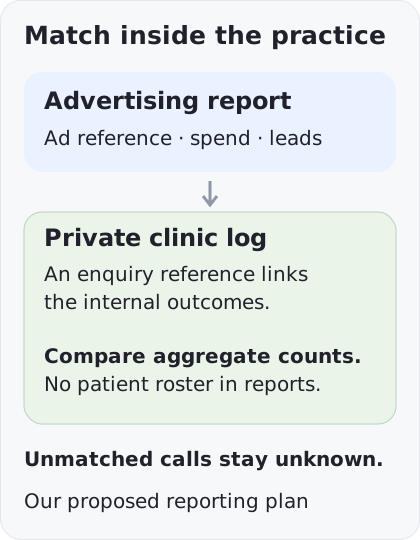
- Give each enquiry an internal reference. Keep its arrival date and known source together. Use the same reference when the appointment is booked, rescheduled or attended.
- Preserve the advertising reference already captured. Where the existing acquisition setup provides an ad or campaign reference, retain it in the clinic’s reporting record. The general guide to matching CRM outcomes to ads explains the mechanics; the medical-data check still applies.
- Record outcomes separately. Suggested stages are enquiry, booked, attended and accepted a treatment plan. Define “booked” as an appointment actually reserved, not an unanswered callback attempt.
- Deduplicate before counting. A repeat form and a later call about the same enquiry should not become two new patients. A reschedule should not become a second booking.
- Compare enquiries from the same period. Group outcomes by when the enquiry arrived and give each group a comparable chance to reach its appointment. Report the observation date too.
Log a new call without a reliable ad link as an enquiry with source “phone” and an unknown advertising source; do not distribute unlinked calls across ads. Asking “Where did you hear about us?” gives a self-reported source, not proof of which ad caused the call; keep self-reported and captured sources separate. To distinguish campaigns, consider a campaign-specific number or reference: this is our reporting proposal, not a Meta requirement. Call recording and storage of phone numbers are subject to the practice’s local rules.
A marketing summary needs aggregate counts and known ad references, not a patient roster. Enquiries, bookings, attended visits and accepted plans are separate outcomes in our suggested clinic workflow, not Meta interface labels.
What does a dental lead really cost?
A dental enquiry’s cost only answers what you paid for the enquiry; booked and attended appointments need separate denominators. Every figure in this worked comparison is invented; none is an industry price or conversion target.
| Ad A · teaching example | Ad B · teaching example | |
|---|---|---|
| Spend | $600 | $600 |
| Enquiries | 20 | 10 |
| Booked appointments | 4 | 5 |
| Attended appointments | 3 | 4 |
| Cost per enquiry | $600 ÷ 20 = $30 | $600 ÷ 10 = $60 |
| Cost per booking | $600 ÷ 4 = $150 | $600 ÷ 5 = $120 |
| Cost per attended appointment | $600 ÷ 3 = $200 | $600 ÷ 4 = $150 |
Ad A has the cheaper enquiry, while Ad B has the cheaper booking and attended appointment. Neither is automatically profitable: treatment value, margin, capacity and the eventual outcome still matter. With no bookings, report “no bookings yet” rather than inventing a cost per booking.
For a sourced, dated 2026 US reference for dentists, use the local-business guide’s industry table. Treat its figure as a reference, not a target; the cost-per-lead guide explains how to set a budget.
How can Variafy help check the advertising side?
Variafy connects an AI assistant to the practice’s Meta ad account so it can read spend, reported leads and cost per lead.
For a dental practice, keep patient-level payment and treatment records out of the assistant; compare your own aggregate bookings and attendance with the advertising report yourself.
A prompt that needs no patient records
“Compare these Meta ads by spend and reported leads for the same enquiry period. Flag ads with spend and no reported leads, and show the figures behind each flag. Do not infer appointments or patients from form submissions.”
Variafy does not write the creative, certify policy compliance or guarantee approval. Changes to the Meta ad account require human approval. Start with the advertising report and keep the appointment decisions with the practice.
What should the practice check before launch?
Review the ad, the form, the outbound data and the internal reporting plan as separate parts of the same launch. Use this checklist before spending, and again when the offer, form or tracking changes.
- Ad: describe the service without asserting the viewer’s health status. In a health context, avoid unqualified promises of a result within a set time.
- Offer and images: apply the cosmetic-offer rules, including adult targeting and the appearance-shaming restriction. Distinguish cosmetic procedures from the dental-product age exemption.
- Form: remove insurance, disability and mental-health questions unless the required written permission exists; review the rest for clinical information.
- Tracking: inspect names, parameters and audience criteria against Meta’s prohibited-information guidance. Keep unresolved transmissions out of the workflow.
- Reporting: define enquiry, booked and attended; retain unknown sources; compare enquiries with equivalent follow-up time.
Meta’s rules do not replace the advertising and patient-data rules in the practice’s country. This guide describes the platform policies checked on 19 October 2026; it does not determine whether a particular dental promotion is lawful locally.
How we checked
Checked on 19 October 2026 against Meta’s Advertising Standards: Privacy violations and personal attributes, Health and Wellness, the Lead ads question restrictions, and Business Help Center guidance on prohibited information. Those original pages were read in Chrome on that date; the links beside each policy point identify them.
Our editorial review compared six dental-advertising guides and Google AI Mode’s dental answer with those policies, including the answer’s recommendation to ask about insurance.
The form alternatives, internal reporting workflow and launch checklist are our proposals. The cost comparison is fictional arithmetic, not a client study or benchmark. Product statements were checked against the implementation on 19 October 2026. Variafy is our product.
Questions
Do Facebook ads work for dentists?
They can generate enquiries, but enquiries alone do not establish booked patients or profit. Track bookings and attendance inside the practice, compare their costs with ad spend, and check the ad, form and tracking against Meta’s rules.
What are good dental Facebook ad examples?
Start with a truthful service description, such as “Dental check-ups available at our Riverside practice”, and a clear next step. Avoid implying that the viewer has a condition; for cosmetic offers, also avoid appearance-shaming. These examples are not a guarantee of approval.
What should a dental Facebook ad say?
Describe the service and the next step without asserting the viewer’s condition. For example, “Routine check-ups available at Riverside Dental” names an offer without diagnosing the reader. The service examples in “What can a dental practice advertise on Facebook?” are teaching suggestions, not a guarantee of approval.
Can a Facebook dental lead form ask which insurance I have?
Not without Meta’s prior written permission. The Lead ads rules checked on 19 October 2026 restrict questions about the insurer’s identity or details and whether someone is insured.
Are dental before-and-after Facebook ads banned?
Meta’s Health and Wellness policy checked on 19 October 2026 does not impose a blanket before-and-after ban: it permits general cosmetic transformations with adult targeting. The dental-product age exemption does not establish that every dental procedure or image is allowed.
How much should a dental Facebook lead cost?
There is no universal price supplied by this guide. In our fictional example, a $30 enquiry costs $150 per booking, while a $60 enquiry costs $120 per booking. The local-business guide lists a sourced, dated 2026 US figure for dentists; treat it as a reference, not a target.
Can a dental clinic send booking events or patient lists to Meta?
Don’t send events that name the treatment or condition, and don’t upload patient lists unless you can establish that the data and its context are allowed. Meta prohibits health information in Business Tools and says event and audience names and criteria must not reflect or imply it. Meta’s list of prohibited information includes medical procedures, treatments and places of treatment, says it is not exhaustive, and doesn’t name dental events either way. Keep unresolved cases in your own records.