Facebook ads for contractors and home services: from enquiry to an approved estimate
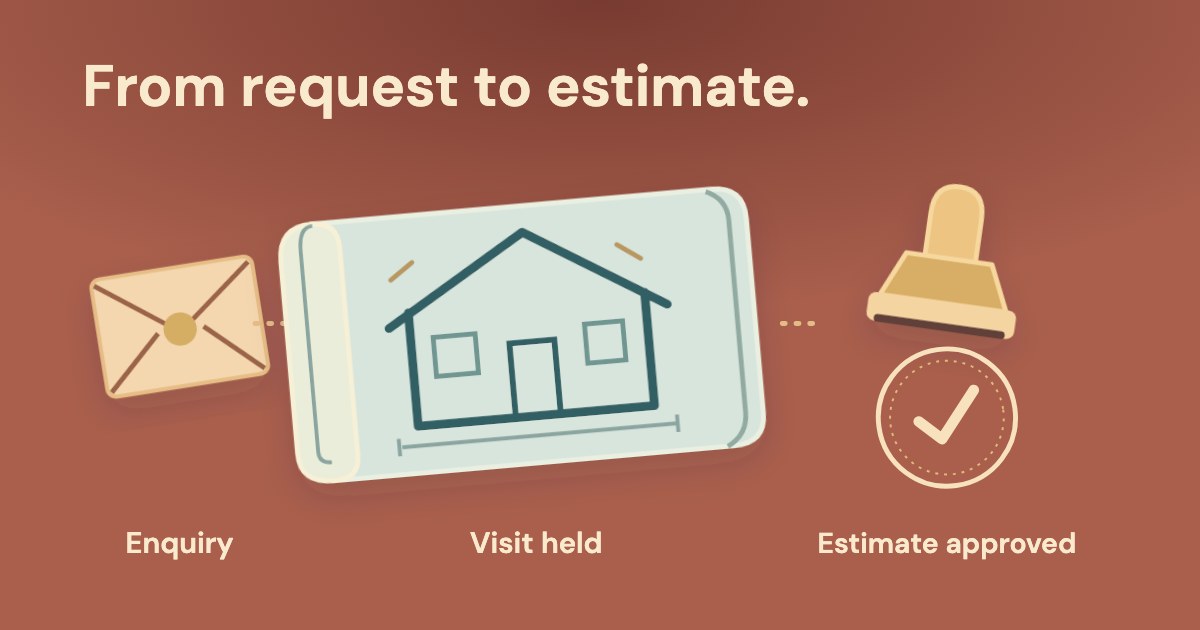
For planned home-service Facebook ads, our suggestion is to offer a specific job and track the enquiry through a held site visit, an estimate sent and an estimate approved. Meta’s Housing pages differ on repairs, so check them before launch; a service name does not settle the category, and a cheap enquiry does not prove a booked job.
On this page9 sections
What should a contractor offer, and does Housing apply?
Our suggestion: advertise a real planned job the team can assess and deliver, with a clear next step. The invented business here offers interior painting to private customers; it has an estimator and a limited schedule, not an emergency response service.
A suggested draft is: “Planning an interior repaint? See our recent room finishes and request a site assessment in our service area. We confirm the visit and prepare an estimate after checking the work.” Replace every detail with the actual service. This is our writing example, not a Meta-approved ad.
including, but not limited to, … housing repairs and home equity or appraisal services
Meta’s category-selection page explicitly includes housing repairs in its Housing description. Its separate About ads for housing page defines housing opportunities and related services, but its example list does not name repairs. The lists are not comprehensive and are not legal advice.
Our reading: the omission does not show that repairs are excluded, and the mention does not show that every repair ad is covered; this evidence does not settle the category for a particular painting, plumbing or renovation ad.
Check the actual offer, linked destination, market and category prompts in Ads Manager before launch. Use the special-category guide for the wider question; this article gives no category verdict.
The housing page says category selection applies when the advertiser is in the US or the audience is in the US, Canada or certain parts of Europe. If those qualifications are met and the category is not selected, the ad may be rejected.
For applicable Housing ads, the selection page limits or removes age, gender, postal-code, exclusion, lookalike and saved-audience options, with some interests unavailable and an expanded city or pin-drop radius. Its stated scope is US-based or US-reaching advertisers and advertisers reaching Canada or certain European countries. Do not turn that into a worldwide targeting rule.
Meta’s housing page lists the places it means by “certain parts of Europe” (49 entries when checked on 20 Oct 2026, including Poland, Czechia, Germany, France, the Netherlands, Spain, Italy and the United Kingdom); check that list against your own market.
Copy needs a separate check. Meta’s personal-attributes policy allows you/your without a personal attribute. Our suggestion: describe the work and process; avoid an invented line such as “Your roof is leaking and you can’t afford repairs,” which implies the reader’s financial situation. This is our application of the policy, not a verdict on an individual ad.
What turns an enquiry into a confirmed site visit?
A confirmed visit needs an agreed time and scope in the contractor’s own record. Our suggestion: give each enquiry a stable ID, assign a contact owner and record whether the customer actually agreed to the visit; a request alone stays pending.
Do not copy an intake questionnaire into an instant form without checking its wording. Meta’s prohibited-questions page, checked 19 Oct 2026 prohibits requests for financial information, including, but not limited to, income and net worth, and for insurance information, among other categories.
It also prohibits the same or substantially similar information as available prefill questions. If a form’s questions are found to violate the Advertising Standards, the lead ad will not run.
The page does not explicitly decide whether a renovation-budget question is permitted, and it does not approve a particular type-of-work question. Because the financial list is open-ended, its silence on budget is not permission either.
Our suggested service, territory and timing fields below are internal business-record fields, not a claim that Meta has approved those questions for an instant form.
The creation instructions allow up to 15 custom questions, with optional questions where applicable. That is a ceiling, not our recommended questionnaire length. The instructions tell you to enter a message explaining how the collected information will be used or shared, and say the information may only be used for the purposes stated in that notice.
The same page tells you to have your legal team check the planned questions, Lead Ads Terms and Advertising Standards. That instruction does not itself approve our example questions or settle the privacy-policy discrepancy.
The privacy instructions disagree
The instant-form overview labels a passage “Privacy Policy (Optional)” yet says a policy is required to run instant forms on Facebook or Instagram. The creation page instead calls adding the organisation’s policy URL optional. Checked 19 Oct 2026: these descriptions do not agree; verify what the actual form requires in Ads Manager rather than declaring either a universal rule.
The separate privacy-policy instructions say the policy link cannot directly open a PDF, image or download; an existing business policy URL can be used, without creating a custom policy just for lead ads. That technical instruction does not resolve the optional/required wording or establish local legal compliance.
Meta’s Appointment request instructions, checked 19 Oct 2026 describe a preferred date and time for engaging with the business. Adding the feature restricts delivery to the Facebook app on mobile devices. Its availability defaults to Monday–Sunday, 07:00–22:00, and that range cannot currently be customised.
Our reading: the preference is not the estimator’s availability or a reserved slot. Confirm it against the actual schedule and record the agreement. For the broader form workflow, follow the lead-form guide; keep this handover in the business’s own job record.
A filled enquiry-to-estimate worksheet
Track milestones for the same enquiries, with a dated snapshot of what remains open. Everything in this example is invented: one painting offer, $1,200 ad spend and 24 unique enquiries received on 1–7 October 2026, followed through 20 October.
| What counts | Position at the cutoff | |
|---|---|---|
| 24 enquiries | One record per enquiry after duplicates are reconciled. | 7 closed as unsuitable; 5 still being qualified; 12 qualified. |
| 12 qualified | Work, territory and timing fit the actual service. | 10 visits booked; 2 qualified customers still awaiting slots. |
| 10 visits booked | A particular visit was agreed, not merely requested. | 8 held; 2 booked for future dates. |
| 8 visits held | The estimator actually attended and recorded the scope. | 6 estimates sent; 2 still being costed. |
| 6 estimates sent | A dated estimate version reached the customer. | 3 approved; 1 declined; 2 awaiting a decision. |
| 3 estimates approved | The customer’s approval and estimate version were recorded. | No completion or payment recorded yet; those are separate records. |
These milestone counts overlap; do not add 24, 12, 10 and 8 as different people. The mutually exclusive snapshot does reconcile: 7 unsuitable + 5 qualifying + 2 awaiting slots + 2 future visits + 2 being costed + 3 approved + 1 declined + 2 awaiting decisions = 24.
Our suggested record includes enquiry ID and date, ad-link tags if present, service-area decision, scope, contact owner, agreed visit, visit-held date, estimate ID/version, sent date, approval evidence and next action/date. Keep personal details in the business’s authorised system; this worksheet does not need to publish them.
Separate the seven unsuitable enquiries by recorded reason. In this invented snapshot, three are outside the service area, two request unavailable work and two need a start date the team cannot offer. Do not call all seven poor-quality traffic without checking which promise or handover produced the mismatch.
What do the costs say before every estimate is decided?
The same spend gives different costs for different milestones. Our reading of the invented cohort is $1,200 ÷ 24 = $50 per enquiry, $1,200 ÷ 8 = $150 per held visit, $1,200 ÷ 6 = $200 per estimate sent and $1,200 ÷ 3 = $400 per approved estimate.
These are descriptive cohort ratios, not Meta benchmarks, profit or final acquisition costs. The $400 figure remains provisional: two sent estimates are undecided and other enquiries have not reached that stage. Do not count an undecided estimate as a loss or an approved estimate as collected revenue.
| Evidence to check | Our suggested next action | |
|---|---|---|
| Visits booked, few held | Future appointments, cancellations, confirmations and agreed access. | Separate visits not yet due from missed visits before blaming the ad. |
| Visits held, estimates missing | Estimator notes, scope gaps and the costing queue. | Assign an estimate owner and delivery date; another lead cannot clear that queue. |
| Estimates sent, few approved | Decisions actually due, questions, scope versions and recorded objections. | Follow up on the specific estimate; separate declined from still open. |
| Approvals, no delivery space | Real crew availability and promised start dates. | Have the owner decide whether to limit new work; do not automatically expand spend. |
Use the same enquiry window and comparable time to reach a decision when comparing campaigns. An ad report for spend this week and a list of approvals from older enquiries are different populations. For the broader distinction between advertising results and money, see matching ads to recorded sales.
Who owns the next step after the enquiry?
Our suggestion: make the next step an assigned task with evidence, not an instruction to “follow up faster.” A short handover can expose whether the advertising promise, qualification, visit or estimate is actually blocked.
- Contact owner: resolve service and territory fit, record an agreed next contact and leave unanswered enquiries open.
- Estimator: confirm the visit, mark it held only after attendance, and identify the estimate version and outstanding scope questions.
- Business owner: set the decision date, available crew capacity and affordable cost using the real margin and buying delay.
- Advertising operator: compare recorded mismatch reasons with the actual ad and destination; propose one evidenced change for approval.
For example, the invented team assigns its two uncosted visits to the estimator and its two unanswered estimates to the estimator. It does not interpret either queue as a reason to add another creative or promise an earlier start date.
The lead-quality guide covers wider diagnosis. Here, the useful output is the specific record, person and next action that can move a planned job forward.
How can Variafy help check the advertising side?
Variafy is in the free beta, with Meta support live. It can read spend, Meta-reported results, campaign and ad-set settings, and the returned ads from a connected account. Ask for the date window, attribution setting and whether the returned list is complete; a missing row is not automatically a zero.
A suggested request is: “Show the campaigns and ads for this painting offer, their spend and reported result types for the agreed dates. State coverage and the targeting summary returned. Separate observations from questions the team must confirm before proposing a change.”
The targeting summary does not establish every named city, postcode or radius. Exact service-area fit still needs a person to compare the actual settings and enquiry record. The product does not automatically import site visits, estimates, approvals or form answers.
For money, it can match payments your business sends through tags carried from the ad link; ambiguous or unmatched amounts remain unattributed, and the report identifies the money source. A Meta-counted purchase is not proof of a customer payment.
If this account has never sent its own payments, the report can show purchases Meta counted when available, labelled as Meta data. An empty payment list does not mean the work earned nothing; there is no business payment in this result to match.
See the CRM-sales guide for that separate setup; account changes require human confirmation.
What should be agreed before the next launch?
Our suggestion: approve a short launch brief containing the actual planned work, service boundary, policy questions, handover owner and next decision date. Use the local-business guide for the wider setup, rather than treating this worksheet as a full account build.
For the invented painting business, the next checkpoint is to complete the costing queue, resolve the two sent estimates and check which qualified enquiries can get a real visit slot. The owner then decides whether the existing offer can accept more enquiries.
Copyable handover
Offer and territory: __. Enquiry dates and cutoff: __. Visit owner: __. Estimates sent / approved / still open: __. Next action, owner and date: __. Available delivery capacity: __. Proposed advertising change and approver: __.
This record makes an approved estimate visible without pretending it is a finished, paid job. Keep updating the same cohort as work and payments occur.
How we checked
Policy and feature wording checked 19 Oct 2026 against 8 public Meta documents: How to choose a Special Ad Category, About ads for housing, Questions prohibited on your instant form, Create a lead ad with instant form.
Also checked: About lead ads with instant form, About privacy policies for lead ads, Add an appointment request and Personal attributes.
The housing page was checked again on 20 Oct 2026 for its list of places under “certain parts of Europe”; it remains one of the same 8 documents.
Conflicting descriptions and their geographic or feature scope remain explicit. The business workflow, copy and numbers are our suggestions and an invented example, not Meta performance data.
Questions
Do Facebook ads work for contractors and home services?
This guide does not establish a success rate. Our suggestion is to test one planned service the team can deliver and follow the same enquiries through held visits, estimates and recorded approvals. Emergency calls and large construction-company campaigns need a different plan.
Are home-repair ads in Meta’s Housing category?
Meta’s category-selection page names housing repairs; its separate housing page omits them from a non-exhaustive example list. Our reading: neither page settles a particular ad. Check the offer, destination, market and category prompts.
Can an instant form ask about a renovation budget?
The checked prohibited-questions page names income and net worth within an open-ended financial-information list but does not explicitly decide a renovation-budget question. This guide does not declare that wording permitted or prohibited. Check the exact question before using it.
Does an appointment request reserve an estimate visit?
Meta describes a date and time preference. Our reading: the business still needs to agree and record an actual visit. The cited feature restricts delivery to the Facebook mobile app, with Monday–Sunday availability from 07:00 to 22:00 that cannot currently be customised.
What is a good cost per contractor lead?
There is no universal cost in this guide. The invented $50 enquiry becomes $150 per held visit and a provisional $400 per approved estimate. Use your own margin, buying delay, capacity and unresolved enquiries to decide an affordable limit.
Should I count approved estimates as revenue?
Our suggestion is to keep approval, work completed and payment as separate records. An approved estimate can still require scheduling and delivery; count collected money from actual payment records, and keep its reporting dates distinct from the enquiry cohort.