How to increase a Facebook ads budget without breaking results
Raise the budget of an ad set that has left learning and had a steady week — not just one cheap week — by a step you are ready to leave alone for seven days, then judge it by what the extra leads cost. Meta publishes no safe percentage: $100 to $101 won’t restart learning, $100 to $1,000 may. In our data, raises of up to 20% did no better than raises of 21–50%. For a few busy days, schedule the higher budget instead; that doesn’t restart learning.
On this page11 sections
What Meta actually says about raising a budget
Meta lists the edits that send an ad set back into learning. Changes to targeting, creative, the optimisation event or bid strategy always count; a budget change counts depending on its size:
If you increase your budget from $100 to $101, that isn't likely to cause one or more ad sets to reenter the learning phase
The same page says a change from $100 to $1,000 may. Between the two, Meta gives no number. The closest it came was a prompt Jon Loomer
reported from Ads Manager in 2023: You can increase your daily budget up to $179 without reentering the learning phase.
—
a 79% raise, shown for one campaign (source). Not every account sees such prompts.
The only “20%” we found on Meta’s sites is in a developer guide for game ads, which suggests raising budgets by no more than 20% per day
(source). The same page says daily spend can vary by up to 25%, while Meta’s help pages put it at 75% —
so it is advice for one ad type, not a rule for lead ads.
Loomer, who used to recommend tiny raises, wrote in 2025: Meta’s more forgiving about budget increases now, so we don’t need to be as cautious as we once were.
(source)
What happened when one business raised its budgets
We looked at every budget change on the ad sets of one online education business we work with, from March to October 2026. For each change we compared cost per lead in the 7 days before and the 7 days after, on ad sets with at least five leads in each week:
| Cost per lead rose the next week | Median change | |
|---|---|---|
| Ad set left alone (no edits) | 47% | −4% |
| Budget cut | 49% | no change |
| Raise of up to 20% | 67% | +16% |
| Raise of 21–50% | 67% | +20% |
| Raise within 72 hours of another edit | 71% | +22% |
Three things stand out:
- Small steps weren’t safer. Raises of up to 20% hurt as often as raises of 21–50%. There were too few raises above 50% to say anything about them.
- Raises cost something; cuts didn’t. A raise made the following week’s cost per lead worse about two times in three, against roughly half the time for ad sets left alone or cut.
- Raising on top of a fresh edit was worst — see Learning limited for why.
This is one advertiser, and a week after a change is not a verdict on it. Treat it as a reason to stop trusting the 20% rule, not as a new rule.
Don’t raise because of one cheap week
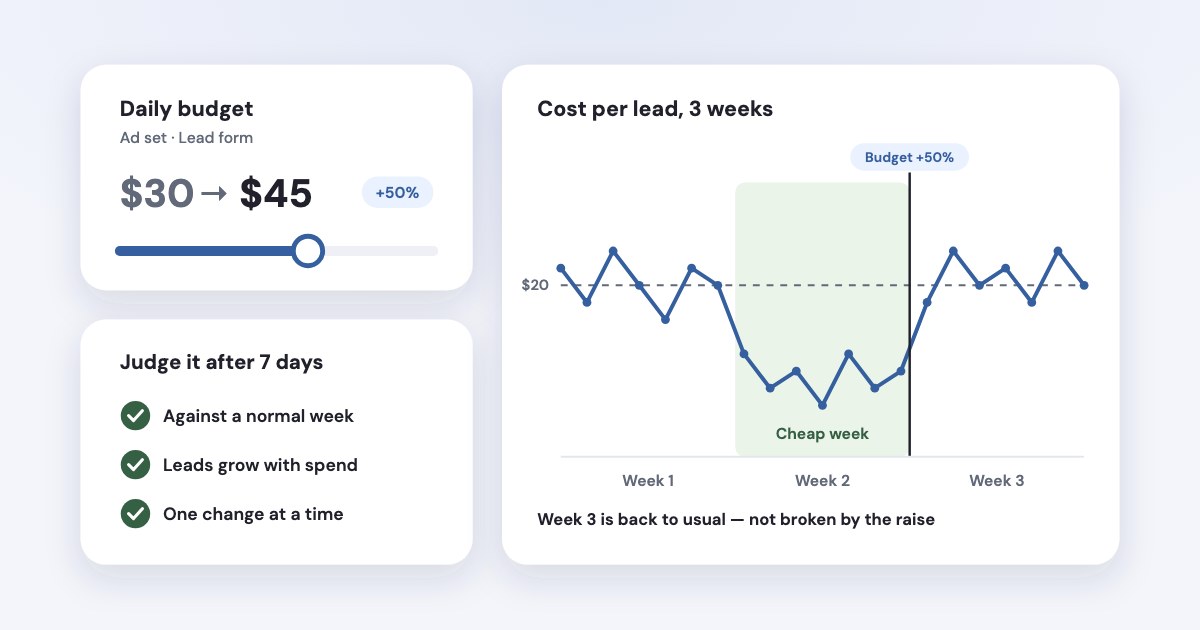
The most common reason to raise a budget is a week that went unusually well. That week rarely repeats. In the same data, after a week at least 20% cheaper than the four weeks before it, cost per lead rose the following week about four times in five — with a raise (77–83%), and in the smaller set of ad sets nobody touched as well (7 of 9 weeks).
What this means for the decision
If you raise after a lucky week, the next week will look worse whatever you do, and the raise will take the blame. Compare the last week with the four before it. Raise when the ad set has been steady for a few weeks, not when it just had its best one.
Meta’s own “raise your budget” recommendation works the same way. It appears for ad sets with stable delivery and a lower cost per result
than similar ones — including you or your peers
, meaning other advertisers (source).
The percentage of extra results it shows is, in Ads Manager’s words, based on data from real advertisers who took this recommendation
over 28 days — an average, not a forecast for your ad set (source).
The extra leads cost more than the average
Meta says it plainly in its bid strategy documentation, about the default Highest volume strategy:
Costs can rise as you exhaust least expensive opportunities or as you increase budget.
(source)
The help pages add that cost per result may increase because your budget is significantly higher than usual
(source).
So look at the cost of the additional leads, not the new average:
- Before: $30 a day, $210 a week, 14 leads — $15 a lead.
- After: $45 a day, $315 a week, 18 leads — $17.50 a lead on average.
- The extra: $105 more bought 4 more leads — about $26 each.
If a lead is worth $40 to the business, the raise pays. If it is worth $20, the average still looks fine while every extra lead loses money. For a school or clinic in one city, the audience runs out faster, and the extra leads get expensive sooner. In our data, the first week after a raise usually brought more spend but hardly more leads; check the CRM for which ones turn into customers (lead quality).
How to raise it, step by step
- Check the ad set is ready. It has left learning, cost per lead has been steady for a few weeks, and it spends its current budget. If it doesn’t spend what it has, more budget changes nothing — look for the reason first (not spending).
- Decide what an extra lead may cost. From what a lead is worth to the business, not from the current average.
- Make one change. Raise the budget and nothing else — no new ads, audience or bid strategy in the same week, or you won’t know what worked. A new budget takes effect in about 15 minutes, and Meta recommends waiting that long before touching the bid (source).
- Expect uneven days. Meta may spend up to 75% over the daily budget on a good day and less on others; a week never goes above 7 times the daily budget (source). One day after a raise tells you nothing.
- Wait a full week. Meta:
Wait at least 7 days after any adjustment before re-evaluating.
(source) It also suggests looking atat least a full week
of results (source). - Judge the extra leads, as above, against the four weeks before. Then raise again, hold, or go back.
Small steps cost time. Getting from $30 to $100 a day in 20% steps takes seven raises: seven weeks if each one gets its week, or seven days if you raise daily and never see a full week after any of them. In the business we looked at, almost half of budget changes were followed by another significant edit of the same ad set within a week, so their effect could never be read.
Other ways to spend more
Budget scheduling for busy days
If you only need more spend for a launch, an enrolment deadline or a seasonal peak, schedule it:
Increasing your budget by scheduling a high demand period through budget scheduling won't prompt the delivery system to enter a learning phase.
It works with daily budgets only; a period lasts at least 3 hours; the scheduled budget can be up to 8 times the daily one; and when the period ends, the budget goes back by itself. Each period is set separately — Meta doesn’t support repeating ones yet (source).
Raise the ad set that works, don’t duplicate it
A copy of an ad set is a new ad set: it starts learning from zero and goes after the same people as the original. Meta enters only one
of your ads in each auction, so they don’t bid against each other, but too much overlap makes results less predictable
,
especially when scaling your budget
(source). Loomer’s practice:
I don’t duplicate ad sets to scale, choosing instead to increase the budget of the ad set that’s working.
(source) A new ad set makes sense for a genuinely new audience, such as another city.
The best-known forum thread on this — a $2,000-a-day campaign duplicated at $5,000 that then did much worse, viewed about 147,000 times on Shopify Community — was a duplicate, not a raise (source).
Campaign budget
With Advantage+ campaign budget, Meta moves money between the ad sets of a campaign, and that doesn’t restart learning:
ad sets within the campaign won't reenter the learning phase as budget is distributed.
(source)
Sales and Leads campaigns get it by default, and it can be switched on or off at most once every 2 hours
(source). Meta doesn’t say whether switching an existing campaign from ad set budgets to a campaign
budget counts as a significant edit, so do it on its own, not in the same week as a raise.
A cost per result goal
If the extra leads get too expensive, a cost per result goal tells Meta where to stop. The trade-off, in Meta’s words: it
May not spend full budget once you hit the cap.
(source) Changing the bid strategy is itself a
significant edit, so don’t combine it with a raise.
Limits that cap a bigger budget
- Account spending limit.
When the amount is reached, all delivery stops.
(source) Raise or remove it before raising budgets. - Daily spending limit of new accounts. You can set a budget above it, but Meta won’t spend more than the limit. Our guide to spending limits and failed payments explains how it grows.
- Payment threshold. A higher budget reaches the billing threshold sooner; make sure the card can take the larger charges.
Budget advice you’ll read, and what Meta says
| What you’ll read | What Meta says | |
|---|---|---|
| The 20% rule | Never raise a budget by more than 20% | No percentage; $100 to $101 is safe, $100 to $1,000 may restart learning |
| Timing | Raise every 3 days, or wait 72 hours before judging | Wait at least 7 days and judge on weekly averages |
| Small edits | Even a tiny tweak resets learning | Only a significant edit causes an ad set to reenter learning |
| Duplicates | Copies bid against each other and drive up costs | Your ads don’t bid against each other; heavy overlap makes delivery less predictable |
| Daily overspend | Meta can spend 25% over the daily budget | Up to 75% on a single day, at most 7 times the daily budget in a week |
How Variafy helps
Ask your assistant “Raise the budget of the ad set with the cheapest leads by 30%” and Variafy:
- Shows the change before it runs: the new budget, the most Meta may spend on a single day and over 30 days. Nothing changes until you approve it.
- Tells you about learning: what Meta reports for the ad set, when it was last significantly edited, and a warning if that was less than 72 hours ago.
- Measures the result: 7 days later it compares the ad set’s spend, results and cost per result before and after the change, and says so when there are too few results to judge.
- Lets you take it back: for 14 days the change can be reversed, as a new change you approve.
Add https://www.variafy.com/mcp to your assistant. Variafy is in private beta:
join the waitlist.
How we checked
Checked on 16 October 2026 against Meta’s Business Help Center (significant edits and the learning phase, daily budget flexibility, budget scheduling, cost per result goals, fluctuations in cost — read on 15 October 2026; campaign budget setup and how fast a new budget applies — read on 16 October) and Meta’s developer documentation: bid strategies (updated 26 June 2026), high demand periods (updated 3 September 2025), performance recommendations (updated 27 August 2026), the ad account reference (updated 3 August 2026) and the Click-to-Play ads budget guide for games (updated 3 March 2026). Ads Manager wording from 2023–2024 is quoted from Jon Loomer’s posts. Our data: budget changes recorded in Meta’s activity log for the ad accounts of one online education business, March–October 2026, ad sets with at least five leads in each of the two weeks compared.
Variafy is our product.
Questions
How much can I increase my Facebook ads budget without resetting learning?
Meta publishes no percentage. Its example: $100 to $101 is unlikely to restart learning, $100 to $1,000 may. In one advertiser’s data, raises of up to 20% and of 21–50% made cost per lead worse equally often, so pick a step you are willing to leave alone for a week.
Is the 20% budget rule real?
Not in Meta’s help pages. The only Meta page we found with 20% is a developer guide for game ads, which calls its numbers guidelines. Meta’s help centre says the effect of a budget change depends on its size, without a threshold.
How long should I wait after increasing a Facebook ads budget?
At least seven days. Meta suggests waiting at least 7 days after any adjustment and judging on weekly averages, because daily spend and cost per result move around on their own.
Why did my cost per lead go up after I increased the budget?
Meta buys the cheapest results first, so extra budget goes to dearer ones. A large raise can also restart learning. And if you raised after an unusually cheap week, the next week would probably have been dearer anyway.
Should I duplicate an ad set or increase its budget?
Usually increase the budget of the ad set that works. A duplicate starts learning from zero and competes for the same auctions as the original; a new ad set makes sense for a genuinely new audience.
Does budget scheduling reset the learning phase?
No. Meta says increasing a budget through a scheduled high demand period does not send the ad set back into learning. It works with daily budgets, for periods of at least 3 hours, up to 8 times the daily budget.
What is vertical and horizontal scaling on Facebook?
Vertical scaling means raising the budget of an ad set or campaign that works; horizontal scaling means reaching new audiences, usually with new ad sets. Meta’s help pages mostly recommend fewer, larger ad sets, so horizontal scaling is best kept for genuinely new audiences.