Facebook lead ads for manufacturers and exporters
A manufacturer can use Facebook and Instagram lead ads to collect export enquiries, but a submitted form does not establish that someone is a buyer. Start with a destination market you can serve, describe the wholesale offer clearly and ask the questions your sales team needs to prepare a quote. Judge the campaign by qualified enquiries and orders, rather than the cheapest form submissions.
On this page9 sections
Define a quote-ready enquiry before building the ad
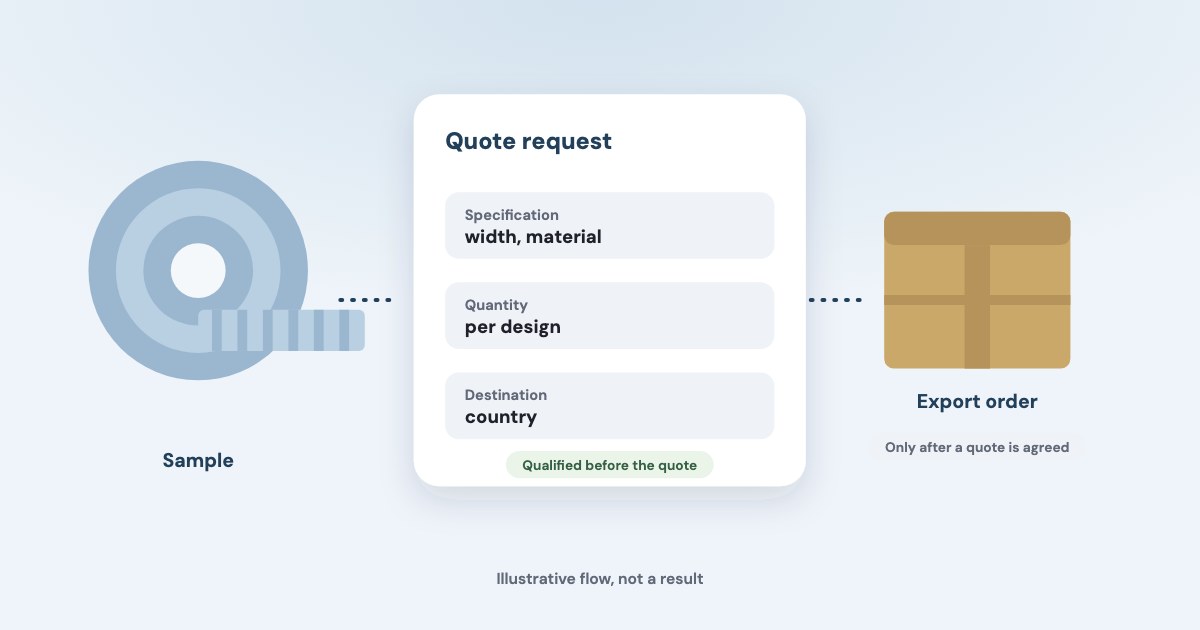
Write down what makes an enquiry worth a salesperson’s time. For an exporter, that might mean a business buying a product you manufacture, meeting the minimum order quantity and requesting delivery to a market you can serve.
Separate an initial enquiry from a qualified enquiry, a quote, a sample request and an order. An unanswered contact is still unresolved; it is not automatically a fake lead.
An illustrative wholesale offer
“Custom woven labels for clothing brands. Minimum order: 5,000 pieces per design. Send your dimensions, quantity and delivery country for a quote.” The product and minimum are fictional: replace them with your actual capabilities.
Show real production, a sample beside a scale reference or the customization options you actually supply. Do not promise a certification, shipping service or production lead time you cannot substantiate.
Choose countries and buyer roles without assuming precision
Choose the first market for operational reasons: delivery coverage, a language your sales team can handle and a product specification you can quote. If several markets need different offers or follow-up, test them sequentially when the budget cannot support separate campaigns.
Meta’s audience guidance distinguishes controls from suggestions. Check the selected countries and any option to expand beyond them; detailed targeting used as a suggestion may be exceeded. Available audience settings can differ by campaign configuration.
- Set your serviceable locations. Read the saved audience settings before publishing, including any location expansion option.
- Search the available detailed targeting. If a relevant job title appears, consider it as an input. “Purchasing manager” and “sourcing manager” are search ideas, not a promise that Meta offers those exact options in your account.
- Qualify the role in the form. Ask whether the person buys for a brand, distributor, manufacturer or another business.
- Check actual enquiries. Meta’s lead-retrieval guidance says location signals are imperfect and some leads may come from outside your settings.
A job title selection does not verify employment or purchasing authority. The targeting guide explains the broader audience model.
Build a form that gives sales something to quote
In Ads Manager, choose the Leads objective and Instant forms as the conversion location. Meta’s instant-form overview explains contact prefilling and qualification features; the creation guide covers the form editor.
Higher intent: Add a review step that gives people a chance to confirm their information.
| Qualification field | Suggested question | How sales uses it |
|---|---|---|
| Business and role | Company name or website; what do you buy for the business? | Check that the enquiry concerns a business purchase |
| Specification | Which product, material, dimensions or customization do you need? | Confirm manufacturing fit before quoting |
| Quantity | What quantity do you need per design or order? | Compare with your stated minimum |
| Destination | Which country should we quote delivery to? | Check serviceability; this may differ from the person’s location |
| Timing | When do you need the sample or production order? | Check production and sales capacity |
This is a suggested question set, not Meta’s required form. Start with the fields needed for the next sales action, state how the information will be used and add your privacy policy link.
Explain the next step on the ending screen: who will reply, through which channel and what information they may request. A promised quote should mean a quote, rather than an unrelated sales sequence.
Filter unsuitable enquiries deliberately
Conditional logic can route answers to another question, a submission or a close-form page. Meta warns that it may raise cost per lead, and you will not receive the details of people routed to close the form.
For example, an order below your minimum could end with a clear explanation or a link to an appropriate retail option. Only close the form if sales truly cannot serve that request; do not discard a potentially useful sample enquiry by accident.
More friction needs a business reason
A higher form completion rate is not the only goal, but adding every possible question can also lose suitable buyers. Treat each change as a hypothesis and record both qualified volume and cost.
For the general choice between an instant form and a website, see lead forms versus landing pages. A detailed specification or drawing may need a later conversation or website workflow.
When lead quality is low, identify the failed step
| Observed problem | Check first | Possible next test |
|---|---|---|
| Retail requests | Does the ad clearly say wholesale and state the minimum? | Put the minimum beside the product and repeat it in the form |
| Wrong product or quantity | Do the questions capture what sales needs? | Add the missing specification or quantity question |
| Unreachable contacts | Was the enquiry delivered and contacted through the promised channel? | Check routing and contact details before changing targeting |
| Suitable companies, no orders yet | Have quotes, samples and open opportunities had time to progress? | Review the sales cohort rather than declaring recent leads lost |
Keep spend, submitted leads, qualified enquiries, quotes and orders together for the same lead cohort. If $400 produces 40 submissions but only four qualified enquiries, the illustrative costs are $10 per submission and $100 per qualified enquiry.
Those figures are arithmetic, not an exporter benchmark. Use the lead-quality guide and qualified-lead calculation to keep the definition consistent.
Compare the workflow with marketplaces using facts
Alibaba’s RFQ documentation describes a buyer posting a sourcing requirement, to which sellers can respond with quotations. Meta instant forms collect information from people responding to your ad inside Facebook or Instagram.
| Workflow | Meta instant-form campaign | Alibaba RFQ workflow |
|---|---|---|
| Starting action | A person responds to your ad and submits your form | A buyer posts a sourcing request; sellers respond |
| Qualification material | Your offer and form questions, followed by sales checks | The posted requirement and subsequent conversation |
| Comparable business outcome | A qualified enquiry, quote or order under your definition | The same definition, with channel costs recorded separately |
These mechanics do not establish which channel is cheaper or produces better buyers. We found no comparable evidence here for a universal cost, quality or sales-cycle ranking.
Keep follow-up and product access visible
Use Meta’s documented export or CRM routes to retrieve submitted leads, and assign a person to follow up. See connecting ad spend to CRM sales for the measurement workflow.
Variafy’s Meta integration is in testing and under Meta app review. Access is by manual tester invitation; joining the waitlist does not guarantee connection of an external or client ad account.
How we checked
Sources checked on 30 October 2026: Meta’s instant-form overview, creation guide, conditional logic, audience controls and suggestions, lead retrieval and Alibaba’s RFQ explanation. Meta Help Center text was read in Chrome.
Not confirmed: availability of any named job title in every account, purchasing authority, exporter CPL benchmarks or comparative marketplace performance. The qualification framework and dollar example are editorial illustrations, not account tests. Variafy is our product.
Questions
Can Facebook lead ads work for a manufacturer?
They can collect export enquiries through instant forms. Whether they produce useful buyers depends on the offer, serviceable markets, qualification and sales follow-up; this guide does not establish a manufacturer conversion benchmark.
Can I target purchasing managers by job title?
Search your account’s available targeting options, but do not assume a named title is available or verifies a purchasing role. Detailed targeting may be used as a suggestion, so qualify the role in the form.
Will Higher intent guarantee better B2B leads?
No. It adds a review step. Check qualified enquiries and downstream orders to judge whether it improves your own campaign.
Are Meta leads cheaper than Alibaba enquiries?
The sources checked here do not establish that comparison. Compare channel costs and outcomes under one qualification definition rather than using an unsupported average.
Related guides
- What is a Facebook lead form — and when is it better than a landing page?
- Facebook lead quality: why lead forms bring junk leads and how to fix it
- Facebook ads targeting in 2026: what Advantage+ audience does and what you still control
- Which Facebook ads bring paying customers: matching CRM sales to ads