Performance Max for lead generation: check the leads you can accept
Judge Performance Max for lead generation by the enquiries your business can accept, alongside the conversions Google reports. Before changing budget or bidding, check the chosen outcome, real enquiry quality and the evidence behind each proposed fix.
On this page8 sections
What should a lead-generation PMax campaign count as success?
Start with one business outcome that the team can identify consistently. A low reported cost per conversion is not enough to establish whether the campaign brings suitable enquiries.
Google’s lead-generation guidance recommends lead-specific goals such as Submit Lead Form, Qualified Lead and Converted Lead, with deeper-funnel actions where possible. That is guidance about useful inputs, not a guarantee that every reported lead will qualify.
Our suggestion: write a short acceptance rule with the sales team. For an invented repair company, an accepted enquiry might mean a reachable person requesting an offered service in the service area, with enough information to arrange the next step. Define duplicates, existing jobs and unanswered contacts separately.
Record who applies the rule and when. “The office dislikes the leads” is too vague to diagnose; “these contacts requested a service we do not offer” gives an operator something specific to investigate.
If recording itself is doubtful, first use the conversion-tracking checks. Changing campaign targets cannot establish whether a broken form or duplicated event is being measured correctly.
Is the campaign bidding towards the outcome you meant?
Check the actual campaign goal and included actions before interpreting its conversion total. The action’s name alone is not enough.
Google distinguishes primary actions, used for bidding when their standard goal is used by the campaign, from secondary actions reported for observation in All conversions. The exception matters: actions included in a custom goal are used for reporting and bidding regardless of their primary or secondary setting.
Our suggestion: ask the account operator to identify the campaign’s selected goals, the included actions and any custom goal. Keep supporting events such as page views distinct from the agreed lead outcome; do not assume changing a label alone removes an action from bidding.
For a tCPA strategy, Google recommends one funnel stage to bid towards; combining website visits and converted leads under one target can be duplicative. That is a reason to inspect the goal definition, not permission to remove actions without checking dependencies.
The same guide distinguishes lead-volume bidding with Maximize conversions from lead-value bidding with Maximize conversion value, optionally with a target ROAS. Its tip to choose a goal closest to a sale with at least 15 conversions in the last 30 days sits under value-based bidding. It is not stated there as a universal minimum for launching any PMax lead campaign.
If you need qualified or closed outcomes fed back from a CRM, use the separate offline-conversions guide. This article evaluates the outcome definition and evidence; it does not replace that implementation.
Do the reported leads survive a business-quality check?
Use a small, consistent acceptance table rather than replacing one unexplained total with another. Our suggested check keeps confirmed outcomes and missing evidence visible.
This invented example assumes one agreed group of 80 enquiries, a matching $2,400 campaign cost and a consistent qualification rule. These are teaching inputs, not client results or Google benchmarks. The enquiry count is assumed to have been reconciled for this example; do not divide spend by an unrelated CRM total.
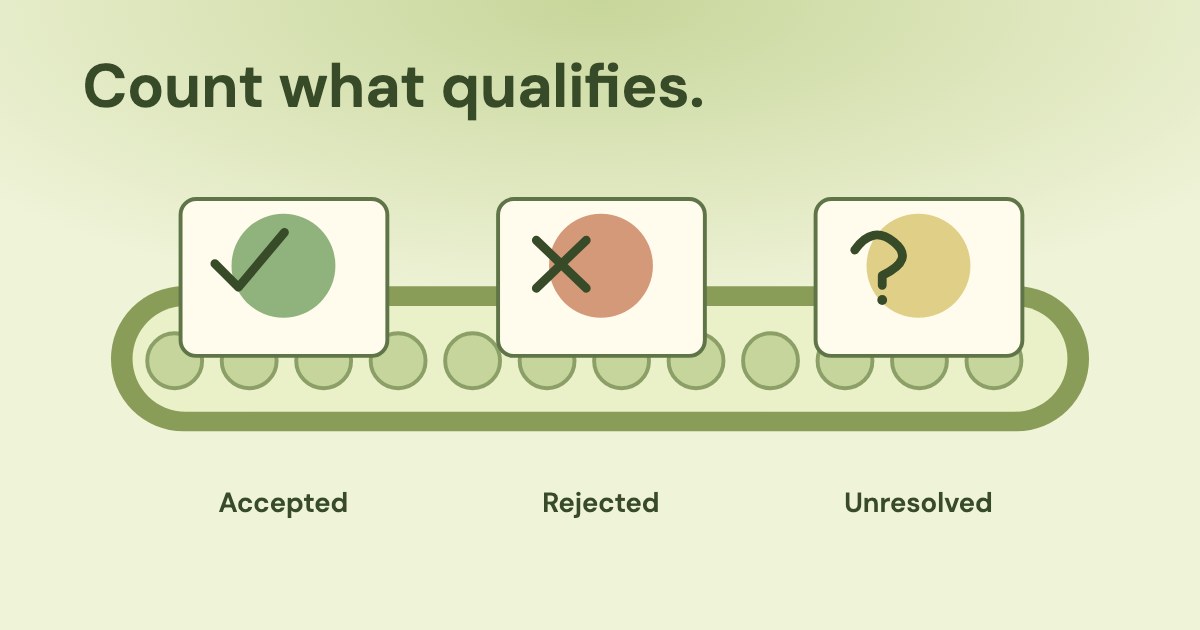
| What it covers | Meaning and next step | |
|---|---|---|
| 30 accepted | Reachable, relevant service enquiries. | Observed cost per accepted enquiry is $2,400 ÷ 30 = $80 for this group, not the cost per customer. |
| 20 rejected | Documented duplicates, invalid details or requests outside the offered service. | Keep reason counts. A service mismatch calls for a different investigation from a technical form-validation failure. |
| 30 unresolved | Not yet assessed consistently or still awaiting contact. | Do not silently count these as either good or bad. Assign an owner and a follow-up checkpoint. |
| 80 recorded | The agreed enquiry group includes all three categories. | A $30 recorded-enquiry cost and an $80 observed accepted-enquiry cost answer different questions. |
The unresolved group makes a confident campaign verdict premature. The calculation is still useful: it shows what has been established and why the cheap recorded-lead headline is incomplete.
For a fair comparison, use the same qualification rule, campaign scope, enquiry dates and follow-up maturity. Our suggestion is to compare groups with equivalent time for assessment. Do not treat recent uncontacted enquiries as worse than an older group that has already completed its sales follow-up.
Keep enough evidence to identify the problem without publishing personal contact details. The useful output is a reason, responsible person and next check; a public article or client narrative does not need a list of names and phone numbers.
Which PMax evidence and controls address the actual problem?
Match the proposed intervention to a confirmed failure. A channel label alone does not establish whether an enquiry is suitable.
Google’s channel report is reached through Campaigns → Insights and reports → channel performance. Its Conversions view concerns the conversions the campaign optimizes for; Results also covers goals it is not optimizing for. Keep the selected view beside any exported number.
The report helps locate channel delivery and diagnostics. It is not a CRM qualification list. Google also says you cannot directly control budget allocation per channel, and a channel with no evident issue may receive little delivery because PMax is prioritizing other inventory. For the separate Search Network partner setting and its reporting limits in a Search campaign, see Search partners and lead quality.
| What to do | Scope and limit | |
|---|---|---|
| Repeated irrelevant queries | Inspect the relevant search-term evidence and the actual service offered. | Negative keywords can address Search and Shopping inventory. Do not present them as a filter for every PMax channel. |
| Invalid form entries | Reproduce the submission path and identify the validation gap. | Google suggests qualifying questions, reCAPTCHA and server-side validation. These are checks to implement appropriately, not a promise that spam disappears. |
| Wrong page on your site | Identify the actual destination and why it does not match the offer. | Google says to consider turning off Final URL Expansion if ads show on irrelevant pages of your own website. Inspect the case before changing it. |
| Enquiries from outside the service area | Inspect the lead locations and current location-targeting setting first. | Google says that if leads arrive from outside targeted areas, change Presence or interest to Presence: People in or regularly in your included locations. This changes who can see ads. The location targeting guide covers a separate geography check and manual comparison. |
| Channel not serving | Read the channel’s status and diagnostics. | Fix an evidenced eligibility or asset issue. Zero delivery on one channel does not by itself prove the campaign is broken. |
Performance Max negative keywords are applicable to Search and Shopping inventory only.
These controls and qualification suggestions are documented in Google’s PMax lead guidance. For the full query workflow, use the search-terms guide rather than treating one exclusion as a complete quality strategy.
How long should you wait before a major change?
The current Google Ads Help page says to allow at least 1–2 weeks after measurement foundations are in place for the campaign to run and exit the learning phase before major changes, or up to 6 weeks for complex setups or low conversion volume.
The Accelerate article instead says at least 6 weeks after those foundations before major changes. Both were checked on 19 Oct 2026; their wording differs.
Our reading: do not turn either recommendation into a universal pass/fail date. A waiting period does not repair an evidenced form failure or prove that rejected leads will become suitable. Preserve the setup, volume, reporting maturity and specific issue when deciding whether the next step is observation or a controlled correction. For the general Learning status and how it differs from lead quality, see bid strategy Learning: wait, check or repair.
What can Variafy help establish?
Variafy offers read-only Google Ads access after your beta invitation. Its reading scope includes campaign type, status, bidding-strategy type and budget, campaign performance, enabled conversion-action settings and aggregate conversions by action, with returned-data limits.
Those readings can help separate campaign settings from reported action totals. They do not by themselves confirm each selected campaign goal, reproduce the channel report, qualify individual CRM contacts or send qualified-lead data to Google.
Our suggested reading request is: “For this PMax campaign and period, separate returned campaign settings, conversion-action settings and action totals. Retain completeness limits. List the campaign-goal and sales-quality evidence a person still needs before judging results.”
The responsible operator must obtain that missing evidence and approve any intervention. Variafy does not change Google Ads campaigns.
What decision should the acceptance check produce?
Finish with a bounded decision, not simply “PMax works” or “PMax is bad”. Our suggestion is to name the evidence, uncertainty and next owner.
Our suggested acceptance note
“Agreed outcome: […]. Campaign and enquiry period: […]. Recorded / accepted / rejected / unresolved: […]. Rejection reasons: […]. Goal and report basis checked: […]. Missing evidence: […]. Next check, owner and date: […]. Proposed decision and approval needed: […].”
There are several useful outcomes: the measurement needs repair; a specific mismatch needs investigating; the accepted-enquiry economics need comparing with the business limit; or assessment is incomplete and a conclusion must wait. None requires pretending that every unresolved lead is worthless.
Use the cost-per-lead guide for the wider economics. Here the deliverable is a traceable acceptance decision with a next check, rather than another list of PMax settings to change at once.
How we checked
Checked on 19 Oct 2026 against 5 Google documents: PMax lead-generation best practices in Google Ads Help and Accelerate; primary and secondary conversion actions; the PMax channel performance report; and PMax negative keywords. The two published waiting-period recommendations are shown separately.
The acceptance rule, table and decision note are our suggestions. All business figures are invented; they are not performance benchmarks. Variafy is our product.
Questions
Is Performance Max suitable for lead generation?
It can be evaluated for that purpose when you can identify the outcome you want and assess enquiry quality consistently. Google recommends lead-specific goals and deeper-funnel outcomes where possible. A high conversion count alone does not establish business suitability.
Why are PMax leads cheap but poor quality?
First check what is being counted and what makes a lead unsuitable. Invalid details, duplicate records and requests for the wrong service need different evidence. Keep unassessed enquiries separate; do not assume every low-cost conversion is spam.
Can negative keywords fix every PMax channel?
No. Google limits Performance Max negative keywords to Search and Shopping inventory. Our reading: they are not a campaign-wide filter for YouTube or Display. Match the control to the evidenced problem and inventory.
How long should a PMax lead campaign run before major changes?
Google Help links at least 1–2 weeks after measurement foundations to running and exiting learning before major changes, or up to 6 weeks for complex setups or low volume. Accelerate says at least 6 weeks. These differ and do not guarantee good leads by a fixed date.
Does a low cost per conversion mean a low cost per qualified lead?
Only if the counted conversion and qualification rule genuinely describe that same outcome. In the invented example, $2,400 divided by 80 recorded enquiries is $30, while dividing by 30 accepted enquiries is $80; 30 unresolved cases remain unclassified.
Related guides
- Google Ads offline conversions: send CRM sales back
- Google Ads search terms report: exclude, keep or wait?
- Google Ads cost per lead: what leads cost in 2026 and how to lower it
- Brand vs non-brand Google Ads: separate the results before changing the budget
- Google Search vs Display ads: choose by the customer task, not the cheapest click