PPC vs SEO: how to choose the next investment for a lead-generation business
PPC buys advertising traffic; SEO improves your ability to earn unpaid search visibility. Paid search can begin generating visits after a campaign is eligible to run, while SEO results depend on the site, competition and the work involved. Neither guarantees customers. Choose the next investment by urgency, acquisition economics, existing demand and your ability to turn enquiries into sales.
On this page11 sections
What should the next limited budget teach you?
For a small business, the decision is usually about the next limited budget rather than a permanent choice of one channel. A useful plan explains what that budget should teach you and what evidence would justify continuing.
What is the difference between PPC and SEO?
PPC means pay per click, a payment model used in advertising. It is broader than Google Search: other platforms and campaign types can also charge for clicks. Here, the paid comparison is paid search versus organic search, so that the business question stays manageable.
SEO means search engine optimisation: work that helps search engines discover and understand your pages and helps people find useful answers. It includes technical accessibility, page content and how the site is organised.
| Question | Paid search | SEO |
|---|---|---|
| What are you funding? | Media, campaign work, creative and the destination | Technical work, useful pages, editorial work and maintenance |
| What controls the next visit? | Campaign eligibility, auction, settings, budget and demand | Search visibility, relevance, competition and demand |
| Is each organic click billed by the search engine? | Not applicable to paid clicks | No; producing and maintaining the visibility still costs money |
| Can you guarantee timing or volume? | No | No |
| What business outcome matters? | Useful enquiries and customers at an affordable cost | Useful enquiries and customers at an affordable cost |
Google says that SEO changes can take from hours to months to be reflected in Search. That is guidance about changes appearing, not a guaranteed time to profitable customer acquisition. Read Google’s SEO starter guide.
When should a business prioritise PPC?
Paid search is a reasonable candidate when people already search for your offer, the landing journey works and you can fund a bounded test. It can also help investigate which commercial questions, locations or offers produce useful enquiries.
Before assigning budget, answer four questions:
- Is there identifiable demand for the service in the geography you serve?
- Can the business afford a test that might not produce a customer?
- Does the enquiry reach someone who can respond and sell the offer?
- Can you distinguish a useful enquiry from a form submission?
If those answers are missing, “PPC is faster” does not resolve the problem. An eligible campaign can spend before the business has learned whether its offer converts profitably.
For an urgent, limited-capacity offer, define the service area, availability and spending ceiling carefully. Buying demand for appointments you cannot fulfil creates a different problem from having too few visits.
Our Google Ads starting-budget guide explains how to fund a question rather than copy someone else’s monthly budget.
When should a business prioritise SEO?
SEO is a reasonable candidate when the business has useful expertise to publish, a site that can be improved and the ability to maintain the work while results remain uncertain. It can serve commercial, comparison and educational searches across a longer buying journey.
Start with the existing site. A valuable service page that search engines cannot properly access may deserve attention before another new article. So may an existing page attracting the wrong enquiries because its offer or service area is unclear.
Choose a specific search task. “Improve SEO” is too vague to evaluate. “Make our emergency-repair service page accessible, complete and useful for people in the area we actually cover” gives the team a clearer job.
Do not equate more indexed pages with more qualified demand. A technically available page can still be unhelpful, uncompetitive or aimed at people who will never buy the service.
SEO also needs maintenance. Availability, prices, service details and instructions can change. Traffic earned last year is not a promise of traffic next year, and organic visibility is not an asset you can leave unattended indefinitely.
Compare costs without calling organic traffic free
Use the same business outcome and observation cutoff for both channels. Separate media-only measures from fully loaded acquisition costs.
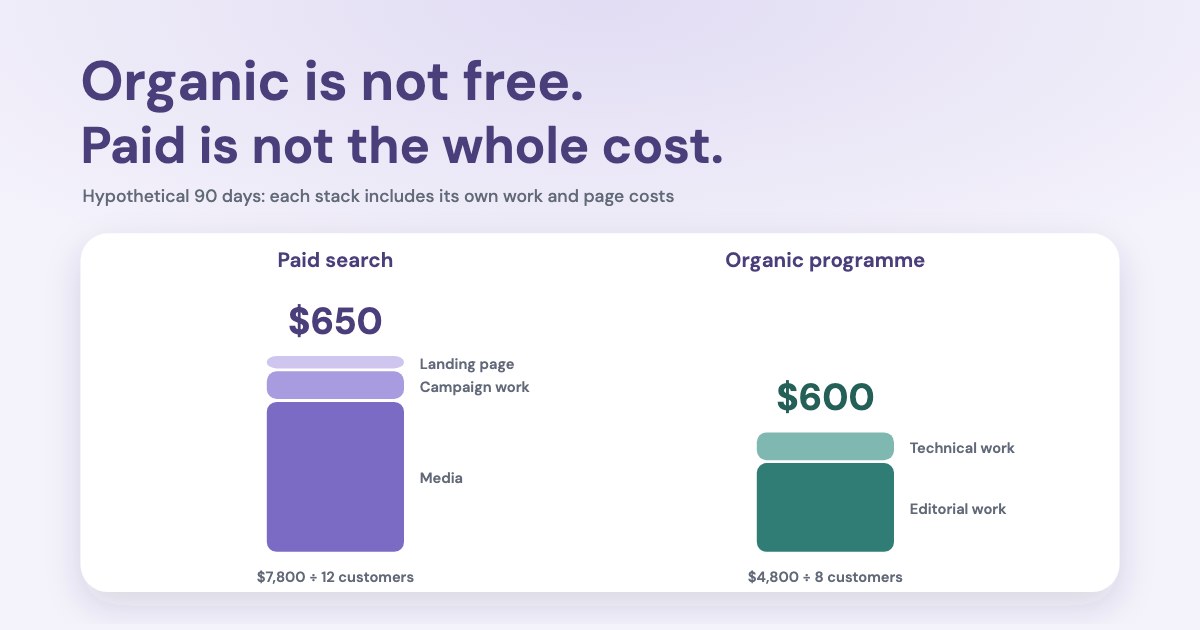
The following fictional 90-day report assumes a consistent rule assigning each new customer to one channel. It is an attribution comparison, not a measurement of incremental customers caused by either investment.
| Included cost or result | Paid search | Organic search programme |
|---|---|---|
| Media | $6,000 | $0 |
| Campaign or editorial work | $1,200 | $3,600 |
| Allocated landing-page or technical work | $600 | $1,200 |
| Total included acquisition costs | $7,800 | $4,800 |
| Eligible enquiries | 120 | 80 |
| New customers by the cutoff | 12 | 8 |
| Included cost per new customer | $650 | $600 |
Paid search media CAC alone is $6,000 ÷ 12 = $500. Comparing that figure with the SEO programme’s $600 fully loaded cost would use different cost scopes.
The table does not prove that an additional $4,800 of SEO work would acquire eight more customers. Organic enquiries may come from older pages or earlier investments. Equally, some paid customers may have known the business before the ad.
Report the cost policy and the limitations beside the numbers. For the relationship between action cost and customer cost, see CAC versus CPA.
How much demand must a paid test convert?
A planning calculation can reveal whether the assumptions are plausible. Suppose a paid click costs an assumed $4, 5% of those clicks produce eligible enquiries and 10% of those enquiries become new customers.
Expected media CAC = $4 ÷ (0.05 × 0.10) = $800.
That is a scenario, not a forecast supported by observed performance. If the business can afford only $500 media CAC and CPC remains $4, the required click-to-new-customer rate is $4 ÷ $500 = 0.8%.
At a 10% lead-to-customer rate, that implies an 8% click-to-enquiry rate. If the assumed 5% is a session conversion rate, first reconcile clicks and sessions rather than substituting it into this formula.
Use the calculation to identify the assumption needing evidence. It might be traffic relevance, page response or sales conversion. A lower CPC alone does not establish affordable customer acquisition.
Can PPC and SEO work together?
They can contribute different evidence. Paid search queries may reveal commercial questions worth addressing on service pages. Search Console can show organic queries and pages already receiving visibility. A better page can support both paid and organic visitors.
However, the paid result does not transfer automatically. A query that converts after clicking an ad may be hard to rank for organically. A page that attracts educational readers may not make a useful direct-response landing page.
Google states that paid search investment does not improve organic ranking. Its paid-and-organic report can compare text-ad and organic visibility after Search Console is linked; it is not a customer-level attribution ledger. Google explains the report and separation.
Do not add every channel’s claimed customers. The same person may discover the business organically and later click a brand ad. Keep a unique customer register and a stated credit rule. Our brand versus non-brand guide explains why that distinction matters.
A practical plan for the next 90 days
The following is an editorial planning framework, not a required SEO timeline or universal budget allocation.
Establish the baseline. Define the offer, geography, customer outcome, cost scope and sales cutoff. Check the page and enquiry routing. Record existing paid and organic visibility separately.
Fund one paid question. If paid search is suitable, choose a narrow offer and a risk ceiling. Record the conversion definition and the outcome that would support continuing. Keep brand and generic demand visible.
Complete one useful organic project. Improve a service page or publish a substantive answer to a real customer question. Specify what will change, who maintains it and how discovery will be checked.
Review evidence at the appropriate speed. Fix a broken form immediately. Let customer outcomes mature. Assess indexing and query visibility separately from leads and sales. An arbitrary 90-day end date does not prove SEO has succeeded or failed.
Choose the next action. Continue a promising investigation, correct a specific failure or stop further spending when the risk is no longer acceptable. Keep uncertainty visible if the sample is too small.
Download the paid-versus-organic cost example and search investment brief.
Review both sources with Variafy
Variafy can help your assistant read connected Google Ads, Search Console and Google Analytics reports. These are separate datasets with different definitions; their connection does not automatically produce a deduplicated customer journey.
Review paid and organic search for the same offer. Show each report's dates, time zone and definitions. Separate brand demand, media cost and the acquisition costs I supply. Use my customer records for the business comparison and identify one fundable next question.
If invited, start with the Google Ads guide and Search Console guide. Both are read-only in Variafy.
How we checked
Questions
Is SEO cheaper than PPC?
It can be under a defined cost model and time horizon. It is not free, and dividing this month’s editorial bill by visits created over several years can misrepresent acquisition economics.
Does stopping PPC stop all leads?
It stops that campaign’s future paid delivery once the stop takes effect. Existing enquiries can still buy, and organic or other sources may continue. Monitor the business outcome rather than assuming every later sale belongs to the current day’s spend.
Should a new business do both immediately?
Only if it can fund and operate both sensibly. Fixing the offer, page or follow-up may be the best first investment. Splitting a tiny budget across many unmeasurable activities is difficult to learn from.