Facebook ads vs Google Ads for a lead business: which is better?
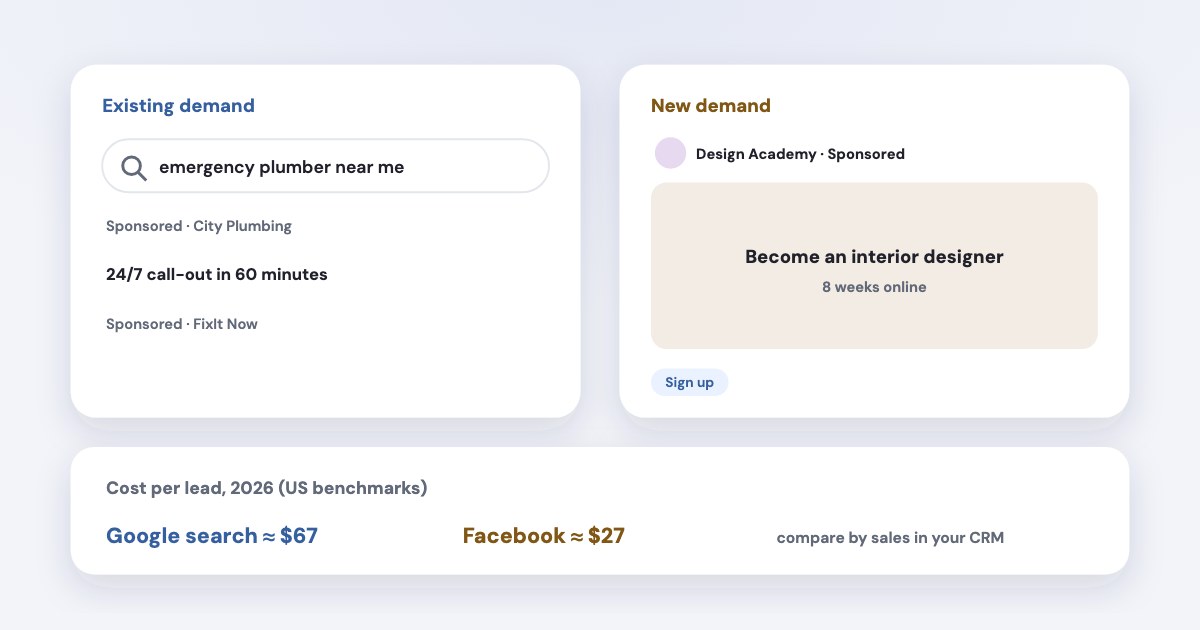
Google Ads catches people who are already searching for what you sell; Facebook and Instagram ads reach people before they search. That decides most cases: urgent local services start with Google, offers people don’t search for yet — a course, a planned treatment — start with Meta. In 2026 benchmarks, a Facebook lead costs less in most industries, but the reports measure different things, and a cheaper lead isn’t a cheaper customer. Both platforms also count the same lead when a person saw your Instagram ad and then searched for you. Compare them by one outcome in your CRM — qualified leads or sales — not by the numbers in each ad account.
On this page8 sections
The real difference: existing demand vs new demand
- Google search shows ads to people typing what they need — “emergency plumber”, “dental implants price”. Intent is high, volume is limited by how many people search.
- Meta shows ads in feeds and stories to people who match your offer but aren’t looking yet. Volume is larger, intent is lower, and the ad has to create the interest.
That’s also why lead quality differs. Meta’s instant forms fill in contact details from the profile, which makes them quick to submit —
Meta offers a Higher intent form to prevent receiving submissions from those people who are only marginally interested
(source). Searchers already have the need. No public study measures the share of leads that become clients on
each platform for small businesses; this is the mechanism, not a measured gap.
What a lead costs on each, in 2026
| Facebook lead campaigns | Google search | |
|---|---|---|
| All industries | $27.39 | about $67 |
| Real estate | $13.74 | $102.51 |
| Education | $26.31 | $77.48 |
| Doctors | $32.14 | $40.04 |
| Home improvement | $42.95 | $90.92 |
| Beauty | $50.91 | $39.25 |
| Dentists | $61.56 | $72.97 |
Facebook: WordStream and LocaliQ’s 2026 US lead campaign benchmarks (source). Google: LocaliQ’s 2026 search benchmarks, which include Microsoft Ads (source). Different periods, samples and, likely, statistics; a Facebook “lead” is mostly an instant form, a Google “lead” any primary conversion, including calls. Read them as “Facebook leads were cheaper in most of these industries”, not as the price of a customer.
Why the two ad accounts disagree
- Meta:
Meta uses a default attribution setting of 7-day click, 1-day view and 1-day engagement conversion.
(source) A lead from someone who only saw the ad counts. - Google:
The "Data-driven" model is the default attribution model for most conversion actions.
(source) The default click window is 30 days (source).
Data-driven attribution shares credit only among Google’s own touchpoints. So a person who saw your Instagram ad on Monday and searched
your name on Tuesday is a lead in both accounts. Google acknowledges the gap: its Platform Comparable columns, available only for Demand Gen,
use attribution that aligns with the default attribution used in other advertising platforms
(source).
A report isn’t the effect
Experiments show platform reports can overstate what ads cause. In an eBay field experiment, ads on searches for the company’s own brand brought no measurable short-term benefit — people came anyway (Blake, Nosko and Tadelis, 2015). Across 15 large Facebook experiments, observational methods often failed to match randomised results (Gordon et al., 2019). Paying Google for searches of your own business name is the first place to check.
How to compare them fairly
- One outcome, in your CRM: qualified leads or sales, by the date of the lead, with the same waiting time for both.
- Tag the source: UTM tags with the ad or campaign, so each lead in the CRM knows where it came from (how).
- Same counting: in Google set lead actions to count “One” per click (source); remove duplicates in the CRM.
- Compare cost per qualified lead and per customer, not cost per lead from the ad accounts.
- Same time zone and windows when you line reports up — Meta’s own advice for comparing tools (source).
- Wait at least two sales cycles before deciding.
Which one for your business
| Start with | Why | |
|---|---|---|
| Urgent local services (repairs, emergency dentist) | Google search | People search at the moment of need |
| Planned treatments, aesthetics, beauty | Both | Search is cheaper in beauty; Meta builds demand for planned care |
| Courses and schools | Meta, plus search on course names | People rarely search for a course they haven’t heard of; Facebook leads were a third of the price |
| Real estate | Meta for volume, search for active buyers | Facebook leads cost far less but need qualifying; housing rules apply |
With a small budget, start with one: Meta learns best at about 50 results a week per ad set, and Google suggests around
30+ conversions in 30 days
before target-based bidding (source). See
how much to spend on Facebook ads and
Google Ads cost per lead.
Compare by sales, not by dashboards: Variafy
Variafy connects ChatGPT, Claude and other assistants to your Meta ad accounts — and with your CRM or a sheet of payments, shows which campaigns bring paying customers rather than leads. After your beta invitation, Google Ads is also available for reading and analysis in the same assistant. Variafy does not change Google Ads; keep each platform’s reported results separate from CRM payments.
How we checked
Checked on 17 October 2026 against Meta’s Business Help Center (Results attribution, instant form types, comparing reporting tools), Google Ads Help (attribution models, conversion windows, counting, Platform Comparable columns, campaigns not running), WordStream and LocaliQ’s 2026 Facebook and search benchmarks, and two peer-reviewed field experiments (Blake, Nosko and Tadelis, Econometrica 2015; Gordon et al., Marketing Science 2019). The recommendations by business type are our synthesis. We also read the pages that rank for these searches.
Variafy is our product. Google and Google Ads are trademarks of Google LLC.
Questions
Is Facebook ads or Google Ads better for leads?
It depends on whether people already search for what you sell. Google search catches existing demand — urgent and local services. Meta reaches people who aren’t searching yet — courses, planned treatments, real estate. Compare both by qualified leads or sales in your CRM.
Are Facebook leads cheaper than Google leads?
In 2026 US benchmarks, mostly yes: about $27 per lead on Facebook vs about $67 on Google search, though beauty was cheaper on search. The reports use different samples and lead definitions, and a cheaper lead isn’t necessarily a cheaper customer.
Why do Facebook and Google both report the same lead?
Meta counts conversions within 7 days of a click and 1 day of a view or engagement; Google’s data-driven attribution shares credit only among Google touchpoints. Someone who saw your Instagram ad and then searched for you is counted by both.
Should a small business run both Facebook and Google Ads?
Start with one. Both platforms need volume to learn, and splitting a small budget slows both. Add the second once the first brings steady leads you can measure in your CRM.
How do I compare Facebook and Google Ads fairly?
Use one outcome from your CRM (qualified lead or sale) by lead date, tag every lead with its source, count each Google lead once per click, and compare cost per qualified lead or customer over at least two sales cycles.
Related guides
- Google Ads cost per lead: what leads cost in 2026 and how to lower it
- Why is my Facebook cost per lead going up — and what’s a good CPL?
- Facebook ads attribution settings in 2026: what the windows mean and which to use for leads
- Why Google Ads and Meta both claim the same sale — and how to reconcile them
- How to split your advertising budget between Google Ads and Facebook Ads
- PPC vs SEO: how to choose the next investment for a lead-generation business