How to split your advertising budget between Google Ads and Facebook Ads
Allocate the next advertising dollar using comparable business outcomes, acquisition limits and capacity — not a fixed Google/Facebook percentage. Keep a proven baseline, give a specific question a capped test budget, and preserve a reserve. Compare the likely return on additional spend, not just each channel’s historical average.
On this page12 sections
Is your measurement good enough to move money?
If you cannot measure both channels well enough to support a decision, the next investment may be a measurement repair or one focused test. Opening more campaigns does not resolve an unknown customer-acquisition cost.
The allocation method below is Variafy’s suggested decision framework. All monetary examples are hypothetical, and the example split is not a benchmark.
First decide what the budget is supposed to buy
“More conversions” is incomplete. A form submission, qualified enquiry, paid order and newly acquired customer have different value.
Write a one-sentence objective:
Acquire additional customers for [offer and location], within [acquisition-cost allowance], while staying inside [cash and service capacity], measured after [observation period].
Record the customer definition, repeat-purchase treatment and cost scope. A channel producing repeat purchases should not be compared with another on new-customer acquisition using an unexplained blended average.
Google and Meta can associate the same sale with their advertising. Before a budget comparison, use the cross-platform reconciliation guide to keep unique business outcomes separate from platform claims.
When should you fund one platform first?
| Your situation | A useful starting decision | Evidence to collect |
|---|---|---|
| People actively search for the exact service, and you can serve that demand | Test a focused Google Search proposition | Relevant enquiries, source evidence and customer outcomes |
| The offer needs demonstration or explanation before people seek it out | Test a clearly defined Meta proposition | Whether suitable people enquire and later buy |
| One channel has repeatable customer economics and the other has no trustworthy tracking | Protect the supported baseline; repair or cap a test of the second | A comparable outcome definition and observation window |
| The total risk allowance cannot fund two interpretable tests | Ask one question on one channel first | Whether the approved test can produce decision-useful evidence |
| Both channels produce mature, identifiable customer outcomes | Compare the next available expansion in each | Marginal acquisition cost, uncertainty and capacity |
These are planning judgments, not guarantees that one platform is always better for a category. Search targeting can still attract irrelevant enquiries; a well-demonstrated offer can still fail to sell. The existing Google Ads versus Facebook Ads guide covers the broader channel comparison.
Build a comparable baseline
For each channel, record:
- Media spend and other acquisition costs separately.
- Unique raw leads, qualified leads and new customers.
- The offer and business segment being served.
- The acquisition cohort and observation cutoff.
- Contribution before acquisition costs.
- Source coverage, pending assessments and missing outcomes.
Do not compare this week’s immature leads on one platform with last quarter’s settled sales on the other. Do not add unrelated conversion actions into one denominator. If a channel’s CRM source coverage is poor, flag the comparison as incomplete before ranking it.
For a lead business, cost per qualified lead offers an earlier business-quality signal. It still needs to connect to sales and contribution before it can justify a larger commitment.
Average CAC tells you what happened, not what the next dollar buys
Suppose mature, consistently assigned customer outcomes show:
| Baseline | Meta | |
|---|---|---|
| Media spend | $1,000 | $2,000 |
| New customers | 10 | 12 |
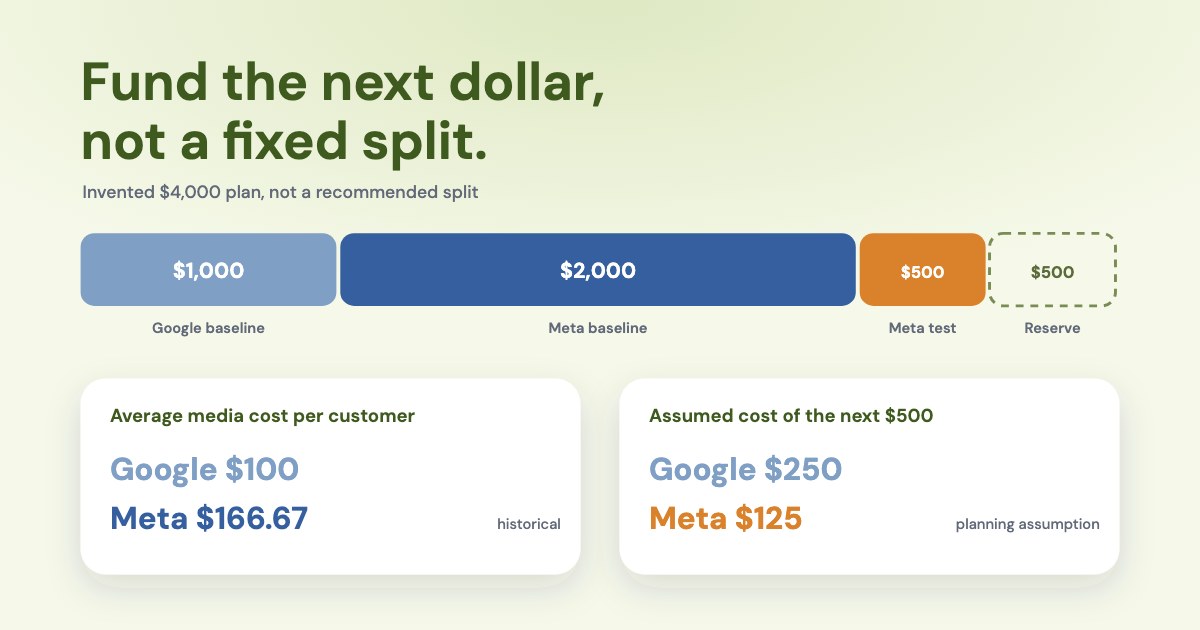
| Average media cost per customer | $100 | $166.67 |
Google appears cheaper. That does not establish that the next $500 should go there. The inexpensive demand you already reach may not represent the additional demand available at a larger budget.
Consider these planning assumptions, not observed incremental effects:
| Proposed expansion | Meta | |
|---|---|---|
| Additional media budget | $500 | $500 |
| Assumed additional customers | 2 | 4 |
| Implied marginal media cost per customer | $250 | $125 |
Marginal media cost per customer = additional media spend ÷ additional customers
Under those assumptions, Meta is the more attractive expansion even though its historical average is worse. If the business’s media acquisition allowance is $200 per customer, only the Meta point estimate fits.
But an estimate is not an experiment result. Ask where it came from, which outcome it predicts and how uncertain it is. Google’s conversion-delay estimates feed Google’s impact estimates, which show the traffic and conversions expected at different targets and budgets. They do not forecast the total causal effect of moving money between Google and Meta.
If Google could add one to three customers and Meta two to five, the plausible implied costs overlap. A single tidy forecast should not hide that uncertainty.
Use a baseline, a test and a reserve
For a hypothetical $4,000 media authorization:
| Budget component | Amount | Purpose |
|---|---|---|
| Existing Google baseline | $1,000 | Continue the supported acquisition activity |
| Existing Meta baseline | $2,000 | Continue the supported acquisition activity |
| Bounded Meta expansion test | $500 | Investigate the specific additional-customer hypothesis |
| Uncommitted reserve | $500 | Retain flexibility if evidence or cash conditions change |
| Total authorized | $4,000 | Not an obligation to spend every dollar |
The choice of a Meta test follows the example assumptions. It is not a general 25/62.5/12.5 split for other businesses.
Keep the experiment interpretable. If you move budget, change the landing page, replace the creative and alter qualification rules at once, a later change in results will be hard to explain.
A simple before-and-after comparison can still be affected by seasonality, demand or other changes. Treat it as observational evidence unless the test design supports a causal conclusion.
Write the test contract before spending
Use the allocation and test brief to agree on:
- Question: What specific expansion or correction are we evaluating?
- Ceiling: What maximum additional media and non-media cost is authorized?
- Outcome: Which business result will decide whether it is acceptable?
- Evidence: Which reports, CRM fields and source-coverage checks will establish it?
- Timing: When will enough of the relevant cohort normally have matured?
- Early intervention: Which tracking, quality or delivery failures require an immediate review?
- Owner: Who can continue, change or end the commitment?
Do not confuse a planning ceiling with an ad platform’s average daily budget. Check the current account’s budget and spending rules before applying settings; the small-business Google budget guide explains that distinction; for raising a Meta budget in steps, see how to increase a Facebook ads budget.
Check capacity and cash before approving growth
If the business can serve only five additional customers this period, a forecast of twenty is not automatically attractive. Ask whether lead handling, scheduling and fulfilment can accommodate the outcomes you are buying.
Likewise, a profitable customer cohort can collect its cash too late to fund this month’s advertising. Show the expected payment timing separately from booked sales. Avoid solving a short-term cash constraint with an optimistic lifetime-value assumption.
The owner should see the ROI and ROAS calculation, the acquisition allowance and the cash requirement together. Budget allocation is a business commitment, not merely a ranking of dashboards.
A weekly review that leads to one clear decision
| What changed? | Review first | Possible next action |
|---|---|---|
| Recent CPA rises | Cohort age, report freshness and conversion definitions | Observe longer or repair the identified measurement issue |
| Raw leads rise but accepted leads do not | Pending workload and rejection reasons | Correct the specific quality or assessment problem |
| Costs fit the allowance and capacity remains | Whether the next expansion has evidence behind it | Approve another bounded step |
| More revenue arrives but contribution falls | Margin, refunds and acquisition costs | Revise the economics or spending commitment |
| Source coverage deteriorates | Missing tags, unmatched records and stale CRM data | Fix comparability before reallocating money |
End the review with a named decision, an owner and a date. “Keep optimizing” is not a useful spending authorization.
Prepare the review with Variafy
Variafy connects supported ad-account readings to ChatGPT, Claude and other compatible assistants. Ask for a decision brief rather than an unexplained budget recommendation:
Prepare a Google and Meta allocation review. Keep platform conversions separate from unique customers. Use the same mature cohorts and the cost assumptions I provide. Show historical average acquisition cost, the evidence for any proposed additional spend, uncertainty, capacity and missing data. Draft the decision; do not apply changes.
Google Ads access is read-only in Variafy. Supported Meta changes follow the configured approval flow. A comparison report does not authorize a budget change.
See the Google connection guide and Meta connection guide for current access conditions.
How we checked
Questions
Should I split my budget 50/50 between Google and Facebook?
Not by default. An equal split is a starting allocation, not evidence that both channels offer equal opportunities. Use an affordable test tied to a defined business outcome.
Should the channel with the lowest CAC get all the budget?
Not automatically. Historical average CAC does not establish the cost of acquiring additional customers, and the channel comparison may be affected by attribution or different cohort ages.
How often should I move budget between platforms?
Review the evidence regularly, but time reallocations around your conversion cycle and the question being tested. A weekly meeting does not require a weekly budget edit.
What if I have no reliable customer data yet?
Set a bounded discovery budget, define suitable enquiries and repair the source-to-outcome measurement. Label assumptions clearly and avoid presenting raw platform conversion counts as verified customers.
Should I spend the entire approved budget?
No. An authorization is a limit and a plan. Spending the reserve requires a reason, particularly when quality, cash or service capacity has changed.