Google Search vs Display ads: choose by the customer task, not the cheapest click
Google Search campaigns reach people searching for something; Display campaigns place visual ads across websites, apps and eligible Google properties. Both can pursue leads or sales. For a business with a clear service people already search for, a focused Search test is often a sensible starting hypothesis. Use Display when you can explain whom it should reach, what it should communicate and how you will judge the resulting business value.
On this page12 sections
Why does the cheapest click mislead?
The cheapest click is a poor way to choose between them. A click during a search and a click while browsing can represent different levels of intent, and neither is a customer.
What is the difference between Search and Display?
Google describes Search and Display as separate campaign types with different inventory and creative approaches. Display can reach new audiences or people who previously visited your site; it is not limited to remarketing. Google’s campaign-type overview and Display guide describe their scope.
| Decision | Search campaign | Display campaign |
|---|---|---|
| Starting context | A search relevant to the campaign | Browsing content or using an app |
| Important message job | Answer the search and offer a relevant next step | Make the offer understandable in its browsing context |
| Evidence to inspect | Actual search terms, goals and useful outcomes | Audience/placement context, goals and useful outcomes where available |
| Common reporting mistake | Treating every search as purchase-ready | Treating inexpensive clicks as qualified demand |
| Business decision | Can we acquire useful demand affordably? | Can this use of visual reach produce the intended value? |
“Search always means high intent” is too broad. Someone searching for a definition or a job is not necessarily looking to buy your service. Similarly, a person browsing a site may be very familiar with your business and ready to act.
Classify the actual task and audience rather than assigning one universal intent label to each campaign type.
Search, search partners and Performance Max are different distinctions
Do not classify a campaign from its picture or name alone. Check its configured type and network context.
Search partners are not the same thing as the Display Network. Our search-partners guide covers that decision. Performance Max is a separate cross-channel campaign type; Google describes it as access to all Google Ads inventory from a single campaign, which does not make the whole campaign a standalone Display campaign. See Google’s campaign-type documentation.
A screenshot showing an image is insufficient evidence of which campaign produced it. Keep the campaign ID, configured type, dates and report scope with an analysis.
When comparing results, avoid mixing Search-only data with a cross-channel aggregate and labelling the second column “Display”. That creates a comparison the underlying report does not support.
When does Search make sense for lead generation?
Start by identifying searches that plausibly describe your offer. A local repair business might investigate urgent service demand in its actual coverage area. A specialist course provider might investigate a named qualification rather than every educational query mentioning the subject.
The task is to match the search, promise and destination. If an ad promises a quote, the page should explain how the quote works. If the service is available only in particular locations, the visitor should not discover that after completing a long form.
Review actual queries, not just the keywords you entered. Keep relevant-but-immature searches separate from clearly irrelevant demand. The search-terms guide provides an exclude/keep/wait workflow.
Search still has limits. Demand may be sparse, competitive or poorly matched to your offer. Increasing the budget does not manufacture more suitable searches at the same acquisition cost. A bounded test needs a risk ceiling and a decision about what counts as a useful lead.
When does Display make sense?
Display deserves consideration when the message benefits from visual explanation, the audience has a defensible relationship to the offer and there is a useful next step. It may support introducing an unfamiliar service, reaching a defined audience or reminding eligible previous visitors about an unfinished decision.
Give the campaign a job. “Get cheap traffic” is an incomplete brief. “Show a clear explanation of this service to the intended audience, then evaluate relevant enquiries and their later outcomes” is more actionable.
For a returning-visitor campaign, establish which visitors should be eligible and which should be excluded under the actual setup. Someone who has already bought, someone awaiting a sales response and someone casually reading a blog may need different treatment.
For a new-audience campaign, do not call subsequent conversions proof that the campaign created all the demand. Other marketing, prior knowledge and selection effects can contribute.
Our suggestion is to start with one clear offer, sufficient creative to explain it and a destination that makes the next step honest. A poor message displayed broadly is not repaired by the lower click price.
Worked example: cheaper clicks and leads, higher customer cost
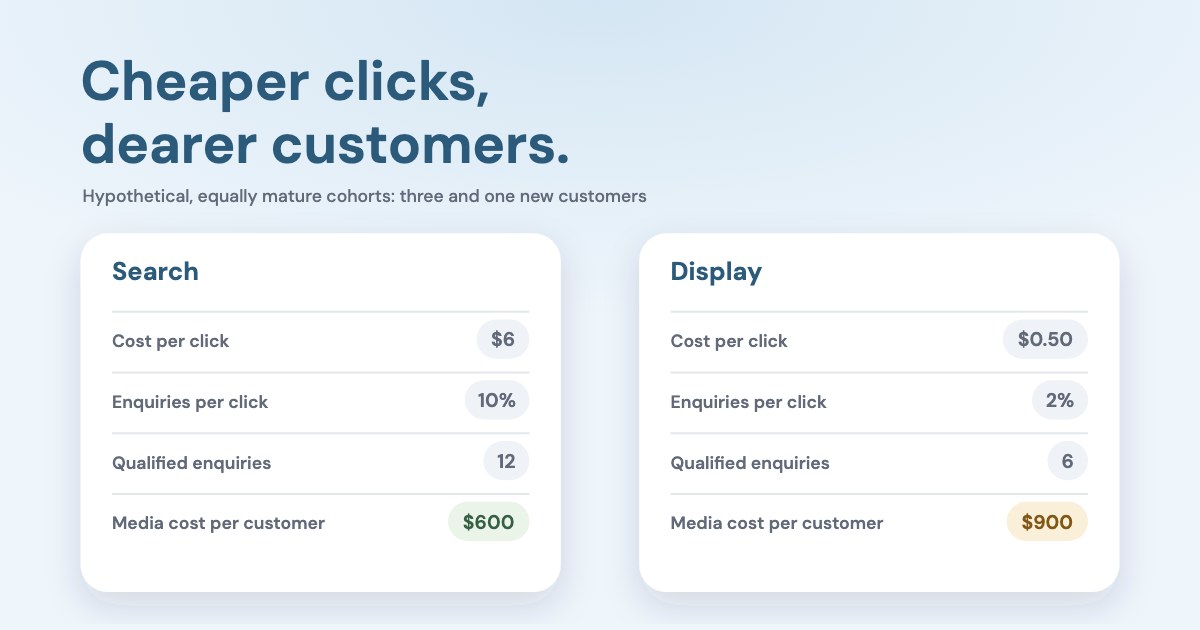
These are fictional, equally mature cohorts. Each customer is assigned once under a stated business reporting rule. The comparison illustrates arithmetic, not a controlled experiment or a benchmark.
| Metric | Search | Display |
|---|---|---|
| Media spend | $1,800 | $900 |
| Clicks | 300 | 1,800 |
| Average cost per click | $6 | $0.50 |
| Eligible enquiries | 30 | 36 |
| Enquiries per click | 10% | 2% |
| Qualified enquiries | 12 | 6 |
| New customers | 3 | 1 |
| Media cost per enquiry | $60 | $25 |
| Media cost per qualified enquiry | $150 | $150 |
| Media cost per new customer | $600 | $900 |
Display produces cheaper clicks and enquiries in this example. The qualified-enquiry cost is equal, and the customer cost is higher. The numbers do not mean Display always performs this way; they show why stopping at CPC or CPL can select the wrong result.
There are only four customers across the two assigned cohorts. That is a limited observation, not reliable evidence of a permanent performance gap. Follow-up quality, traffic mix and random variation may matter.
Add creative, management and sales costs when comparing fully loaded acquisition. Our CAC versus CPA guide explains the cost scope.
Compare conversion definitions before comparing CPA
Record the action, counting rule, attribution model and window behind each result. A submitted form, qualified enquiry and paid booking are different denominators.
View-through conversions need particular care. They concern people who saw an ad without interacting and later converted. For ordinary Display reporting, Google’s current documentation places these in the view-through and all-conversion reporting context rather than the main Conversions column; it also documents exceptions for particular campaign types and optimisation settings. Read the specific view-through guidance.
Keep view-through outcomes separate when comparing a click-based report. Do not add them to a business’s customer total without resolving overlap. The association between an impression and a later action is not proof that the action would not have happened without the ad.
If a report supplies only a blended conversion count, state what cannot be separated. A missing breakdown is a limitation, not permission to assume all conversions have the same meaning.
A controlled expansion from Search into Display
If Search is already producing useful demand, a Display test should answer a new question instead of quietly mixing its results into the existing total.
- Define the intended audience and distinguish new prospects from previous visitors.
- Set the business outcome and a spending ceiling the business can afford to risk.
- Check the creative, destination and actual audience-expansion settings.
- Confirm that the intended conversion reaches both the report and the responsible team.
- Preserve separate campaign reporting and record other marketing changes.
- Review useful leads and mature customer outcomes, with view-through reporting labelled separately.
The comparison should have a planned observation window and quality guardrails. It should not use a fixed number of days as proof that enough evidence exists. If outcome volume remains low, decide whether to extend the test, change the question or stop further exposure.
Download the Search/Display example and campaign-type test brief.
What should you check if Display produces poor enquiries?
First verify that the enquiry is real and reaches the business once. Then examine the offer, placement or audience context available in the platform, device journey and qualification reasons.
Separate mistaken clicks, unsuitable enquiries, duplicate records and useful leads the team failed to contact. They require different fixes. If the main issue is the page or sales handoff, moving all the budget to Search may reproduce the same failure at a different click price.
Use the landing-page conversion guide for page measurement and lead conversion guide for the later stages.
Inspect the campaign types with Variafy
Variafy can help your assistant read Google campaign types, settings and reported performance. Available breakdowns and row limits should be stated; full customer identity and qualification can require your business records.
Compare these campaigns by configured type, spend, clicks and named conversion actions. Use the customer-stage summary I provide to calculate useful-lead and customer costs. Keep view-through outcomes and missing breakdowns visible. Propose one investigation rather than changing campaigns.
If invited, follow the Google Ads connection guide. Google Ads tools in Variafy are read-only.
How we checked
Questions
Are Display ads only for awareness?
No. Google documents lead and sales uses as well. Whether they serve your business profitably is a separate, measurable question.
Should I compare Search CTR with Display CTR?
You can describe both, but different inventory and browsing contexts make a shared target difficult to interpret. A higher CTR is not proof of more useful customers.
Is a Performance Max campaign the same as running Search and Display separately?
No. It is a different cross-channel setup. Do not treat its aggregate result as a standalone Display result.