Microsoft Ads vs Google Ads: compare customer cost before copying the budget
Microsoft Advertising and Google Ads both offer search advertising, but they buy different traffic through different systems. Do not assume that a lower Microsoft CPC means a lower customer-acquisition cost. Compare the same offer, geography, conversion definition and mature customer outcome, then decide whether an additional platform deserves a bounded test.
On this page12 sections
What is Microsoft Advertising, and is it Bing Ads?
Microsoft Advertising is the current product name; many people still search for Bing Ads. This guide focuses on search acquisition for businesses that receive enquiries and sell later, rather than treating every campaign type on either platform as interchangeable.
Microsoft Advertising versus Google Ads at a glance
| Question | Google Ads | Microsoft Advertising |
|---|---|---|
| Search context | Google Search and eligible search-partner traffic, depending on setup | Microsoft Bing and search-partner traffic, depending on setup |
| Is every campaign a search campaign? | No | No |
| Can a platform report an action without a new customer? | Yes; inspect the action and counting rules | Yes; inspect the goal and counting rules |
| Can you assume the same CPC or conversion rate? | No | No |
| Is copying the campaign enough to validate the new platform? | No | No |
Microsoft’s Search ads page says ads can appear on Bing and on search partner sites, and that you can import existing Google Ads campaigns. Use the actual network and campaign settings in your account rather than assuming that a search-engine name describes every placement.
For Google search partners as a separate reporting question, see our Search partners guide. The same word “partner” does not establish that both platforms expose identical settings or reports.
Is Microsoft Ads cheaper than Google Ads?
It may have a lower CPC in your particular test. That observation alone says nothing conclusive about qualified-enquiry cost or customer cost.
Differences in location, device, brand demand, network mix and query intent can affect both the price of a click and what happens afterward. Compare the business outcome before calling either platform cheaper.
The relationship is:
Media CAC = average CPC ÷ click-to-new-customer rate.
Use the same cohort and attribution scope on both sides. If one rate starts with analytics sessions and the other starts with advertising clicks, reconcile those denominators first.
A smaller platform can still provide valuable additional demand. Conversely, an inexpensive test may have limited useful volume. The business needs evidence about its service area and offer, not a universal demographic stereotype or an old global market-share statistic.
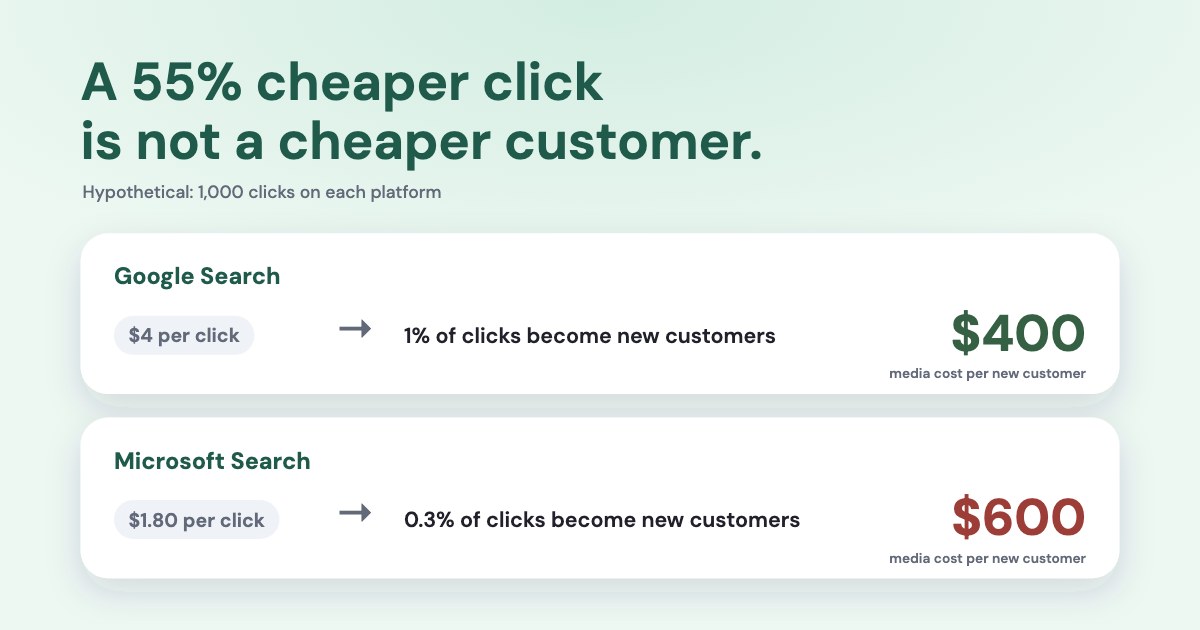
Worked example: a 55% cheaper click, a higher customer cost
These fictional cohorts have had the same time to produce customers. Counts represent unique enquiries and new customers assigned once under a stated business rule. The equal click counts are illustrative, not a forecast of available volume.
| Metric | Google Search | Microsoft Search |
|---|---|---|
| Clicks | 1,000 | 1,000 |
| Media spend | $4,000 | $1,800 |
| Average CPC | $4 | $1.80 |
| Eligible enquiries | 100 | 40 |
| Enquiries per click | 10% | 4% |
| Qualified enquiries | 40 | 12 |
| New customers | 10 | 3 |
| Media cost per enquiry | $40 | $45 |
| Media cost per qualified enquiry | $100 | $150 |
| Media cost per new customer | $400 | $600 |
Microsoft CPC is 55% lower in this example, while media CAC is 50% higher. The difference comes from the conversion path, not a contradiction in the arithmetic.
At a $1.80 CPC, matching a $400 media CAC requires a 0.45% click-to-new-customer rate: $1.80 ÷ $400. If 10% of eligible enquiries become new customers, the implied click-to-enquiry rate is 4.5%.
Those are planning thresholds under the assumptions, not promised performance. There are only three Microsoft customers in the example, so the observed rate is uncertain. A different sample could reverse the ranking.
Keep supporting costs visible. Adding an illustrative $300 of platform-specific management work makes included acquisition cost $430 per Google customer and $700 per Microsoft customer. Neither figure includes omitted sales or delivery costs. Our CAC versus CPA guide explains the distinction.
When should you test Microsoft Advertising?
A test is worth considering when the offer already converts, the business can handle additional enquiries and there is a clear question about useful demand on Microsoft inventory.
Examples of fundable questions include whether a service receives relevant searches in a particular location, whether a specific commercial offer can acquire qualified prospects, or whether the team can operate another platform without consuming the expected benefit in management time.
Keep the question narrow. A test covering every location, offer and campaign type makes it harder to understand a poor result.
Before launch, define an acceptable risk budget, the intended business outcome, how much sales time the test can consume and when outcomes should be mature enough to review. There is no universal minimum spend or fixed two-week period that guarantees a reliable conclusion.
If volume is too low to decide, label the result inconclusive. A finite-volume channel can still be useful; it simply may not answer a large-scale growth question.
Import from Google carefully
Microsoft supports importing selected Google campaigns and scheduling later imports. Its documentation and Search page also make clear that imports need configuration and review. See Microsoft’s import guide.
Treat an import as a starting configuration, not evidence that the new campaign is ready to spend. Microsoft’s options include raising imported campaign budgets by a percentage and choosing whether existing budgets are updated, and it advises reviewing every imported campaign. Our review checklist is:
- Confirm the Microsoft account, currency, campaign status and intended launch timing.
- Review bids, budgets, locations, language and the actual network settings.
- Check the ads, destinations, tracking parameters and mobile enquiry journey.
- Review imported exclusions, audiences and other supported settings for their intended meaning.
- Validate the conversion goals and confirm a test enquiry reaches the business correctly.
- Record whether future scheduled imports can change the settings again.
If a setting is unsupported or transformed, decide what to do before launching. A report saying that an import completed is not proof that every original setting has an identical meaning on the destination platform.
Also decide which system is the source of future configuration. Unrecorded scheduled imports can complicate the explanation when someone later asks why a budget or status changed.
Do the conversions measure the same thing?
Write a small mapping between Google conversion actions, Microsoft conversion goals and the business outcome. Names alone are not sufficient.
| Check | What to establish |
|---|---|
| Action | Is it an enquiry, qualified lead, booking or purchase? |
| Counting | Are repeated actions counted, and what identifies a unique business enquiry? |
| Attribution | Which interactions can receive credit, and over what window? |
| Bidding/reporting scope | Does the chosen column include the goals you intend? |
| Timing | Are dates and outcome cutoffs comparable? |
| Customer identity | Does the buyer represent a new customer or an existing one? |
Microsoft’s Universal Event Tracking documentation explains its website measurement setup. Do not assume that a working Google tag proves Microsoft conversion tracking is working.
Keep platform-reported conversions alongside deduplicated business outcomes. Both platforms may have participated in the same journey, so adding their claims is not a safe method for counting all new customers. See our cross-platform double-counting guide for the underlying reconciliation principle.
Compare closed periods and customer cohorts
An early report can show complete spend before the associated customer outcomes arrive. Compare cohorts of similar age and note open leads separately. Recent data can also remain provisional while the platform processes it.
Keep the account time zone and currency in the report. If currencies differ, either leave the costs separate or use a documented conversion policy; do not silently add different currencies.
Separate brand from generic demand. A test dominated by searches for your own business name cannot establish the cost of reaching people who have never heard of it. Likewise, a different network or device mix can affect the comparison.
Inspect the lead-handling process too. If one platform’s enquiries arrive in an unmonitored mailbox, the apparent platform difference may partly be an operational failure. Use the lead-response-time guide to audit the handoff.
A decision brief for adding the second platform
Download the Google/Microsoft comparison example and second-platform test brief.
The brief should end with one of three honest decisions: continue the specific test, repair a named failure or stop further exposure. If the evidence is incomplete, state which uncertainty remains and whether it is worth paying to resolve it.
Do not fund the next test solely because the first platform’s historical CAC looks good. Additional volume can have different economics, and managing another account has a real cost.
Read both accounts in Variafy
Variafy offers read-only Google and Microsoft Advertising connections after your beta invitation. Microsoft readings include account information, campaign settings and available campaign/account performance. Do not assume its tools expose every Microsoft report, import history or individual customer journey.
Compare these Google and Microsoft campaigns for the specified closed dates. State currency, time zone and reported conversion scope. Use my enquiry and customer summary for the business comparison, list missing evidence and prepare one test decision without changing campaigns.
If invited, use the Microsoft connection guide and Google connection guide.
How we checked
Questions
Is Microsoft Advertising the same as Bing Ads?
Microsoft Advertising is the product name used here; Bing Ads is the older name many readers still use. Check the configured campaign and inventory rather than assuming every Microsoft ad is a Bing search ad.
Should I copy the same daily budget from Google?
No automatic copy is justified by the platforms' similarity. Review the budget against the new test’s demand, risk ceiling and supporting workload.
Can I use one customer-cost target for both?
Yes, if it reflects comparable customer value, cost scope and capacity. It is a business target, not evidence that either platform can achieve it at the desired volume.