Facebook ads for real estate: lead ads that work under the housing rules
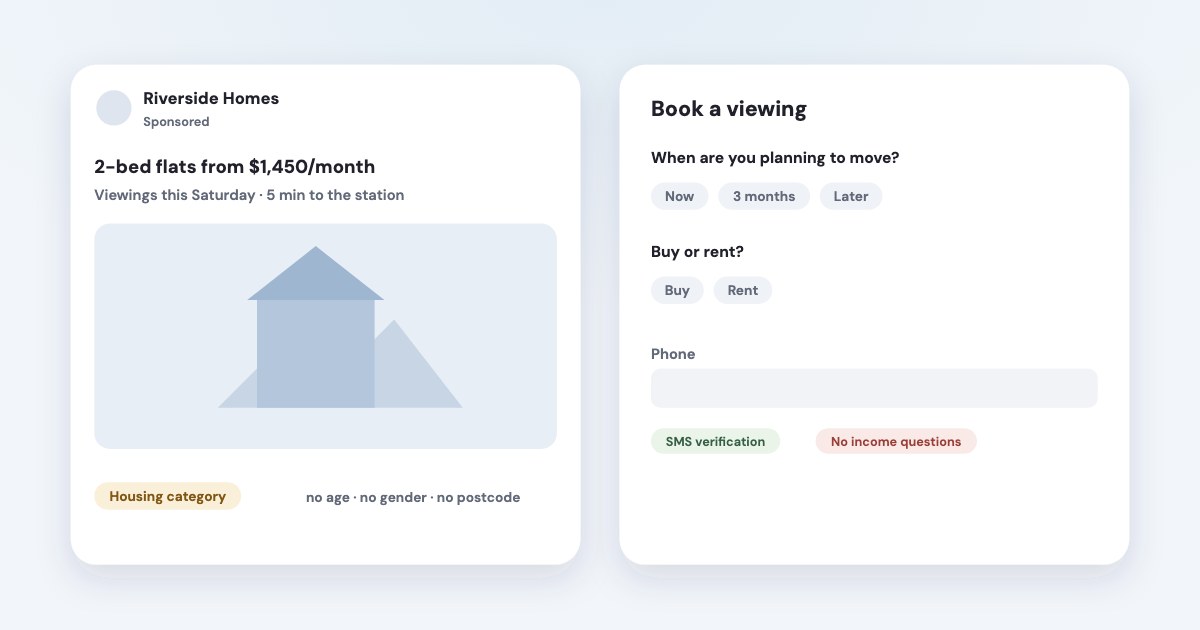
Real estate ads on Facebook run under the Housing special ad category in the US, Canada and Europe, so start there: no age, gender or postcode targeting, a wider radius, no lookalike audiences. That rules out the “target young couples in this postcode” approach — and makes the ad and the lead form do the filtering instead. Write about the property, not the buyer; use a lead form that asks timeline and buy-or-rent, not income; add phone verification. In the US, LocaliQ’s 2026 data puts the average real estate cost per lead from Facebook at about $14, half the all-industry average — but cheap leads in real estate need fast follow-up to become viewings.
On this page8 sections
Real estate ads are “Housing” ads
Meta’s housing category covers Sale, rental or temporary housing listings
, Real estate and house hunting services
and Home equity or appraisal services
; hotels, resorts and general homeownership tips are not included (source).
It’s required for ads to the US (since December 2019), Canada (December 2020) and Europe (December 2021) — the whole EU, the UK, Norway,
Switzerland and a few more (source). Set it up as in our guide to the
special ad category.
| Not available | Still available | |
|---|---|---|
| Who | Age ranges (fixed 18–65+), gender (all), lookalike and saved audiences | Custom audiences, Advantage+ audience |
| Where | Postcodes, location exclusions, a small radius | Cities and regions; at least 15 miles / 25 km around a point in the US and Canada |
| Interests | Behaviours, demographics, many interests | Interests from Meta’s approved list |
Listing catalogs follow the same rules: Meta requires housing campaigns to declare the category, and Advantage+ catalog ads using Home Listing Catalogs must adhere to these restrictions.
(source)
What to say — and what not to
US fair housing law makes it unlawful to publish any housing ad that shows a preference or limitation based on race, colour,
religion, sex, disability, familial status or national origin (source). The National Association of Realtors’ advice
is the simplest rule: When advertising a property, focus on describing the property, not the buyer or tenant.
(source)
- Instead of “perfect for young families” or “ideal for empty nesters” — write “3 bedrooms, 5 minutes to the school”.
- Instead of “Are you tired of renting?” — Meta’s personal attributes rule rejects ads that imply things about the reader (source) — write “2-bed flats from $1,450 a month, viewings this weekend”.
- Lead with the property: price or price range, location, one photo that sells, a viewing date.
In 2025 HUD withdrew its 2024 guidance on housing ads on digital platforms (source). The law itself and Meta’s rules didn’t change.
A lead form for real estate
Meta’s own example for “Test drive or showing — Automotive, real estate” asks when the person plans to buy and whether they want to buy or rent (source). Build on that:
- Higher intent form type. It adds a review step to
prevent receiving submissions from those people who are only marginally interested
(source). - Two or three multiple-choice questions: timeline (now / 3 months / later), buy or rent, area or property type.
- Phone verification. In a Meta case study, a Dubai real estate company cut invalid phone numbers by 45% with SMS verification (source).
- Don’t ask for sensitive data. Meta requires prior written permission to ask for things like income, credit score or government IDs in lead forms. A price range is fine; “What is your annual income?” isn’t.
Speed matters more in real estate
A buyer enquiring about one listing is often enquiring about three. Call or message within the hour if you can, and send the leads to a sheet or CRM automatically — see lead ads to Google Sheets and lead quality.
Targeting that still works
- Broad location + Advantage+ audience. With age and interests locked, let Meta find buyers within the area. Meta itself
encourage[s] you to broaden—not restrict—your audience.
(source) - Custom audiences: website visitors who viewed listings, people who opened your lead form, past enquiries — all still allowed (source). Exclude people who already enquired about the same property.
- One campaign per market rather than many small ad sets: small radii aren’t allowed anyway, and fewer ad sets learn faster (why).
What a real estate lead costs
Real Estate: CPL $13.74
LocaliQ’s 2026 US data — 452 lead campaigns from April 2025 to June 2026 — puts real estate at a 9.95% conversion rate and $13.74 per lead, against $27.39 across all industries (source). For comparison, its search-ads data puts real estate at about $103 per lead on Google (Google benchmarks).
Two cautions: these are US averages from one provider’s clients, with no European figures; and a cheap Facebook lead is often an early-stage browser. Judge by viewings and sales, not leads — matching CRM sales to ads shows which ads bring buyers.
Set up housing campaigns without errors: Variafy
Variafy connects ChatGPT, Claude and other assistants to your Meta ad accounts. It creates campaigns with the Housing category and checks the audience against the housing rules in its preview — before Meta rejects it at publishing — searches allowed interests and locations, and reports cost per lead by campaign and, with your CRM connected, which ads brought viewings and sales. Reading lead forms and their leads isn’t available yet. Every change is previewed and runs only after you confirm.
How we checked
Checked on 17 October 2026 against Meta’s Business Help Center (ads for housing, employment and financial products and services, choosing a special ad category, asking the right questions in lead forms, instant form types), Meta’s Marketing API documentation on special ad categories and real estate ads, Meta’s October 2025 post on lead quality, the US Fair Housing Act (42 U.S.C. §3604), the National Association of Realtors’ advertising guidance, HUD’s 2026 Federal Register notice and LocaliQ’s 2026 Facebook ads benchmarks. This is not legal advice.
Variafy is our product.
Questions
Do real estate ads on Facebook need a special ad category?
Yes. Ads for property sales or rentals and real estate services must use the Housing category when they reach the US, Canada or Europe, including the EU and the UK. Without it they may be rejected.
How do I target buyers with Facebook ads for real estate?
Within the housing rules: choose cities or regions (at least a 15-mile / 25 km radius around a point in the US and Canada), allow Advantage+ audience, and use custom audiences of website visitors and past enquiries. Age, gender, postcodes and lookalikes aren’t available.
What questions should a real estate lead form ask?
Timeline and whether the person wants to buy or rent — Meta’s own example — plus area or property type. Use the higher intent form type and phone verification. Don’t ask for income or credit score without Meta’s written permission.
How much does a real estate lead cost on Facebook?
In LocaliQ’s 2026 US data, real estate lead campaigns averaged $13.74 per lead, against $27.39 across industries. There are no comparable European figures, and the real measure is cost per viewing or sale.
What should I avoid in real estate ad copy?
Anything that describes who should buy — age, family status, religion, origin — rather than the property. US fair housing law prohibits such preferences, and Meta rejects ads that imply personal attributes of the reader.