How to use AI for Facebook ads in 2026: a task-by-task guide for lead businesses
Facebook ads already run on AI: Meta’s models pick and rank every ad, and on a new lead campaign Advantage+ audience, placements and campaign budget are on by default. So the useful question is what to give that AI and what to keep for yourself. Let Meta handle who sees the ad and where; check every AI-generated image before it runs; write texts from your own results; and use an assistant such as ChatGPT or Claude, connected to your ad account, for what Meta doesn’t do — reading results across campaigns, comparing them with your CRM and watching for problems. Every AI feature Meta offers is free; you pay only for the ads.
On this page12 sections
Does Facebook ads use AI already?
Yes, on every impression, and you can’t switch it off:
When someone opens Instagram or Facebook, Andromeda – our retrieval technology – quickly scans tens of millions of ads and selects a few thousand strong candidates… From there, models like GEM choose and rank the ads
On 13 October 2026 Meta’s engineers reported that GEM has delivered 18.9% conversion improvement and 12% ad click-through rate (CTR) improvement
(source) — without a baseline or period, as analysts pointed out (source). These are
averages across Meta’s ads, not a promise for your account. What you control is the input: the event you optimise for, how different your
ads are, and whether Meta learns which leads turned into customers.
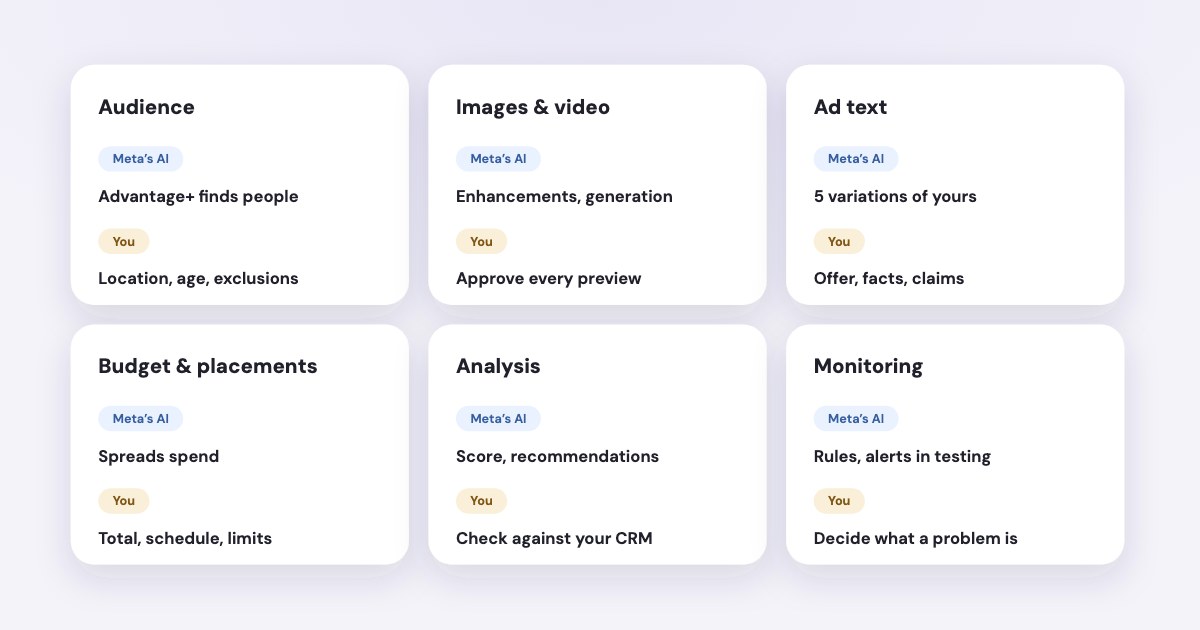
AI for Facebook ads, task by task
| What Meta’s AI does | What stays with you | |
|---|---|---|
| Audience | Advantage+ audience finds people beyond your targeting | Location, minimum age, language, exclusions |
| Images and video | Enhancements: crops, backgrounds, music, animation, generated images | Which enhancements run; approving previews |
| Ad text | Up to five variations of your primary text and headline | The offer, the facts, the claims |
| Budget and placements | Spreads budget across ad sets and placements | Total budget, schedule, cost limits |
| Analysis | Opportunity score, recommendations, the Ads Manager assistant | Comparing results with your CRM and other channels |
| Monitoring | Automated rules, alerts in testing | What counts as a problem and what to do about it |
The sections below go through each row: what Meta says, where it goes wrong, and where an outside assistant helps.
Audience: let Advantage+ search, set the hard limits
Advantage+ audience expands beyond
the targeting you give it. You can set strict criteria where AI should not expand beyond
:
minimum age, location, languages and excluded custom audiences (source). Everything else — age ranges,
interests, lookalikes — is a suggestion. For lead campaigns it is the default: when Advantage+ is on, Advantage+ audience, placements and campaign budget are also enabled.
(source)
Does it work for leads? Jon Loomer’s 30-day test on registrations found Advantage+ audience brought 9 more than detailed targeting and
36 more than lookalikes, adding that the first difference may not be statistically significant
(source).
Some B2B advertisers report the opposite on quality: cheaper leads, dearer qualified ones. Judge it by the leads that become customers —
see lead quality.
Images and video: check what the AI changes
Meta lists 31 Advantage+ creative enhancements, 17 of them marked as AI — background and image generation, animation, music,
touch-ups, translations and more. Some enhancements may be turned on by default, but you can turn them off at any time.
(source) Defaults are collected under Review defaults (source), and
there’s a catch: Some enhancements can only be turned off in Advanced preview, and won’t be visible in the Ad creative.
(source)
AI edits do go wrong
In June 2026 REI said Meta’s AI changed its ad into an inaccurate one — a bike with two handlebars ran on Instagram (source). In July 2026 brands told Business Insider that fixing AI changes had become routine, and Meta said advertisers are responsible for reviewing AI outputs (source). Open Advanced preview before every launch.
Two more limits. Financial services, health, housing, employment and credit advertisers may not have immediate access to all generative AI features
(source). And five AI backgrounds on one photo are not five creatives: Meta treats look-alike ads as
variations of the same creative
(source). Variety means different ideas, not different
filters (more on fatigue).
Ad text: AI as a critic of your drafts
Meta can generate up to five variations of your primary text and headline, but won’t report how each variation did. Outside assistants write better copy when you give them your best and worst ads with their numbers, and research measured on real clicks found AI helps most as a critic of drafts, not as a ghostwriter. Prompts and rules are in AI Facebook ad copy and ChatGPT and Claude prompts for Facebook ads.
Budget and placements: mostly automatic
Sales, Leads, and App promotion campaigns will have Advantage+ campaign budget enabled by default.
You can switch it,
but there is a 2 hour minimum time limit when switching Advantage+ campaign budget on or off.
(source)
For placements, Meta reports an experiment where Advantage+ placements gave an 11.7% lower cost per action (CPA) on average
than manual placements (source).
One conflict to know: automated rules with cost conditions can’t switch ads or ad sets on or off when the campaign budget is automatic (details). If you raise budgets, do it in steps (how).
Analysis: Meta’s advice and a second opinion
Meta offers three helpers. The opportunity score ranks recommendations — but Meta itself warns it
does not reflect your actual or future performance, even if your score is high.
(source) The
business assistant in Ads Manager answers questions about your account and applies recommendations
(our guide). And since August 2026 Meta has said its Meta AI for small businesses can
connect to ad campaigns, point out which creatives stopped working and prepare recurring reports (Meta, in Spanish).
All three see Meta only, and recommend how to spend inside Meta. An assistant like ChatGPT or Claude with a connector to your ad account can also read your CRM: which ads brought customers, which leads were junk, what another channel did the same week (why that changes the picture).
Monitoring and automation: keep a human “yes”
Meta’s own options are automated rules in Ads Manager (which are worth it)
and, since April 2026, a connector that lets AI agents work in your ad account: a secure, Meta-authenticated connection from their ad account to an AI agent
(source). Meta creates ads paused and requires approval for actions — the same split we recommend: let AI
read, explain, draft and alert, and approve budget increases and new ads yourself (AI agents
for Facebook ads).
What Meta’s numbers actually show
Most figures Meta publishes for its AI come without a method. The exception is Advantage+ for leads: a meta-analysis of 20 tests
from November 2024 to January 2025 showed 14% lower cost per lead with more than 95% confidence, and 10% lower cost per qualified lead with
only 83% (source). On the same page, connecting a CRM did more: 15% lower cost per quality lead and a 44% increase in rate of converting a lead to a quality lead
in an A/B test of 273 advertisers.
The takeaway for a lead business: Meta’s AI gets cheaper leads on its own; better leads need your sales data (how to send it). No independent test with a control group on lead campaigns has been published.
Where Variafy fits
Variafy is a connector for ChatGPT, Claude and other assistants. It covers the rows where Meta’s AI stops: it reads every campaign, explains why results moved, ranks ads by the money they brought when your CRM or a sheet is connected, and watches your ad accounts every 15 minutes for stopped spend, rejected ads and broken tracking. Changes are previewed and run only after you confirm.
How we checked
Checked on 17 October 2026 against Meta for Business pages on Advantage+ audience and Advantage+ leads, Meta’s Business Help Center (creative enhancements and their defaults, turning enhancements off, Advantage+ campaign budget, Advantage+ placements, opportunity score), Meta’s posts on creative diversification, its engineering posts on GEM, its connector announcement and its August 2026 post on Meta AI for small businesses, Jon Loomer’s Advantage+ audience test, and reports by Carscoops and MediaPost. We also read the pages that rank for these searches. We don’t rank third-party tools here.
Variafy is our product.
Questions
Does Facebook ads use AI?
Yes. Meta’s Andromeda system selects a few thousand candidate ads from tens of millions for each person, and models such as GEM rank them. On new lead campaigns, Advantage+ audience, placements and campaign budget are also on by default.
How can I use AI for Facebook ads?
Let Advantage+ handle audience and placements within hard limits you set, review AI creative enhancements before launch, write texts from your own results with ChatGPT or Claude, and use an assistant connected to your ad account and CRM to analyse results and watch for problems.
What AI tools does Meta Ads Manager have?
Advantage+ audience, placements and campaign budget; Advantage+ creative enhancements including generated backgrounds, images, music and text variations; opportunity score and recommendations; the Meta AI business assistant; and an official connector for outside AI agents.
Are Meta’s AI ad tools free?
Yes. Advantage+, creative generation, the business assistant and the connector cost nothing extra; you pay only for ad delivery.
Can I turn off AI in Facebook ads?
You can turn off individual creative enhancements, Advantage+ campaign budget and Advantage+ audience settings, though narrowing settings too much switches the campaign out of Advantage+ mode. The AI that selects and ranks ads for each impression can’t be turned off.